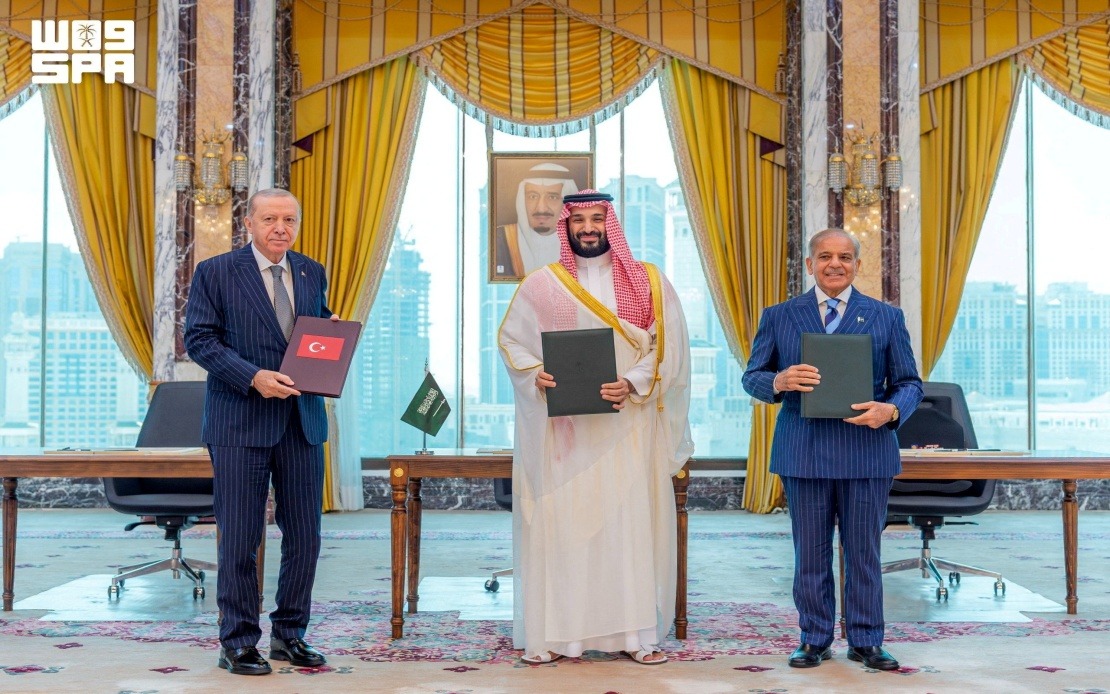
Three major regional powers have taken a significant step toward deepening their military cooperation by formalising a collective defence alliance. Pakistan's Prime Minister Shehbaz Sharif, Saudi Crown Prince Mohammed bin Salman bin Abdulaziz Al Saud, and Turkish President Recep Tayyip Erdogan signed the Joint Defence Agreement on Friday at Al Safa Palace in Makkah, marking a watershed moment in trilateral relations among nations that collectively wield considerable influence across South Asia, the Middle East, and beyond.
The agreement represents a binding commitment among the three signatories to treat any armed assault on one member as an attack upon all three. This mutual defence clause echoes language commonly found in major alliance structures, effectively creating a tripwire against external aggression that any potential adversary must now contemplate carefully. The pact moves beyond rhetorical solidarity by explicitly stipulating mechanisms for enhanced defence cooperation across all operational and strategic dimensions, transforming what has traditionally been bilateral relationships into a more robust multilateral security framework.
Pakistan brings substantial strategic weight to this arrangement, as one of only nine nations globally possessing nuclear weapons capability. The country's geographical position bridging South Asia, Central Asia, and the Middle East grants it outsized geopolitical significance. Historically, Islamabad has maintained robust defence partnerships with both Ankara and Riyadh independently, but formalising these relationships into a trilateral structure suggests a deliberate effort to create a unified deterrent posture that reflects shared interests across the broader Islamic world and regional security architecture.
Türkiye's participation underscores its expanding footprint as a consequential actor across multiple regions simultaneously. As both a NATO member and an increasingly independent power pursuing its own strategic interests, Ankara's commitment to this pact signals confidence in closer integration with South and West Asian partners. The Turkish dimension also brings NATO's implicit influence into regional calculations, though the agreement itself emphasises the three nations' autonomous decision-making rather than alignment with external power structures.
Saudi Arabia's role as the leading Gulf Arab state and guardian of Islam's holiest sites carries profound symbolic and practical weight. The kingdom's diplomatic outreach through this agreement reflects its pivot toward multilateral security arrangements beyond traditional arrangements with Western powers. The choice of Makkah as the signing venue carries deliberate symbolic weight, emphasising the Islamic dimension of the partnership and reinforcing the notion of shared civilisational bonds underpinning the strategic arrangement.
The joint statement accompanying the accord emphasises that the three nations share fundamental commitments to regional stability, prosperity, and security. The language carefully frames the agreement not as directed against any particular state, but rather as a collective effort to deter unspecified aggression and maintain a stable equilibrium. This rhetorical caution reflects awareness that such alliances invariably generate concern among neighbouring and competing powers, and the signatories appear intent on presenting their arrangement as defensive rather than aggressive in character.
Saudi Arabia's Deputy Public Diplomacy Minister Rayed Krimly moved quickly to address international and regional concerns by clarifying that the pact neither imperils any country's security nor represents tension escalation between specific rivals. Krimly emphasised the operational dimensions of cooperation including joint defence capability development, enhanced strategic deterrence, improved operational readiness, and integrated defence systems deployment. These specifics suggest the agreement contemplates genuine military coordination mechanisms rather than merely symbolic declarations of solidarity.
This latest accord builds upon existing bilateral frameworks that have matured over years of engagement. Pakistan and Saudi Arabia, for instance, formalised their own bilateral defence agreement in September of the previous year, obligating reciprocal support against external military threats. The new trilateral structure effectively amplifies these existing bilateral relationships by creating additional interconnections and mutual dependencies, making the entire arrangement more resilient and comprehensive than its constituent parts.
For Malaysian observers and the broader Southeast Asian community, this agreement carries implications worth monitoring closely. The consolidation of security architecture among major Muslim-majority nations across Asia and the Middle East reflects shifting patterns of regional alignment and autonomous defence capability building. As these nations strengthen internal cohesion and collective deterrence capacity, their positioning within broader geopolitical competitions becomes more defined and potentially more resilient to external pressure.
The pact also demonstrates how nations are increasingly seeking security solutions through multilateral arrangements with peers rather than exclusively relying on traditional great power guarantees. This trend parallels similar movements in Southeast Asia where regional states have invested in multilateral institutions and frameworks. For countries like Malaysia that must navigate between multiple regional power centres, the consolidation of distinct regional blocs creates both challenges and opportunities for diplomacy and strategic positioning.
The timing of this agreement during a period of significant regional volatility across the Middle East and South Asia underscores the signatories' desire to establish clear deterrence frameworks and reduce miscalculation risks. By formalising mutual defence commitments, the three nations signal that major military actions against any of them will trigger coordinated responses, potentially raising the costs of aggression substantially. Whether this deterrent effect proves effective will depend on how other regional and global powers interpret and respond to the arrangement.
Looking forward, implementation of the agreement's specific provisions will determine its practical significance. Joint exercises, coordinated procurement decisions, integrated command structures, and regular consultations at leadership levels will all serve as indicators of how seriously the three nations pursue substantive integration versus symbolic solidarity. The degree to which Pakistan, Saudi Arabia, and Türkiye can overcome distinct national interests and regional priorities to achieve genuine military coordination will ultimately shape whether this arrangement becomes a transformative development in regional security architecture or remains largely aspirational in character.

