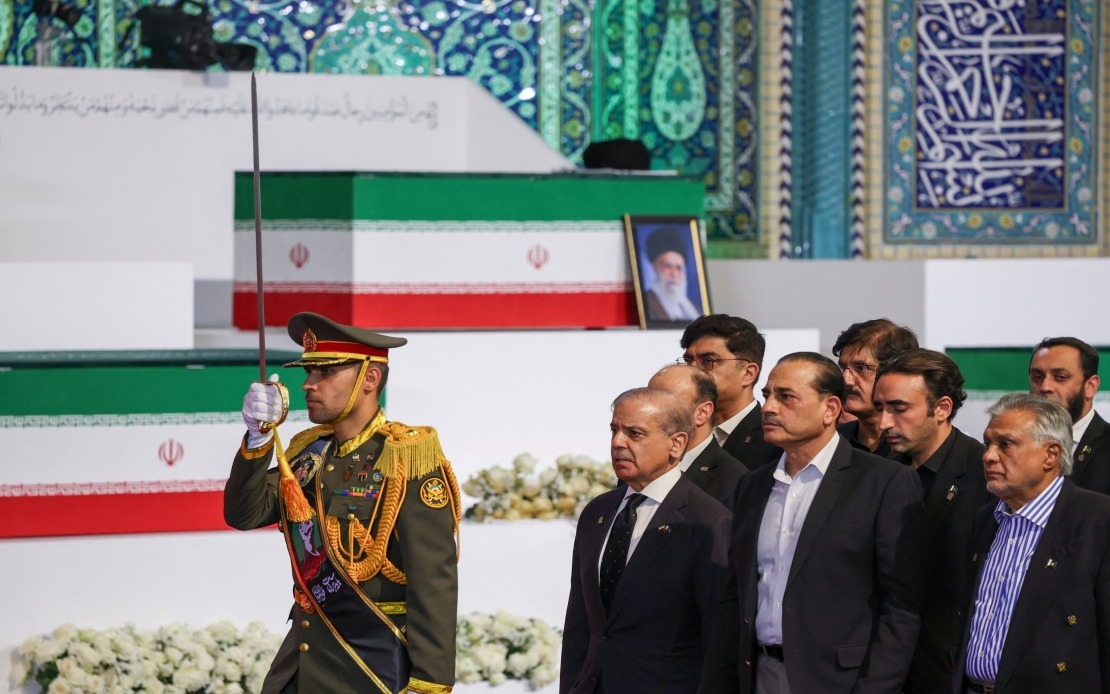
Pakistan's decision to send a delegation led by Prime Minister Shehbaz Sharif to the funeral of Iran's Supreme Leader Ayatollah Ali Khamenei has drawn warm commendation from Iranian officials, underscoring the strategic importance Islamabad places on maintaining strong ties with its western neighbour at a time of regional tension. The funeral ceremony on Friday attracted dignitaries from approximately 100 nations, reflecting the global significance of Khamenei's death and the scale of international engagement with Tehran's leadership transition.
The composition of Pakistan's delegation demonstrated the seriousness with which Islamabad approached the occasion. Beyond Prime Minister Shehbaz Sharif, the contingent included Deputy Prime Minister and Foreign Minister Ishaq Dar, military chief Field Marshal Syed Asim Munir, PPP chairman Bilawal Bhutto Zardari, National Assembly Speaker Sardar Ayaz Sadiq, Interior Minister Mohsin Naqvi, and Information Minister Attaullah Tarar. This gathering of top civilian and military leadership on a single delegation is relatively uncommon and signals cross-party consensus within Pakistan regarding the importance of the Iran relationship.
Iranian Ambassador to Islamabad Reza Amiri Moghadam responded with effusive praise, stating that Pakistan's representation constituted not only the highest-ranking attendance but also the largest contingent from any single country at the funeral ceremony. In a statement on social media platform X, Moghadam characterised the Pakistani presence as reflecting "the enduring friendship, mutual respect, and fraternal bonds between our two brotherly nations." The emphasis on Pakistan's distinct standing among mourning delegations suggests that Tehran views the gesture as particularly meaningful, possibly reflecting shared strategic interests amid broader regional alignments.
The context for this diplomatic display extends beyond ceremonial courtesy. Khamenei, who had served as Iran's Supreme Leader since 1989, was killed on February 28 in what Iran characterised as a United States and Israeli attack on his compound in Tehran. The tragic circumstances of his death, which also claimed several family members, elevated the significance of international attendance at his funeral. For Pakistan, participating prominently in honouring the deceased leader carried implications for its relationship with a neighbour that shares a 900-kilometre border and significant trade and security considerations.
Prime Minister Shehbaz Sharif personally paid homage to Khamenei at the ceremony, delivering remarks that highlighted the late leader's "wisdom, leadership and profound influence on Iran and the wider region." Such formal acknowledgment of Khamenei's regional role reflected Pakistan's pragmatic approach to maintaining productive relations with Iran, irrespective of broader geopolitical differences that may exist between Islamabad and Tehran on certain issues. The attendance of Pakistan's civilian and military leadership alongside one another conveyed a unified national position on the matter.
The funeral ceremonies themselves unfolded over several days, with public observances beginning on Saturday and the scheduled burial set for July 9 in Mashhad, Khamenei's birthplace in northeastern Iran. The extended timeline for funeral rites reflected the significance Iran attached to mourning its longtime leader and provided an extended window for international delegations to participate. Among the numerous countries represented were Malaysia, Bangladesh, Saudi Arabia, Turkiye, Qatar, Oman, Egypt, Russia, Iraq, China, and India—a roster encompassing regional powers, strategic allies of Iran, and global heavyweights.
For Malaysia and other Southeast Asian nations observing these developments, Pakistan's prominent positioning at the funeral offers insights into evolving diplomatic alignments in a region where Pakistan traditionally maintains careful balance between different power centres. Pakistan's willingness to field such a high-level delegation speaks to the enduring significance it accords to its Iranian relationship, particularly given broader regional complexities involving Gulf states and other actors. The funeral attendance thus becomes a lens through which to understand Pakistan's strategic priorities and how it manages relationships across the Islamic world.
The Ambassador's emphasis on "shared values" and "historic ties" connecting Iran and Pakistan reflects narratives that both nations cultivate regarding their relationship. These rhetorical framings serve purposes beyond ceremony—they reinforce bilateral bonds and signal to domestic audiences and regional observers that the countries view their connection as foundational rather than transactional. For Pakistan, maintaining strong ties with Iran remains important for managing its western border, addressing terrorism concerns, and maintaining influence within broader Muslim-majority nation networks.
From a Southeast Asian perspective, Pakistan's approach to this funeral ceremony illustrates how major regional powers navigate diplomatic protocol during moments of transition or crisis. The decision to prioritise attendance and send senior figures reflects Pakistan's recognition that such moments offer opportunities to reinforce relationships and signal commitment to key partners. As Malaysia and other ASEAN nations maintain their own strategic partnerships across the Islamic world, the Pakistan example demonstrates the continuing importance of high-level diplomatic presence in contemporary international relations, even—or perhaps especially—during periods of regional uncertainty.

