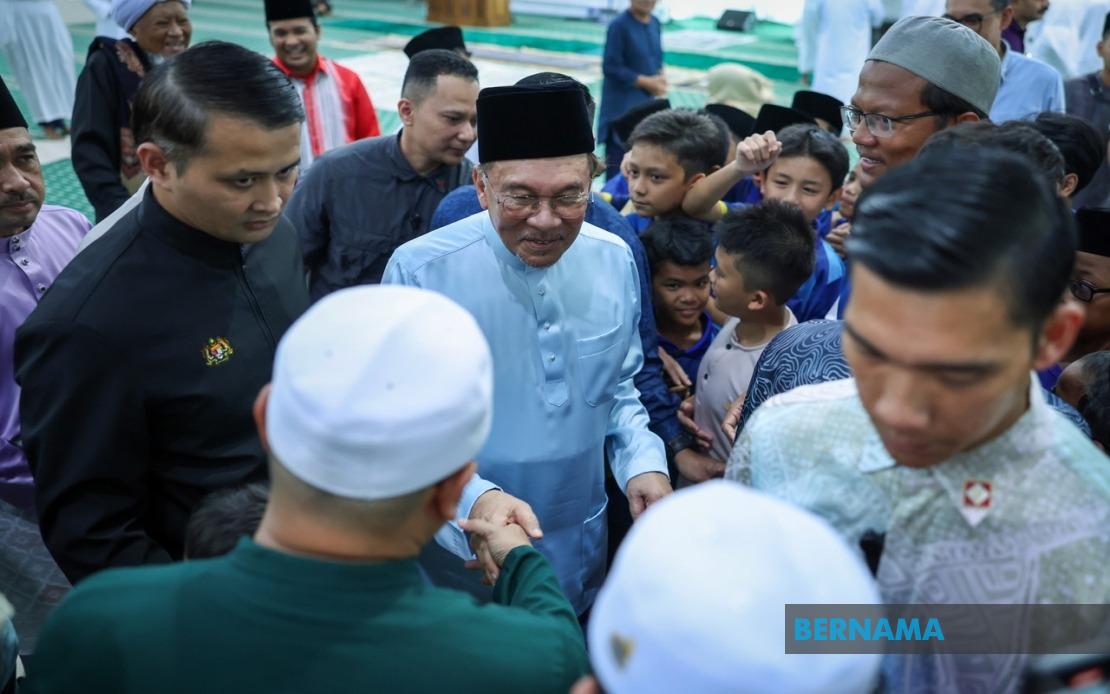
Prime Minister Datuk Seri Anwar Ibrahim has clarified that parliamentary constituency allocations are fundamentally meant to serve ordinary constituents rather than function as personal resources for elected representatives. Speaking after Friday prayers at Masjid Ar-Rasyidin in Alor Gajah, Anwar emphasised that such funds must be directed towards concrete improvements in residents' living conditions and community infrastructure. This statement came in response to mounting complaints from several opposition MPs who have accused the government of deliberately withholding their constituency budgets, a sensitive issue in Malaysian politics where development funding often becomes a flashpoint between ruling and opposition parties.
The Prime Minister outlined the intended use of these allocations with specific examples, noting that funds should finance essential services and facilities that directly benefit the public. Educational institutions, religious establishments including mosques, drainage system repairs, and other pressing local infrastructure requirements represent the legitimate deployment of such resources. When the government allocates RM2 million to a constituency, Anwar stressed, that sum should flow directly into these community-oriented projects rather than being controlled by the individual MP regardless of their political affiliation. This principle underscores a fundamental distinction in Malaysian governance between the public nature of parliamentary funds and the personal interests of elected officials.
Anwar's remarks suggest an attempt to reframe the debate around constituency allocations within the context of good governance and fiscal accountability. His assertion that this policy "has long been in place and was known to MPs who had previously served in government" indicates that the government views this approach not as a novel or politically motivated decision, but rather as an established principle understood across parliamentary experience. This framing appears designed to deflate claims of partisan discrimination by positioning the allocation system as following longstanding administrative practice rather than reflecting current political calculations. The presence of Minister in the Prime Minister's Department (Religious Affairs) Senator Dr Zulkifli Hasan and Melaka Police chief Datuk Dzulkhairi Mukhtar at the statement suggested official weight behind the pronouncement.
The conflict over constituency allocations reflects deeper tensions within Malaysia's political structure, where the distribution of development resources carries enormous consequences for both constituent welfare and electoral competition. When opposition MPs find themselves without direct control over allocations, they lose a critical tool for demonstrating responsiveness to their voters and building grassroots support. Conversely, the government's position that funds should bypass potentially obstructive opposition representatives and reach communities directly raises questions about political fairness and the autonomy of elected officials to serve their constituents. This dynamic has become increasingly contentious in recent years as Malaysia's political landscape has grown more fragmented and competitive.
The Prime Minister's declaration that "if an MP is now in opposition, we will channel the funds directly to the people" represents the government's stated mechanism for managing this tension. Rather than withdrawing funding entirely from opposition-held constituencies—which would be politically untenable and potentially damaging to public services—the administration claims to ensure that development continues while circumventing opposition MPs entirely. However, this approach raises practical and democratic concerns about how such direct channelling functions, who determines priorities, and whether communities ultimately receive equitable development compared to constituencies represented by government-aligned MPs. The mechanism for identifying local needs and executing projects without MP involvement remains unclear from the Prime Minister's comments.
For Malaysian readers and Southeast Asian observers, this controversy illuminates the complex relationship between elected representation and executive resource allocation in democracies with single-chamber or dominant legislatures. In systems where the executive branch maintains substantial control over development spending, elected representatives from opposition parties face structural disadvantages in serving their constituents. This pattern appears across various democratic contexts in the region and globally, yet creates persistent friction between principles of democratic representation and executive authority. Anwar's clarification suggests the Malaysian government intends to maintain this approach despite opposition protests.
The inclusion of remarks about PKR deputy president Nurul Izzah Anwar in the same statement added an unexpected personal dimension to the Prime Minister's address. His daughter's request to step down from her party position, attributed to "other commitments requiring her attention temporarily," was presented as a temporary arrangement while maintaining her party membership and activism. This detail, though initially seeming peripheral to the constituency allocation discussion, demonstrates how personal and political considerations frequently intersect within Malaysian governance structures. The matter of whether prominent political figures can effectively balance multiple roles while maintaining public duties continues to generate scrutiny in Malaysian political discourse.
The constitutional and practical implications of the government's allocation strategy deserve closer examination. Parliamentary representatives, even those from opposition parties, hold elected mandates to represent their constituencies and facilitate development within their jurisdictions. Systematically removing their control over allocated funds arguably diminishes their capacity to fulfill these mandates effectively. Yet the government's counterargument—that development should reach communities regardless of their representatives' political leanings—also contains merit from a public interest perspective. This tension between accountability to voters and ensuring equitable public service delivery remains unresolved.
Looking forward, the sustainability of this allocation approach will depend on whether constituencies with opposition representatives actually receive adequate development attention and whether the "direct channelling" mechanism produces visible improvements in public infrastructure and services. If these communities experience developmental neglect despite government promises, the political costs could accumulate and become significant in future electoral cycles. Conversely, if opposition constituencies do receive fair development despite their representatives' lack of direct control, the government's position gains practical legitimacy even if it remains theoretically controversial. The coming months will reveal whether this policy achieves its stated objectives or becomes another flashpoint in Malaysia's ongoing political competition.

