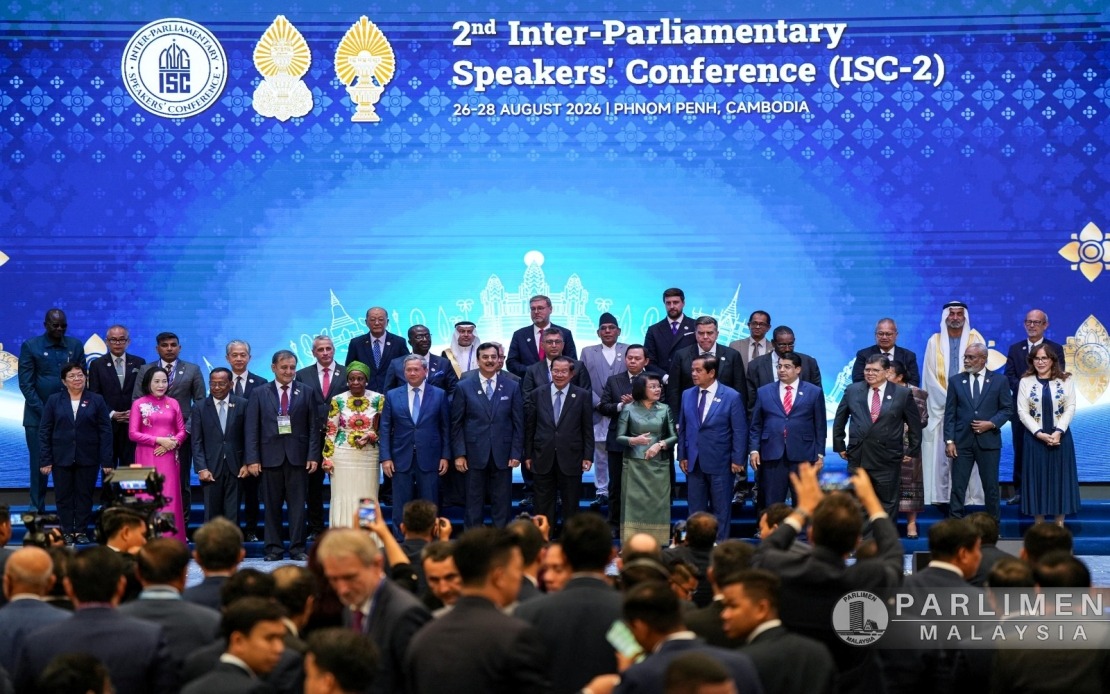
Malaysia's Dewan Rakyat Speaker Tan Sri Dr Johari Abdul has called for a fundamental shift in how the world addresses its most pressing challenges, advocating that national parliaments assume a more substantial role alongside governments in tackling conflicts, geopolitical divisions and transnational crises. Speaking at the Second Inter-Parliamentary Speakers' Conference in Phnom Penh, Johari emphasized that legislative bodies possess distinct perspectives and capabilities that remain underutilised in contemporary global governance structures. His intervention reflects growing recognition within Southeast Asian political circles that traditional executive-dominated approaches to international relations may be insufficient for the interconnected challenges facing the modern world.
The conference, jointly organized by Cambodia's National Assembly and Senate from August 26 to 28, brought together parliamentary leaders under the banner "Solidarity for Peace and Shared Prosperity: Strengthening International Law and Resolving Conflicts Peacefully." This gathering represents an emerging institutional framework designed to facilitate dialogue among legislative bodies on matters traditionally reserved for diplomatic negotiations between governments. By hosting such forums, participating nations signal their commitment to exploring alternative channels for conflict resolution and international cooperation that engage broader segments of their political systems.
Johari articulated a sophisticated argument about the complementary nature of executive and legislative perspectives on international affairs. He contended that while executive branches often prioritize immediate political considerations and diplomatic protocol, parliaments frequently develop more comprehensive understandings of underlying issues through their closer engagement with constituents and grassroots communities affected by international tensions. This distinction, he argued, creates potential for more holistic policy-making when both branches coordinate their efforts effectively. The speaker suggested that parliamentary input can introduce humanitarian concerns and long-term societal impacts into foreign policy deliberations that might otherwise remain dominated by strategic calculations.
The human dimensions of contemporary conflicts particularly preoccupied Johari's analysis. He drew attention to the frequently overlooked toll that geopolitical disputes exact on ordinary populations—displaced families, interrupted educational opportunities for children, and communities torn apart by violence. By centering these human costs, Johari reframed parliamentary involvement not merely as an institutional preference but as a moral imperative. This rhetorical approach resonates within Malaysian and Southeast Asian contexts, where societies remain acutely conscious of conflict's devastating impacts through their own historical experiences and ongoing regional security concerns.
Johari identified parliamentary diplomacy as a crucial mechanism for maintaining communication channels when formal governmental relations deteriorate. He argued that legislative engagement creates distinct opportunities for dialogue that transcend official diplomatic protocols, potentially preserving opportunities for negotiation even when governments have reached impasses. This function gains particular significance in regional contexts where relationships between neighbouring states remain complicated by historical grievances, territorial disputes or competing strategic interests. Parliamentary exchanges can operate in less formal registers than state-to-state diplomacy, potentially reducing rhetorical temperature while exploring substantive solutions.
The speaker emphasized that persistent disagreement need not inevitably escalate toward confrontation, a proposition of particular relevance to Southeast Asia's complex geopolitical landscape. By facilitating conversations across political and national boundaries, parliamentary institutions can cultivate interpersonal relationships and institutional trust that create foundations for eventual governmental settlements. This multi-track approach to diplomacy has gained increasing recognition among international relations scholars and practitioners seeking alternatives to zero-sum competitive frameworks that characterize much contemporary geopolitical discourse.
Malaysia's broader foreign policy commitments anchored Johari's intervention. He reiterated the nation's foundational principles regarding international relations—respect for sovereignty, protection of territorial integrity, adherence to international law and commitment to peaceful dispute resolution. These principles, far from being merely rhetorical flourishes, represent enduring commitments that shape Malaysia's approach to regional affairs and its participation in multilateral institutions. By invoking these principles within a parliamentary context, Johari suggested that legislatures have particular responsibility for ensuring government adherence to declared commitments and values.
Johari specifically highlighted ASEAN's significance as a regional institution built upon dialogue, consultation and continuous cultivation of peace. The Association's foundational approach to regional governance through consensus-building and non-confrontational dispute resolution offers a model that parliamentary bodies can actively support and reinforce. He argued that regional parliaments possess capabilities to strengthen understanding among Southeast Asian peoples and to encourage solutions grounded in the shared commitments that undergird ASEAN cooperation. This suggestion implies that parliamentary bodies can serve as custodians of regional institutional norms and mediators when governments encounter difficulties.
The speaker positioned parliamentary involvement as particularly valuable for addressing contemporary complex conflicts characterized by multiple stakeholders, unclear resolutions and deep geopolitical entanglement. Modern international tensions frequently resist neat executive solutions precisely because they involve competing national interests, competing principles and competing visions of regional order. Parliamentary engagement brings additional perspectives, legitimacy and problem-solving capacity that can complement traditional diplomatic channels. By involving broader political communities in conflict resolution processes, nations potentially increase the sustainability of any eventual settlements.
Johari's remarks occurred within a wider institutional context reflecting Southeast Asian commitment to developing new frameworks for regional cooperation and international engagement. The Inter-Parliamentary Speakers' Conference series—with Pakistan hosting the inaugural edition in 2025, Cambodia hosting the second edition in August, and Indonesia scheduled to host the third edition in 2026—demonstrates expanding commitment among diverse nations to building parliamentary-level connections. This institutional infrastructure creates ongoing opportunities for legislators to develop working relationships and shared understandings before crises emerge, potentially enhancing the region's capacity for cooperative problem-solving.
The progression of conference venues—from Pakistan through Cambodia to Indonesia—reflects deliberate geographic distribution intended to engage different regional actors and perspectives. This itinerant model encourages successive host nations to address their particular regional contexts while contributing to broader dialogues about international law, conflict resolution and the changing nature of global governance. For Malaysian participants, these conferences offer platforms for articulating the nation's regional perspectives while learning from parliamentary colleagues navigating similar geopolitical complexities.
Johari's intervention ultimately challenges conventional assumptions about the separation between legislative and executive authority in foreign affairs. While many nations maintain formal structures that vest primary foreign policy authority in executive branches, the Dewan Rakyat Speaker argued persuasively that this arrangement leaves valuable potential underexploited. By engaging parliaments more directly in international peace-building efforts, societies can potentially develop more legitimate, sustainable and comprehensive approaches to resolving conflicts. For Southeast Asia specifically, this argument carries particular weight given the region's commitment to multilateral cooperation and consensus-based decision-making.
The call for enhanced parliamentary involvement in global governance reflects broader trends toward recognizing that complex contemporary challenges require multifaceted responses engaging diverse segments of national political systems. Parliaments, as institutions connecting government with broader citizenries, offer unique capabilities for building public support for international agreements, articulating constituent concerns in international forums and maintaining dialogue across dividing lines. As geopolitical tensions continue intensifying across multiple regions, the institutional infrastructure that Johari advocates—greater parliamentary engagement in peace-building and conflict resolution—may prove increasingly valuable for maintaining stability and facilitating constructive dialogue.

