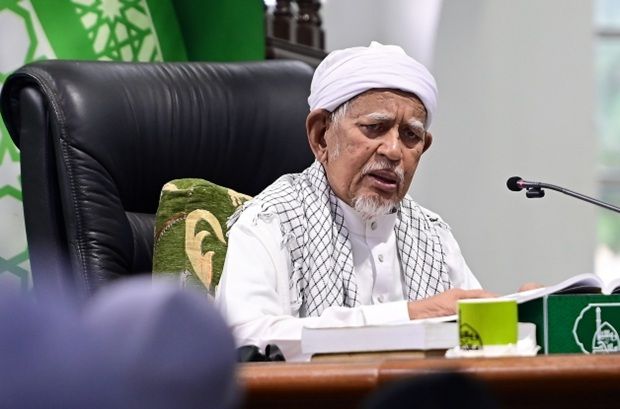
PAS President Abdul Hadi Awang's emphatic claims about his party's pivotal role in Barisan Nasional's recent success in Johor have ignited tensions that extend far beyond that state's boundaries. His assertion that PAS was indispensable to the coalition's electoral performance has reopened fundamental questions about the direction of Malaysian coalition politics, particularly regarding how developments in Peninsular Malaysia will reshape relationships with East Malaysia's leadership. The political ripples from Johor are reaching territories where the old rules of political engagement may no longer apply.
The implications for Negri Sembilan appear especially fraught. Within the state, observers question whether PAS fully comprehends the delicate position of Tuanku Muhriz, whose throne and legitimacy have already faced criticism from certain quarters. The Sultan's well-documented stance against corruption and his distinctive public persona—one that emphasises accessibility and principled leadership—suggests governance priorities that may not align seamlessly with PAS's ideological platform. This potential friction sets the stage for complications as Barisan Nasional, working in tandem with PAS, Wawasan and Gerakan, prepares to contest 26 of Negri Sembilan's 36 seats. For many observers, this arrangement appears less like democratic coalition-building and more like a pointed challenge to Prime Minister Anwar Ibrahim and the Cabinet ministers who have actively collaborated with Barisan Nasional.
Yet the greater concern among analysts lies eastward, where the political calculations prove far more consequential. Sabah and Sarawak collectively command 56 parliamentary seats—a decisive bloc capable of determining national political outcomes. These two states have consistently demonstrated that their electoral priorities diverge substantially from prevailing sentiments across much of Peninsula Malaysia. For decades, Borneo's political leadership has pursued development-centred agendas and sought equitable federal resource allocation. Beyond these practical concerns, the region has cultivated a distinct political culture rooted in pragmatic governance and inter-ethnic accommodation. This emphasis on moderation and multicultural coexistence is not merely a regional preference but a foundational principle shaping how Borneo engages with national politics.
The Johor outcome, particularly Menteri Besar Hafiz Onn's acquisition of additional appointed seats to expand his majority from 46 to 51 in the state assembly, carries symbolic weight in East Malaysia. It demonstrates that electoral manipulation and institutional engineering have become acceptable tools within the Barisan framework. But more troubling to Borneo's leaders is the visible partnership between PAS and traditional Barisan components—UMNO, MCA and MIC—suggesting that religious-mobilisation strategies have become central to coalition mechanics. This represents a fundamental departure from the consensual, cross-community approach that has historically characterised East Malaysian politics.
Sabah and Sarawak's political traditions evolved within fundamentally different social contexts where religious and ethnic diversity is not merely tolerated but constitutes the bedrock of daily governance. Parties operating in these states have generally maintained caution regarding approaches perceived as ideologically rigid or centred on religious mobilisation. When PAS—an explicitly Islamic-nationalist party—becomes publicly celebrated as the architect of Barisan victories, Borneo's political establishments understandably grow apprehensive. The participation of Wawasan, led by Hamzah Zainuddin and representing remnants of Bersatu, compounds these anxieties by suggesting that politically restless figures are finding accommodation within the Barisan tent precisely when the coalition's Islamic character appears ascendant.
East Malaysian political leaders naturally evaluate peninsular developments through the lens of national cohesion. Questions regarding state autonomy, the constitutional foundations established in 1963, religious harmony, and federal-state relations consistently rank higher in Borneo's political hierarchy than ideological contestation. When narratives emerge suggesting that PAS has become indispensable to UMNO's electoral fortunes, Sabah and Sarawak's leadership cannot help but question whether the bargain that created Malaysia remains intact. Tuanku Muhriz's longstanding emphasis on constitutional principles and equitable governance amplifies these concerns, as his perspective resonates with East Malaysian sensibilities regarding Malaysia's federal architecture.
The broader challenge confronting coalition politics in Malaysia concerns the relationship between electoral arithmetic and mutual confidence. PAS's triumphalism may indeed strengthen its standing with core supporters and bolster party morale, yet it simultaneously complicates relationships with coalition partners whose electoral bases operate under profoundly different social conditions. In Borneo, political parties have negotiated their electoral trajectories within societies where interethnic and interreligious coexistence is non-negotiable. Their voters expect parties to prioritise development, fairness and inclusion over ideological positioning. This creates an inherent tension: as PAS becomes more visible and celebrated within Barisan structures, partners in Sabah and Sarawak face mounting pressure from their own constituencies questioning the wisdom of remaining aligned with an increasingly Islamic-nationalist coalition.
The constitutional dimensions underpinning Malaysia's federation add another layer of complexity. The 1963 agreement establishing Malaysia was itself a delicate compromise accommodating Singapore's participation and East Malaysia's distinct governance traditions. Sabah and Sarawak accepted this arrangement partly because it promised respect for their autonomy and religious pluralism. Contemporary coalition dynamics that appear to subordinate these principles to peninsular electoral considerations strike at the heart of that original compact. Political leaders in East Malaysia therefore approach each development in the peninsula with heightened sensitivity toward potential implications for the federation's balance.
Critics might argue that PAS possesses every democratic right to contest elections, present policy alternatives and mobilise support through constitutional means. Registered political parties form the legitimate foundation of Malaysia's parliamentary system, and competitive elections remain essential to democratic governance. However, democratic legitimacy in a federal system requires more than electoral victory—it demands sensitivity toward the federation's broader composition and respect for the varied historical experiences, cultural traditions and political expectations of participating regions. Political success concentrated in one region cannot unilaterally reshape the terms of engagement for partners operating within entirely different political ecologies.
Malaysia's enduring political strength has historically derived from its capacity to construct broad-based coalitions despite substantial differences among participating parties. This flexibility enabled governments of diverse composition to maintain national stability while accommodating genuine regional diversity. Yet that flexibility depends upon mutual restraint and recognition that coalition partners possess legitimate grievances and distinct political cultures. When one coalition component celebrates electoral dominance in ideological terms and claims to have fundamentally altered the political order, it risks severing the implicit understandings that hold multiethnic, multireligious coalitions together. The challenge facing Malaysian politics is whether new arrangements in Johor can coexist with the political expectations embedded in Negri Sembilan, Sabah and Sarawak—or whether the federation faces an extended period of coalition instability and mutual mistrust.

