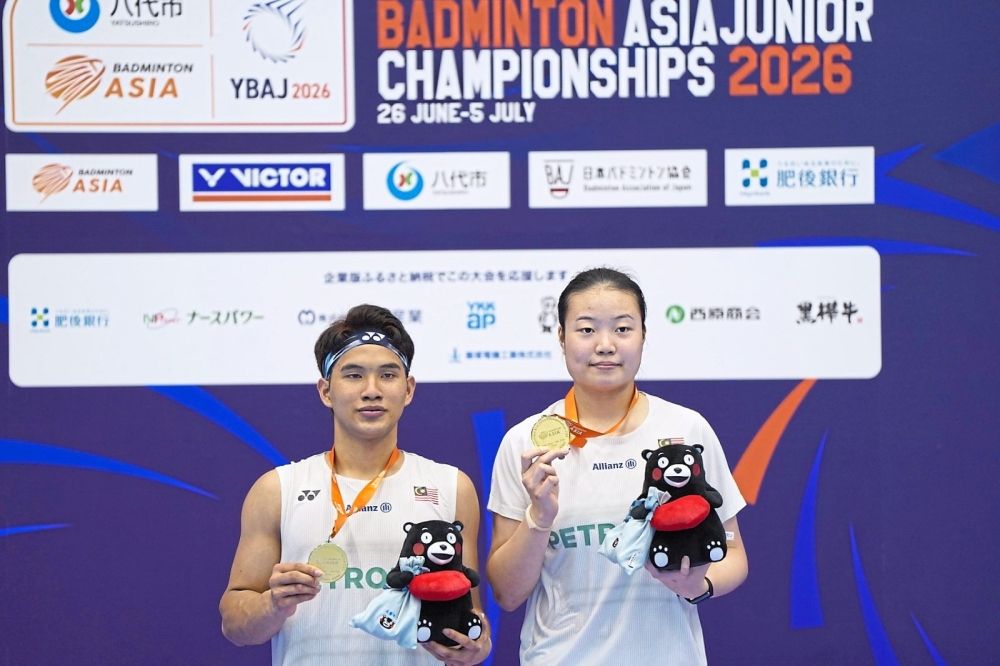
Malaysia's badminton landscape has received a significant boost following Ahmad Redzuan Zulwaqqarizal-Low Zi Yu's triumph at the Asian Junior Championships in Yatsushiro, Japan, as the pair captured the mixed doubles crown in a nerve-wracking final that vindicated their commitment to mental resilience under pressure. The victory marks the nation's first title in this event since Tan Wee Kiong and Woon Khe Wei claimed gold at the 2007 edition in Kuala Lumpur, a gap spanning nearly two decades that had tested Malaysian badminton's depth in the junior mixed doubles category. The 21-15, 22-20 scoreline secured in 43 minutes tells only part of the story, as the Chinese pairing of Zheng Weigang and Li Menghan mounted a fierce challenge that forced the decisive third game after the Malaysian pair squandered a two-point lead.
The path to victory demanded exceptional composure from Redzuan and Zi Yu, particularly during the final set where the match hung in balance at 20-20. Rather than succumbing to the mounting pressure that typically undoes junior players, the Malaysian pair demonstrated a maturity beyond their years, capitalizing on crucial moments when their Chinese opponents faltered. Zi Yu credited the team environment and psychological preparation as decisive factors in their ability to maintain focus when the championship ultimately hung on individual points. The presence of supportive teammates, despite having already completed their own events, provided an intangible yet powerful source of motivation that resonated throughout the pivotal closing stages. This emphasizes how badminton success at the junior level increasingly depends not merely on technical proficiency but on the holistic support infrastructure surrounding each athlete.
For Redzuan, the significance of this breakthrough transcends the immediate accolade, representing redemption after three consecutive years of early-round exits at this prestigious championship. His inaugural participation came at the 2023 edition in Yogyakarta, where he competed in both boys' doubles and mixed doubles before disappointing defeats ended his campaign prematurely. Rather than discouraging further participation, Redzuan returned to defend his position in the following year's Yogyakarta championships and again in 2025 at Surakarta, each instance reinforcing the value of persistence over talent alone. His willingness to endure setbacks without abandoning his trajectory speaks to a philosophical approach in elite junior sport where resilience often determines long-term success more conclusively than initial ability. The Terengganu-born shuttler's latest triumph validates the patience and systematic improvement methodology that characterizes sustainable athletic development.
Redzuan himself acknowledged the gap between technical execution and championship performance, emphasizing that while his execution of trained strategies proved effective, considerable refinement remains necessary before he tackles senior-level competition. This candid assessment reflects maturity in recognizing that junior championships, despite their prestige, represent merely stepping stones toward international badminton's demanding senior tier. The pressure of progression, particularly for a player who endured multiple unsuccessful campaigns, could easily manifest as overconfidence or complacency; instead, Redzuan has adopted a growth-oriented perspective that frames this victory as foundation-building rather than achievement completion. Such mentality proves particularly valuable in the Malaysian context, where expectations for junior titleholders often translate into premature senior circuit exposure before adequate preparation.
Zi Yu's performance demonstrated remarkable balance while managing dual event participation, claiming not only the mixed doubles gold but also a girls' doubles bronze medal alongside Genevie Lim. The 15-year-old's ability to compete at championship level across multiple disciplines reflects the demanding workload now expected of emerging junior badminton talent, particularly those identified as having senior potential. Her semi-final girls' doubles loss to Japan's Aoi Banno-Yuzu Ueno, ranked as second seeds, arrived in a competitive three-game affair that showcased the caliber of competition at this tournament. The bronze medal finish, while secondary to the mixed doubles gold, underscores Zi Yu's consistency and reliability across contrasting partnership dynamics, suggesting her capacity to adapt to different playing styles and rhythms that characterize multi-event badminton schedules.
Zi Yu's approach to managing multiple partners—relying on their technical competence while maintaining individual focus—reflects a pragmatic strategy often adopted by elite junior multi-discipline players. Rather than attempting to control every aspect of her partners' performances, she instead concentrated on executing her own assignments while providing encouragement during critical junctures. This distribution of responsibility proves essential when athletes lack the experience to psychologically shepherd less-established teammates through pressurized situations. Her recognition that both Genevie Lim and Redzuan possessed sufficient capability to manage their respective court responsibilities liberated Zi Yu to maintain optimal focus on her own technical and tactical execution, ultimately benefiting team performance more substantially than micromanagement approaches.
The championship results across other categories revealed mixed outcomes for various regional powerhouses, with China securing women's singles through Yin Yiqing's convincing victory over compatriot Zhang Yixin at 21-17, 21-15. Taiwan dominated the men's doubles final, where Huang Tzu-yuan and Lin Sheng-ming overwhelmed fellow Taiwanese pair Chen Ping-hsuan and Lee Wei-ting in a lopsided encounter that illustrated growing disparities in men's doubles development across regions. Japan's success in women's doubles, achieved by Aoi Banno-Yuzu Ueno through victory over domestic rivals Ria Haga-Rio Yamakita in a thrilling 23-21 third set, demonstrated the strength of Japan's women's badminton pipeline at junior level. Hong Kong's Hong Tianyue claimed men's singles honors by defeating Indonesia's Fardhan Joe, adding another layer to competitive dynamics in the region's junior badminton hierarchy.
From a Malaysian perspective, the mixed doubles breakthrough assumes particular importance given the country's historical proficiency in this specific discipline. Mixed doubles badminton, with its unique demands for complementary athleticism and tactical sophistication, has traditionally suited Malaysian pairs who have dominated across multiple decades at senior level. The 19-year gap since the last mixed doubles championship victory prompted concerns about potential atrophy in this traditional strength area, though Redzuan-Zi Yu's success convincingly demonstrates that developmental pathways remain productive. Their championship performance suggests the current generation of Malaysian junior badminton coaches and support structures have successfully adapted to contemporary competitive pressures, maintaining the technical standards while emphasizing psychological resilience increasingly necessary at this level.
The implications for Malaysian badminton's senior future appear sufficiently encouraging given these emerging talents' demonstrated capability against established regional competitors. Redzuan's progression from three unsuccessful attempts to championship victory illustrates the validity of extending support to junior players through development cycles that extend across multiple competition cycles, trusting that persistent talent combined with improved maturity eventually produces results. Zi Yu's balanced performance across multiple events demonstrates the kind of versatility that historically characterizes Malaysian badminton exports who transition successfully into senior professional environments where adaptability proves crucial. Moving forward, the challenge will involve transitioning both players into senior circuits without disrupting the psychological frameworks that proved effective at junior level, while introducing them to the substantially elevated physical and tactical demands awaiting them in that tier.
The broader championship results indicate that while Asian junior badminton remains highly competitive with distributed strength across multiple nations, Malaysian teams have successfully defended their position within this hierarchy while demonstrating capacity for breakthrough performances in traditionally strong categories. Redzuan-Zi Yu's victory provides stakeholder organizations and younger cohorts with tangible evidence that disciplined development approaches, combined with patient support for emerging players navigating inevitable setbacks, ultimately generate champions. Their achievement resonates beyond Yatsushiro as validation that Malaysia's badminton infrastructure, despite various challenges, continues producing talent capable of competing at the highest junior levels and establishing foundations for potential senior international success.

