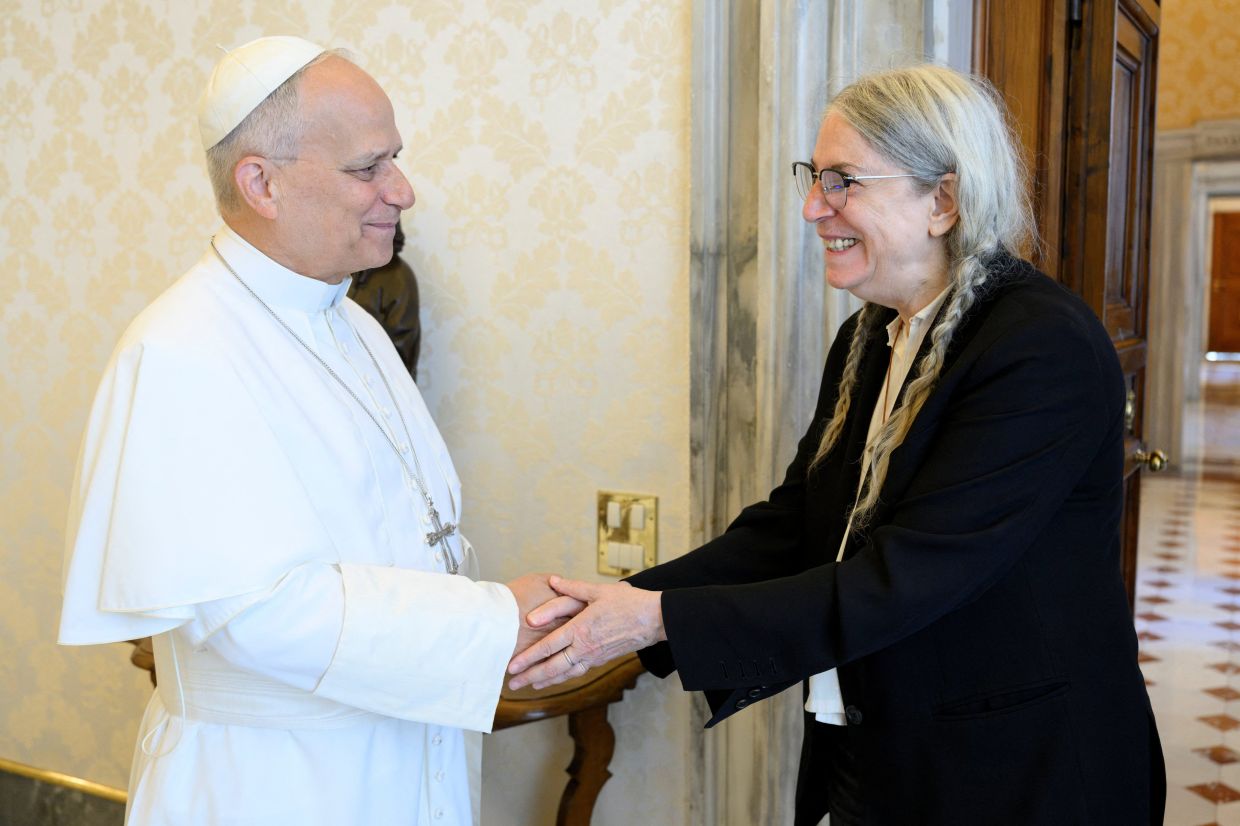
American rock and poetry icon Patti Smith sat across from Pope Leo XIV in the Apostolic Palace on Friday for an intimate encounter that left the legendary musician visibly moved. The moment was characteristically understated—Smith, dressed simply with her trademark braids and a crucifix necklace, greeted the pontiff with a soft "Hi" as she took her seat at his desk. Yet the quiet exchange belied the significance of the meeting between two figures whose lives have intersected across music, spirituality, and artistic vision.
Smith's presence at the Vatican reflects a deepening relationship with the Catholic Church's highest offices, facilitated largely through her friendship with Rev Antonio Spadaro, the undersecretary in the Vatican's culture ministry. Though Smith has consistently maintained she is not Catholic, her spiritual affinity with the institution has grown considerably over recent years. She has articulated a particular admiration for the late Pope Francis, drawn to what she describes as his "gentle, open, and steadfast sense of humanity"—qualities that resonated deeply with her own artistic and philosophical worldview. This attraction to Francis extended decades earlier as well; Smith has long cherished Pope John Paul I, whose influence surfaced in her music throughout her career.
The Vatican has increasingly recognised Smith's cultural significance, creating opportunities for her to contribute meaningfully to the Church's artistic and spiritual mission. Earlier this year, Smith performed during the inauguration of the Holy See's pavilion at the Venice Biennale, one of the world's most prestigious contemporary art exhibitions. The timing of the May 8 performance held particular resonance—the date marked the anniversary of Pope Leo XIV's election, linking Smith's artistic contribution directly to the new pontiff's tenure. This engagement underscores how the Vatican under Leo's leadership continues to value secular artists who share its spiritual values, even when they operate outside formal religious structures.
According to Spadaro, who attended Friday's audience alongside Smith, the encounter stretched across approximately 40 minutes and transcended the formal protocols typically associated with papal meetings. Rather than a ceremonial audience, Spadaro characterised the exchange as "a conversation between two people discovering they were old friends, sharing memories woven from words and music, dreams, visions, and hopes—both from yesterday and for today." This description suggests that Leo was already familiar with Smith's work and significance, treating her not as a visiting musician but as a peer engaged in similar spiritual and cultural inquiry. The pope apparently recognised a reference to one of Smith's compositions, responding "That was marvelous" when she referenced a particular song.
Smith's relationship with the papacy underwent profound transformation following the death of Pope Francis on April 21, 2025. The pontiff, whom she had met in 2013 and performed for in 2014, had become a spiritual touchstone for the singer during his 11-year papacy. In the immediate aftermath of his passing, Smith took to social media to share a poem comparing Francis to a dandelion—"humble yet strong." She wrote that "Nature and poetry and the suffering shall miss their champion," a characteristically poetic distillation of Francis's advocacy for the environment, the arts, and the vulnerable. This public expression of grief demonstrated how deeply Smith had felt connected to Francis's vision, even as a non-Catholic observer.
For Malaysian and Southeast Asian readers, Smith's sustained engagement with the Vatican carries particular significance in understanding the global dimensions of faith and culture. The Catholic Church's investment in dialogue with secular artists reflects a broader institutional recognition that spiritual questions transcend denominational boundaries and that artistic expression serves as a legitimate vehicle for exploring ultimate meaning. Smith's position as a bridge figure—neither entirely within nor entirely outside the Church—mirrors the religious pluralism increasingly characteristic of modern Asian societies, where individuals often draw wisdom from multiple traditions.
The meeting also illuminates Pope Leo XIV's approach to his early tenure. By facilitating encounters with internationally significant artists and cultural figures, Leo signals his commitment to the Vatican's engagement with contemporary culture. His attendance earlier this week at a concert honouring him by tenor Andrea Bocelli further demonstrates a deliberate cultivation of the relationship between faith and high culture. This represents a continuation of themes from Francis's papacy while potentially establishing Leo's own signature approach to the intersection of spirituality and artistic expression.
Smith's journey to the Vatican, from her emergence as a punk rock pioneer in the 1970s to her current status as a contemplative voice in cultural discourse, exemplifies how artistic credibility and spiritual authenticity need not conflict. Her willingness to engage seriously with institutional religion while maintaining her artistic independence offers a model for how secular figures can contribute meaningfully to religious dialogue. The ease with which she and Leo apparently communicated—despite their vastly different backgrounds and roles—suggests that common ground exists between the artistic imagination and ecclesiastical authority when both are pursued with genuine sincerity.
Looking forward, Smith's presence at the Vatican and her apparent comfort in these spaces suggest she may continue to serve as a cultural ambassador for the Church's artistic interests. Her work, which has long grappled with mortality, transcendence, and social justice, aligns naturally with contemporary Catholic teaching under both Francis and Leo. Whether Smith will take on additional roles at the Vatican, perhaps through further performances or collaborations on cultural projects, remains to be seen. What is clear, however, is that her relationship with the institution represents something noteworthy in contemporary religion: a genuine meeting of minds across significant divides, held together by mutual respect for the power of art and authentic human expression.

