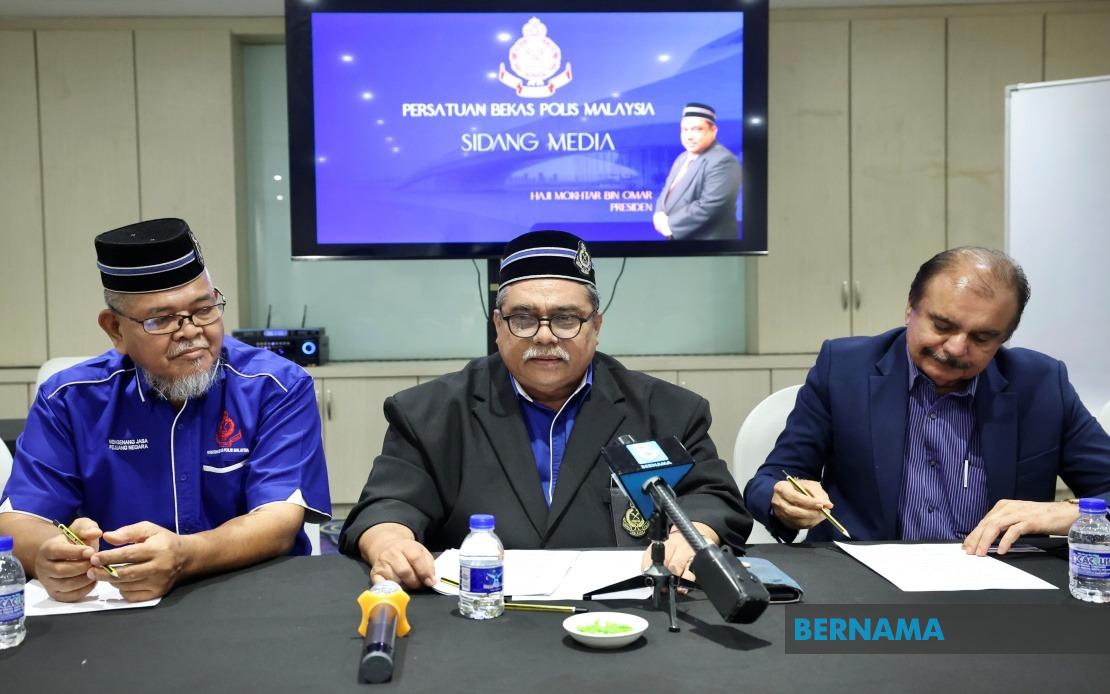
The Malaysian Ex-Police Association (PBPM) has formally appealed to the federal government to establish a monthly cost-of-living allowance for roughly 40,000 non-pensionable former police personnel, arguing that these individuals merit state support in recognition of their contributions to national security and their current financial vulnerability. The association's president, Mokhtar Omar, made the case during a press conference in Kuala Lumpur on August 13, pointing to historical records and the growing economic pressures facing retired officers who lack pension entitlements.
The demographic that PBPM represents consists of former officers with varying service backgrounds spanning several decades. According to association records dating back to 1972, non-pensionable members constitute approximately 46 percent of PBPM's total registered membership of 86,000 individuals. This group encompasses personnel who served in specialised units including the Special Squad and Home Guard, as well as contract inspectors who were engaged during the Emergency period. The historical timeframe indicates that many of these individuals are now elderly, having spent formative years of their careers in roles that ultimately did not qualify them for the standard pension framework that covers other former law enforcement personnel.
Mokhtar Omar emphasized that the financial circumstances of these former officers have deteriorated significantly as inflation and cost-of-living pressures mount across Malaysia. Without regular pension income and facing mounting expenses for basic necessities, housing, and healthcare, many members are sliding into hardship despite their decades of service to the nation. The association president characterised this situation as incompatible with the principle of national gratitude, suggesting that the government has both a moral obligation and practical capacity to address the welfare gap these individuals face.
The proposed intervention takes a measured approach in its financial dimensions. PBPM has suggested implementing a monthly special allowance ranging between RM300 and RM500 for eligible recipients, a figure the association argues represents a manageable commitment relative to the government's budget. Mokhtar Omar stated explicitly that implementing such a scheme would not impose undue fiscal burden on the federal coffers, particularly given the diminishing numbers of eligible individuals as the cohort ages. This framing appears designed to address potential government concerns about sustainability and expenditure control.
Beyond the proposed allowance, PBPM is simultaneously advocating for a structural review of the Police Heritage Trust Fund (TAWP), an existing welfare mechanism that the association contends operates at inadequate assistance levels. The organisation is calling for enhanced benefit rates from the trust fund and a significant expansion of its mandate to encompass broader categories of support. Specifically, PBPM seeks to incorporate educational assistance for dependents, healthcare coverage expansion, and disaster relief provisions into the fund's operational scope. This multifaceted approach suggests the association recognises that a single monthly payment alone may not adequately address the complex welfare needs of a diverse retired population.
In parallel with its government advocacy, PBPM is pursuing an independent fundraising strategy that underscores the urgency the association perceives around member welfare. The organisation is planning a fundraising dinner scheduled for October with an ambitious target of raising RM1 million from corporate sponsors, multinational enterprises, private sector organisations, and philanthropically-minded individuals. This dual-track approach—simultaneously petitioning government while mobilising private resources—reflects pragmatic acknowledgement that government response may be delayed or insufficient.
According to Datuk Dr Basant Singh Sidhu, PBPM's Information Chief, the October fundraising event will support immediate humanitarian needs facing association members in acute distress. The collected funds will be allocated to procure essential items and services including medical equipment, wheelchairs, nutritional supplements such as milk, hearing aids, and other necessities that contribute to basic quality of life. This targeted application of fundraised money demonstrates that PBPM has detailed knowledge of the specific vulnerabilities and requirements within its membership base.
The timing and framing of PBPM's appeal carries significance within Malaysia's broader policy landscape regarding veteran welfare and social safety nets. The association's articulation emphasises historical service during the Emergency—a period of national significance—as foundational justification for contemporary support. This historical argument carries particular weight given Malaysia's ongoing commemoration of its independence struggle and the role of security forces in that narrative. By situating its members within this historical context, PBPM positions the allowance request not as a general welfare entitlement but as a specific obligation arising from historical military and security service.
The non-pensionable status that characterises this population reflects contractual and regulatory frameworks that existed when these individuals entered service. Many were engaged on temporary or contract bases during emergency periods when rapid force expansion was necessary, and their employment terms never translated into long-term pension rights despite the permanence and sacrifice their roles demanded. This administrative legacy now creates a gap in social provision that PBPM argues should be rectified through contemporary policy initiative. The association's position implicitly challenges the sufficiency of existing frameworks in accounting for all those who contributed meaningfully to national security objectives.
For Malaysian policymakers, the PBPM case presents a reckoning with deferred obligations to a finite and aging population. The association's documentation showing 40,000 affected individuals provides concrete scale to the proposal, while the suggested allowance range permits budgetary flexibility. The integration of trust fund reform with the proposed allowance suggests PBPM has engaged in strategic thinking about sustainable welfare architecture rather than seeking merely temporary relief measures. Whether the government responds favourably may depend on broader fiscal priorities and the political value assigned to honouring former service personnel in current parliamentary contexts.

