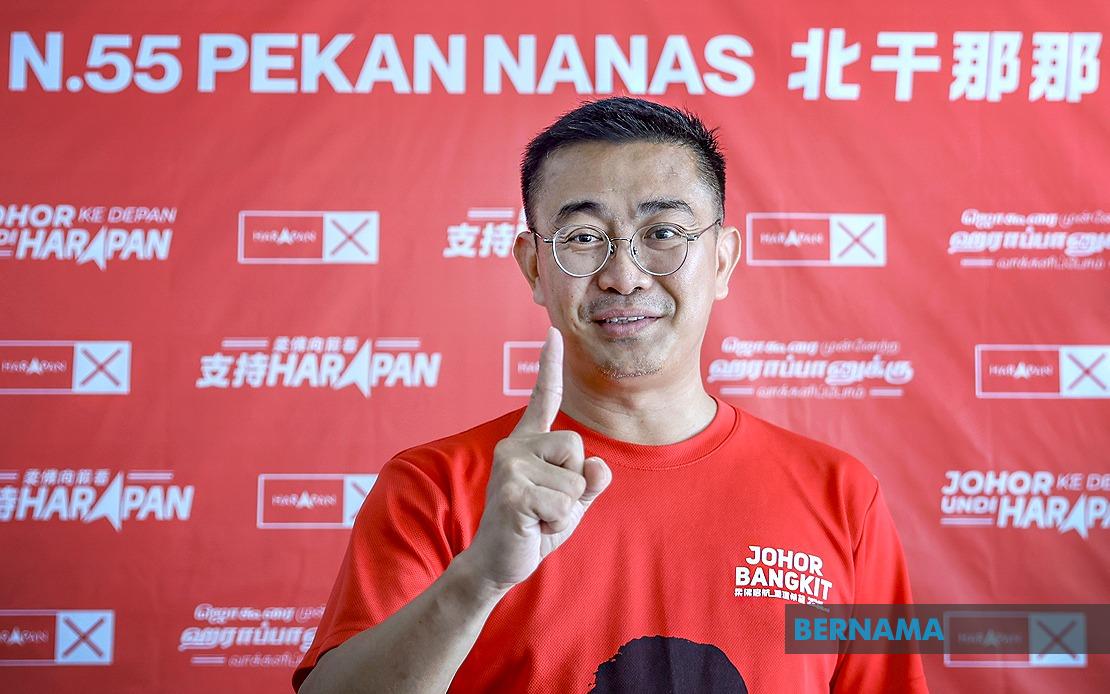
Pekan Nanas represents a closely watched battle in the ongoing Johor state election, with Pakatan Harapan's Yeo Tung Siong mounting a determined bid to wrest back the constituency from Barisan Nasional incumbent Tan Eng Meng. The former assemblyman, who held the seat for two consecutive terms between 2013 and 2022, is banking heavily on his track record of constituency service as his primary campaign argument, framing the election as a choice between proven experience and an incumbent administration he characterizes as requiring change.
Throughout his campaign trail, Yeo has emphasised the depth of grassroots engagement he has undertaken, reporting that nearly 60 per cent of registered voters in Pekan Nanas have directly encountered him through an extensive outreach programme. His efforts have encompassed the traditional components of Malaysian electoral campaigning: walking through residential neighbourhoods, holding community forums, conducting one-to-one consultations at residents' homes, and building visibility in public gathering spaces such markets and food establishments. The positive reception he describes receiving during these interactions signals that a significant segment of the electorate remains receptive to his candidacy, though the remaining 40 per cent of voters represents untapped persuasion ground.
As a former secondary school administrator whose background included responsibility for student discipline and school management, Yeo projects an image of accessibility and responsiveness that contrasts sharply with the formal distance often associated with elected office. He frames his approach to constituent service as inherently informal and people-centred, maintaining that his door remains open to residents seeking assistance regardless of administrative protocol or hierarchical considerations. This positioning reflects a strategic calculation that Johor voters, particularly in a semi-urban constituency like Pekan Nanas, prioritise practical, attentive representation over political party affiliation.
During his previous tenure, Yeo points to specific infrastructure achievements that he argues addressed longstanding community challenges. Most notably, he secured RM500,000 in government funding to rectify persistent flooding problems in the Pulai River area through channel straightening works, a project that would have required sustained advocacy with both state and federal agencies. Additionally, he collaborated with private sector partners to implement drainage infrastructure improvements around Kampung Melayu Raya, demonstrating capacity for cross-sector partnership in tackling grassroots infrastructure needs. These accomplishments, while modest by some measures, reflect the incremental but tangible improvements that resonated with constituents during his previous terms.
Contemporary voter concerns documented during Yeo's campaign reveal a constituency preoccupied with transportation efficiency and economic opportunity. Traffic congestion between Pontian and Johor Bahru has emerged as a consistent complaint among residents, suggesting frustration with journey times and road infrastructure capacity in this semi-developed area. Simultaneously, employment prospects have featured prominently in community feedback, indicating that while Pekan Nanas benefits from proximity to Johor Bahru's economic centre, local job availability remains constrained enough to concern residents who may prefer work opportunities within their own constituency.
Yeo's response to transportation concerns involves two specific infrastructure proposals designed to reduce travel friction. A shortcut route connecting Ulu Pulai to Pekan Nanas would create an alternative corridor avoiding existing congestion points, while a second connection between Pulai and Sri Bunian Junction would similarly provide route alternatives for commuters. These projects, if realised, would theoretically compress journey times for residents travelling to employment and services in Johor Bahru, addressing what appears to be a primary quality-of-life grievance. The feasibility and timeline for such projects remain unspecified in his campaign platform, representing potential vulnerability if questioned about implementation capacity.
On employment generation, Yeo proposes revitalising a career and skills fair programme he previously organised during his tenure as assemblyman. This initiative, conducted in partnership with regional employers, aims to match local job seekers with available positions while simultaneously showcasing employment opportunities to younger residents. The approach acknowledges that constituency-level representation possesses limited direct job-creation capacity, instead focussing on the intermediary role of improving information flow and connection between labour supply and demand. Whether such initiatives genuinely expand opportunity or primarily provide visibility remains contested in development circles, though their political appeal as evidence of effort remains substantial.
Social safety-net provisions constitute another dimension of Yeo's service vision. He articulates commitment to ensuring that vulnerable residents access appropriate support through established government channels including the Social Welfare Department (JKM) and the Social Security Organisation (SOCSO). This emphasis reflects awareness that pockets of socioeconomic vulnerability persist within Pekan Nanas despite the constituency's semi-developed status, and that constituent assistance with navigating government benefit systems represents a crucial service function. The implication that such assistance was not adequately prioritised during the BN incumbent's tenure constitutes an indirect critique of Tan Eng Meng's representative capacity.
The electoral context in Pekan Nanas reflects broader patterns within the 16th Johor state election, where Pakatan Harapan seeks to recapture ground lost in previous contests while Barisan Nasional maintains incumbent advantages and administrative machinery. For Malaysian political observers, Pekan Nanas exemplifies the dynamics of semi-developed constituencies where voters oscillate between competing coalitions based on evaluations of local service delivery rather than ideological commitment to national political platforms. Yeo's campaign strategy of emphasising personal track record and accessibility over party machinery represents a distinctly local approach that may or may not align with broader state and national electoral trends.
The direct one-on-one competition between Yeo and incumbent Tan Eng Meng eliminates the complication of three-cornered contests that characterise many Malaysian constituencies, clarifying voter choice around a binary decision about incumbent displacement. For Pekan Nanas residents, the election effectively resolves to a referendum on whether previous performance warrants restoration of a former representative or whether continuity with the current administration merits endorsement. Such contests frequently hinge on nuanced assessments of local performance, incremental service delivery, and personal connection rather than grand ideological contests, making Yeo's emphasis on constituency accessibility and specific infrastructure achievements strategically appropriate for his electoral context.

