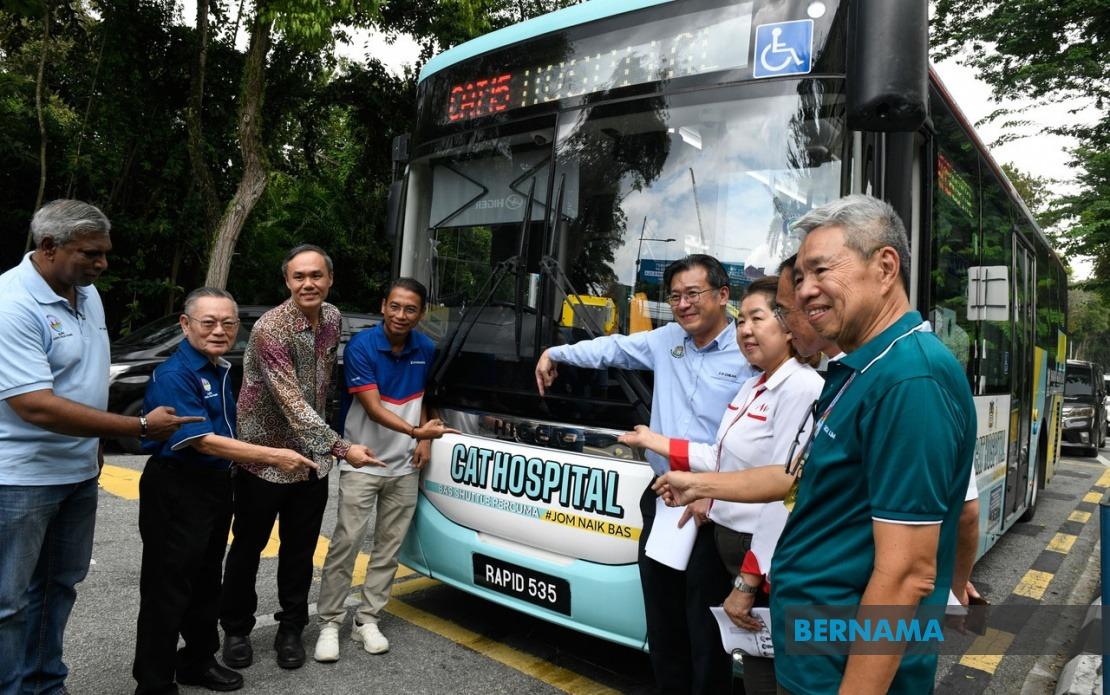
The Penang Island City Council (MBPP) is backing a major public transport initiative with an annual commitment of RM900,000 to sustain a free shuttle bus service that ferries residents between Komtar and Penang Hospital, alongside three private medical institutions and multiple healthcare centres dotting the city core. Launched at the start of this year, the Central Area Transit (CAT) service represents a deliberate effort to reshape how people access healthcare in the island's congested urban zones, reflecting growing concerns about parking scarcity and traffic flow around the hospital district.
The engineering leadership at MBPP frames the undertaking as a multi-pronged solution to well-documented transportation challenges. According to MBPP Engineering Director Cheah Chin Kooi, the scheme encourages commuters to abandon private vehicle dependency and opt instead for convenient mass transit, thereby reducing the volume of cars competing for limited parking infrastructure surrounding the Penang Hospital complex. Such congestion has long frustrated patients, healthcare workers, and visitors navigating the area's narrow streets and overstretched parking facilities.
The genesis of this initiative traces back to a comprehensive survey conducted by MBPP following the hospital's expansion project. The expansion amplified demand for accessible transport, prompting council officials to recognise that existing public transport arrangements were inadequate. The resulting CAT service emerged as a targeted response, specifically designed to benefit vulnerable road users including elderly patients, their caregivers, and those with mobility challenges who might otherwise struggle with the walk from regular bus stops to the hospital entrance.
Operationally, the service covers an eight-kilometre corridor serviced by three Rapid Penang buses making 36 daily journeys at 20-minute intervals. Service hours run from 6 am until 8 pm, covering the span when most healthcare visits occur. This straightforward schedule eliminates the guesswork for passengers unfamiliar with public transport, a consideration that proves especially important for elderly and first-time users. The frequency ensures minimal waiting times, a crucial factor in healthcare settings where timely access can carry genuine medical significance.
Performance metrics suggest the initiative is resonating with Penang residents. Since the service commenced operations in January, daily passenger volumes have nearly doubled from an initial 300 riders to approximately 600 currently. This upward trajectory indicates growing public confidence in the service's reliability and usefulness, challenging the widespread assumption that Malaysians automatically prefer private vehicles when available. The positive uptake vindicates MBPP's investment rationale and suggests similar initiatives might succeed elsewhere across the state.
The Penang Hospital directorate, represented by Dr Goh Hin Kwang, has moved in parallel to enhance the passenger experience. Pedestrian infrastructure along Jalan Residensi has undergone upgrading to create safer walking paths, while improvements to the main entrance on Jalan Utama are underway to smoothly integrate the bus service with hospital access points. These complementary physical improvements acknowledge that a shuttle service's utility depends not merely on the buses themselves but on how seamlessly they connect with surrounding urban design.
From a regional perspective, the MBPP initiative offers instructive lessons for other Malaysian city councils grappling with similar healthcare access and traffic management dilemmas. Kuala Lumpur, Johor Bahru, and Kota Kinabalu face comparable pressures around major medical institutions, yet few have implemented comparable free shuttle solutions. The RM900,000 annual expenditure, while significant, pales beside the broader economic costs of traffic congestion and parking inadequacy—factors that discourage healthcare visits, delay patient arrivals, and impose hidden costs on the healthcare system.
The scheme also reflects evolving thinking about government's role in addressing practical quality-of-life issues. Rather than restricting interventions to regulatory measures or infrastructure development, MBPP has embraced direct service provision, subsidising transport to achieve public health objectives. This represents a departure from purely market-driven approaches and suggests receptiveness to the idea that some mobility needs warrant public investment even where commercial operators might struggle to operate profitably.
Beyond traffic and parking considerations, the free shuttle addresses equity dimensions often overlooked in transport planning. Vulnerable populations—low-income patients, unaccompanied elderly visitors, caregivers managing multiple responsibilities—benefit disproportionately from eliminating transport costs and simplifying navigation. For these groups, even small fees and complex transfer requirements can deter necessary healthcare access, making subsidised transport a legitimate public health measure.
Looking forward, the service's sustainability depends on consistent funding allocation and operational reliability. As ridership continues its upward trajectory, MBPP may need to consider fleet expansion or additional routes serving neighbouring healthcare facilities. The current model, while successful, operates within carefully defined parameters; demand beyond the existing capacity could expose whether this investment can scale without proportionate cost increases.
The collaboration visible in today's announcement—encompassing MBPP, Rapid Penang, the hospital administration, and the Penang Women's Development Corporation—underscores the multi-stakeholder coordination required for such initiatives. This institutional cooperation, though perhaps invisible to daily users, represents the organisational infrastructure enabling public services to function smoothly. Whether similar arrangements can be replicated across Malaysia's other major urban centres will partly determine how broadly such innovations reshape urban mobility patterns.

