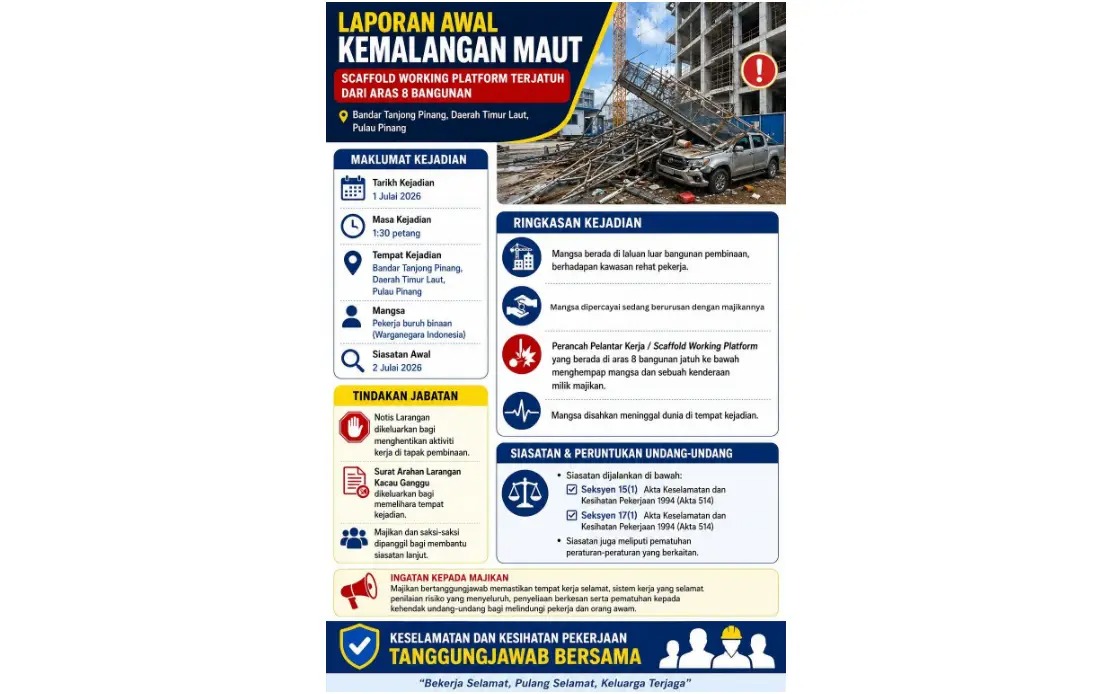
The Department of Occupational Safety and Health (DOSH) in Penang has moved swiftly to shut down a major construction project in Bandar Tanjong Pinang following a fatal workplace accident that has raised fresh concerns about safety compliance on Malaysia's building sites. The enforcement action comes after an Indonesian construction worker was fatally struck by a falling scaffolding platform on July 1, an incident that has reignited scrutiny of how developers and contractors manage worker protection in high-rise construction environments.
According to DOSH, the deadly incident unfolded at 1.30 pm when a scaffolding working platform detached and fell from the eighth floor of the building under construction. The worker, who was positioned on an external walkway at a lower level near the workers' rest area, sustained fatal injuries from the impact. The falling platform also damaged a vehicle belonging to the worker's employer, underscoring the force of the collision and the hazardous conditions that existed on site.
The prohibition notice issued by Penang DOSH represents a formal legal mechanism to prevent all related construction activities from resuming until safety authorities are satisfied that the site meets regulatory standards. Coupled with the non-disturbance order that preserves the scene in its original condition, these measures effectively freeze operations while investigators piece together how systemic failures allowed such a catastrophic event to occur in the first place.
The investigation framework that DOSH has established examines whether employers complied with their fundamental obligations under Sections 15(1) and 17(1) of the Occupational Safety and Health Act 1994. These provisions establish the baseline requirements for employers to conduct comprehensive hazard assessments, implement control measures, and ensure that all work is executed in accordance with established safety standards. Given the nature of the incident—a collapse from height involving temporary structures—investigators will likely scrutinise whether proper engineering calculations, installation protocols, and maintenance schedules were followed.
For Malaysian construction industry observers, this incident highlights a persistent vulnerability in how scaffolding systems are managed on local building sites. Temporary elevated work platforms are among the highest-risk elements in construction, yet cases of inadequate inspection, improper assembly, and insufficient maintenance continue to surface. The fact that a platform fell from the eighth floor suggests either design inadequacy, installation defects, deterioration that went undetected, or operator error—possibilities that regulators will methodically investigate through interviews with employers, site supervisors, and witnesses.
The use of migrant workers on Malaysian construction projects, while economically significant and necessary for the sector, also introduces complexity in safety management. Language barriers, limited familiarity with local regulations, and sometimes incomplete orientation to site-specific hazards can compound risks. DOSH's investigation will likely examine whether this particular worker received adequate safety training and whether he understood the protocols for working near potentially unstable structures.
Penang DOSH has publicly committed to pursuing enforcement action if violations are discovered during the investigation. This suggests investigators have already identified preliminary concerns that warrant formal prosecution consideration. Such action could involve substantial penalties for the employer, main contractor, or relevant subcontractor, depending on the assessment of culpability. Beyond financial penalties, conviction records can affect a company's eligibility for future government contracts and damage commercial reputation in a sector where safety credentials increasingly matter to project owners.
The regulatory response demonstrates that Malaysian authorities recognise fatal construction accidents cannot be treated as isolated incidents or inevitable consequences of building activity. DOSH's public statement emphasising that all workplace fatalities are taken seriously signals an expectation that developers, main contractors, and subcontractors will elevate their safety culture from mere compliance checkbox exercises to genuine operational priorities.
For the broader Southeast Asian construction sector, Malaysia's response—with DOSH issuing immediate prohibition orders and threatening enforcement action—reflects regional expectations for worker protection. As countries across the region compete for foreign investment and development projects, regulatory bodies face pressure to demonstrate that they can maintain safety standards without becoming overly bureaucratic. The Penang incident will likely inform discussions at industry forums regarding best practices for scaffolding management, inspection frequency, and documentation requirements that could eventually influence standards across Malaysia and neighbouring countries.
The investigation's findings will probably generate updated guidance or enforcement memoranda from DOSH to construction firms nationwide. Previous fatal incidents have triggered such regulatory responses, effectively using tragedy as a catalyst for systemic improvement. Whether this particular incident becomes a turning point depends partly on how comprehensively investigators document the failures that permitted a worker to remain in harm's way when a preventable structural collapse occurred.
Employers and contractors across Penang and Malaysia would be wise to proactively review their scaffolding systems, inspection protocols, and worker safety induction programmes rather than awaiting formal DOSH guidance. Insurance providers and project owners are increasingly demanding evidence of robust safety management, creating economic incentives for compliance beyond regulatory mandates.
As investigations continue, the identity of enforcement violations will become clearer. Whether failures are attributed to design engineers, installation contractors, site supervisors, or the main contractor will shape both the legal outcomes and the safety lessons the industry absorbs. What remains certain is that this fatality has activated formal machinery designed to prevent recurrence, and the construction sector's response will be carefully monitored by regulators across the region.

