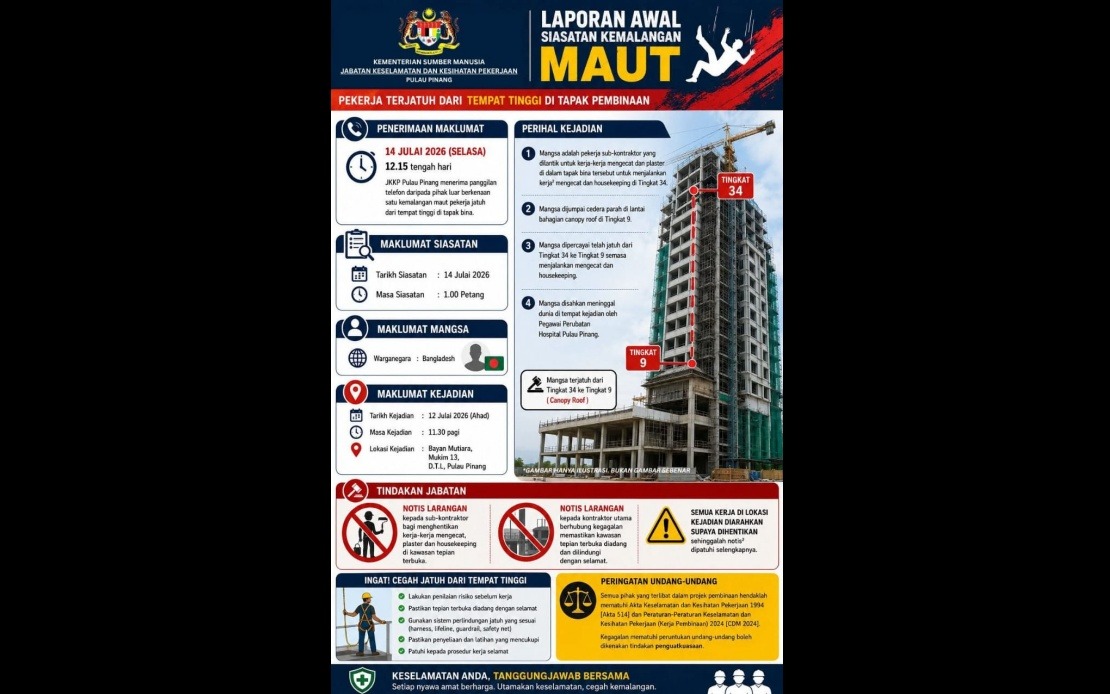
The Penang Department of Occupational Safety and Health (DOSH) has launched a formal inquiry into the fatal accident that claimed the life of a Bangladeshi worker at a construction project in Bayan Mutiara, after he sustained catastrophic injuries from a significant fall between building levels. The incident underscores the persistent hazards facing migrant labourers in Malaysia's construction sector, a workforce that comprises the vast majority of site personnel across major urban development projects nationwide.
Authorities received notification of the tragedy at 12.15 pm following a call from an unidentified external source, prompting the rapid mobilisation of DOSH investigators to secure and examine the site. According to Penang DOSH director Hairozie Asri, preliminary assessment indicates the worker descended approximately 25 storeys after losing his footing on the 34th floor, ultimately coming to rest on a protective canopy structure at Level 9. Medical staff from Penang Hospital pronounced him deceased upon arrival, though full details surrounding the medical cause remain undisclosed.
The victim held employment through a subcontracting arrangement rather than direct hiring, a common arrangement in Malaysian construction that frequently distances primary contractors from direct accountability over working conditions. The subcontractor responsible for his engagement maintained a contract specifically covering interior finishing tasks including painting, plastering, and housekeeping duties. This contractual structure raises questions about the adequacy of safety supervision and whether subcontracting arrangements in Malaysia's construction industry create gaps in worker protection and occupational oversight.
Following the investigation's commencement, DOSH acted decisively to prevent further incidents by issuing comprehensive prohibition notices halting all painting, plastering, and housekeeping activities in exposed areas where workers operate without full perimeter protection. A corresponding order addressed to the main contractor mandated an immediate cessation of all construction-related work at the accident location pending full compliance with regulatory requirements. These measures reflect the escalating concern within Malaysia's safety apparatus regarding the vulnerability of workers undertaking high-level tasks at major urban construction sites.
The incident highlights a recurring concern within Malaysia's migrant worker community, where language barriers, limited familiarity with local safety protocols, and vulnerability within subcontracting systems can compromise protective measures. Bangladeshi nationals constitute a significant portion of Malaysia's estimated 1.7 million migrant workers, predominantly concentrated in construction, manufacturing, and service sectors. The fatal fall at Bayan Mutiara represents another incident in an ongoing pattern of workplace tragedies affecting foreign labourers undertaking hazardous tasks.
Construction fatalities involving migrant workers have become increasingly visible in Malaysian media and regulatory discourse, reflecting broader concerns about standards implementation across the property development sector. Large-scale residential and commercial projects, particularly those involving multiple subcontracting tiers and compressed timelines, frequently emerge as high-risk environments. The 34-storey building where this incident occurred exemplifies the vertical complexity and associated dangers inherent in contemporary Malaysian urban development.
Regulatory bodies like DOSH operate within established frameworks governing construction safety, yet practical enforcement remains inconsistent across projects of varying scales and contractor sophistication. The department's response to this incident—issuing prohibition notices and establishing work stoppages—follows protocols established under Malaysian occupational safety legislation. However, critics argue that reactive measures following fatalities, while necessary, remain insufficient without proactive workplace inspections, enhanced subcontractor accountability mechanisms, and mandatory safety training specifically designed for migrant workers with language-appropriate instruction.
The economic dimensions of Malaysia's reliance on migrant construction labour create inherent tensions within safety frameworks. Subcontractors operating with compressed profit margins may prioritise schedule adherence over comprehensive protective equipment and fall-prevention systems. Workers themselves, conscious of employment precarity and visa dependencies, may hesitate to report unsafe conditions or decline hazardous assignments. This dynamic creates a structural vulnerability that regulatory interventions must navigate carefully.
Penang's construction sector, energised by major residential and commercial developments including high-rise residential towers and mixed-use complexes, maintains a significant contingent of foreign workers undertaking tasks across all skill levels. The state's rapid urban growth has generated consistent demand for construction personnel, a demand overwhelmingly met through migrant labour sourced via formal channels and informal arrangements. Incidents like the Bayan Mutiara fatality remind policymakers and industry participants of the human costs underlying Malaysia's development trajectory.
Moving forward, the formal investigation will examine whether fall-prevention protocols were established, whether appropriate personal protective equipment was supplied and enforced, and whether the subcontracting arrangement created supervision gaps. These findings, once documented in DOSH's official report, may influence future regulatory adjustments or reinforce existing safety standards. For the broader construction industry and migrant worker advocates, this incident represents another opportunity to advance workplace protections and strengthen enforcement mechanisms protecting Malaysia's most vulnerable labourers.

