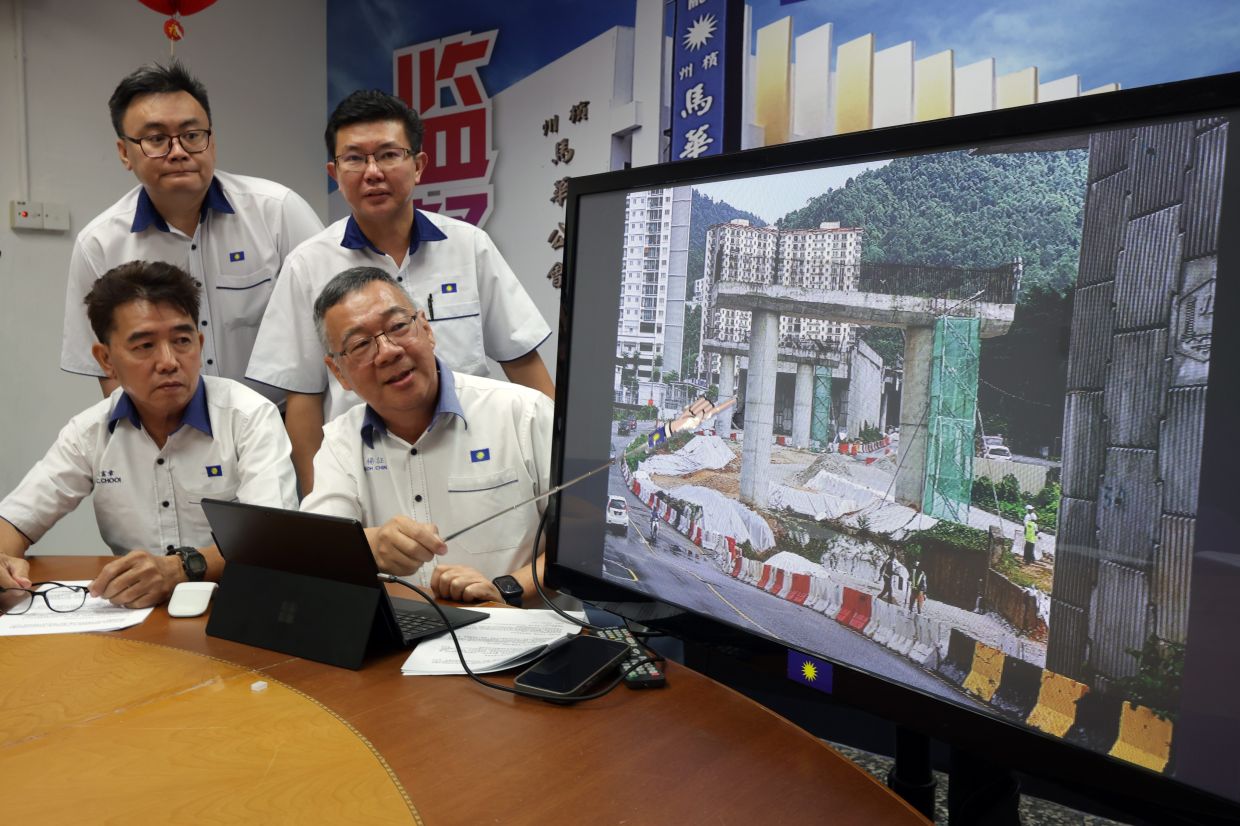
The political fault lines over Penang's long-delayed Air Itam-Tun Dr Lim Chong Eu Expressway bypass project have deepened, with the opposition Penang MCA mounting an unusually aggressive push for transparency that threatens to escalate the dispute beyond technical construction matters into questions of governmental accountability. The party's secretary Yeoh Chin Kah has issued a pointed challenge to the state administration, demanding immediate release of payment records, consultant certification reports, and comprehensive project assessments—setting a seven-day deadline before escalating complaints to federal anti-corruption authorities.
At the heart of the confrontation lies a fundamental credibility gap. While Paya Terubong assemblyman Wong Hon Wai insists the project has reached 91% completion and remains on schedule for an April 12, 2027 opening, Yeoh's characterisation of ground conditions tells a starkly different story. A site inspection conducted by Penang MCA members in early July revealed extensive unfinished work across multiple critical sections, including Valley Road, Changkat Tembaga, and Jalan Thean Teik. The party leadership found bridge piers in place but a conspicuous absence of bridge beams, bridge decks, road surfacing, guardrails, noise barriers, and mechanical and electrical installations across numerous segments.
Yeoh has strategically reframed the dispute as no longer about explaining construction delays—a reality Penang residents have grown accustomed to over several years—but rather as a matter of fundamental public accountability and confidence in government institutions. This rhetorical shift moves the conversation beyond technical project management into the realm of governance credibility, a particularly sensitive issue for any administration. The MCA's threat to lodge formal reports with both the National Audit Department and the Malaysian Anti-Corruption Commission signals an intention to weaponise the dispute politically while simultaneously placing it within formal oversight frameworks that carry real institutional weight.
The Air Itam bypass, formally designated as Package Two of the broader Penang undersea tunnel and paired roads infrastructure initiative, represents a significant urban mobility intervention designed to serve approximately 300,000 residents across Air Itam, Bandar Baru Air Itam, and Paya Terubong. This six-kilometre toll-free expressway was originally envisioned as operational by 2024, a target that proved wildly optimistic given the project's complex engineering requirements. The infrastructure combines elevated viaducts, underground tunnel sections, and ground-level road networks, requiring sophisticated coordination between multiple construction fronts and regulatory compliance checkpoints.
The original 2024 completion target has since slipped twice, with authorities now pointing to April 2027 as the revised deadline. This extension pattern itself raises questions about project management practices and why initial timelines proved so unreliable. For Malaysian observers accustomed to infrastructure delays across the country, this project exemplifies broader systemic challenges in construction oversight and contractor accountability. The willingness of Penang MCA to formally challenge what appears to be inflated progress reporting suggests either deteriorating political relationships within the state administration or genuine concerns about financial irregularities that may warrant investigation.
Wong's response emphasises ongoing bridge beam installation, with twelve beams scheduled for launch between July and August on the Gelugor side, with six additional beams planned for the fourth quarter. He notes that bridge beams on the Bandar Baru Air Itam side have already been deployed, though he candidly acknowledges that construction completion will not translate immediately to public access. Instead, government agencies must conduct a Road Safety Audit before the Public Works Department determines an actual opening date. This multi-stage approval process, while necessary for safety assurance, effectively means the project's true completion date remains uncertain even after construction finishes.
The formation of a Penang MCA special monitoring committee represents an institutional response to what the party evidently perceives as inadequate transparency from the ruling administration. This approach allows the opposition to maintain continuous scrutiny over coming months while building an evidentiary record that could prove politically damaging if completion targets slip again. For Malaysian taxpayers and regional observers, the dispute underscores a persistent challenge in major infrastructure projects: the gap between official progress narratives and actual on-site reality, and the difficulty of obtaining reliable information from authorities invested in portraying projects optimistically.
The implications of this dispute extend beyond Penang's administrative borders. Malaysia's infrastructure reputation internationally depends substantially on the ability to deliver complex projects on schedule and within budget. Repeated extensions, transparency disputes, and political recriminations over individual projects accumulate reputationally, affecting investor confidence in the nation's capacity to manage large-scale development initiatives. For Southeast Asian counterparts considering engagement with Malaysian construction firms or authorities on regional infrastructure, such episodes carry demonstrable consequences for how Malaysian entities are perceived and evaluated.
The demand for documentary evidence—payment records, consultant certifications, project assessments—targets the administrative apparatus that underpins major construction oversight. If Penang MCA's allegations about progress misrepresentation prove substantiated through audits or investigations, the implications could extend to questions about how completion percentages are calculated, whether consultant independence is maintained, and whether financial controls function effectively. These institutional questions matter far beyond any single project, affecting the credibility of government agencies responsible for massive capital expenditure across multiple sectors.
Yeoh's insistence that this dispute concerns public confidence rather than mere delay management correctly identifies why the dispute has transcended technical construction discussion. Residents who have waited years for infrastructure completion understandably demand transparency about timelines and financial stewardship. The MCA's seven-day ultimatum before involving federal authorities effectively forces the Penang government into a choice: provide comprehensive documentation voluntarily or face formal investigations that could prove more politically damaging regardless of actual findings. For Malaysian observers monitoring governance standards and institutional accountability, this confrontation may ultimately determine whether routine infrastructure delays remain politically isolated incidents or become catalysts for broader accountability mechanisms that strengthen oversight of major government projects.

