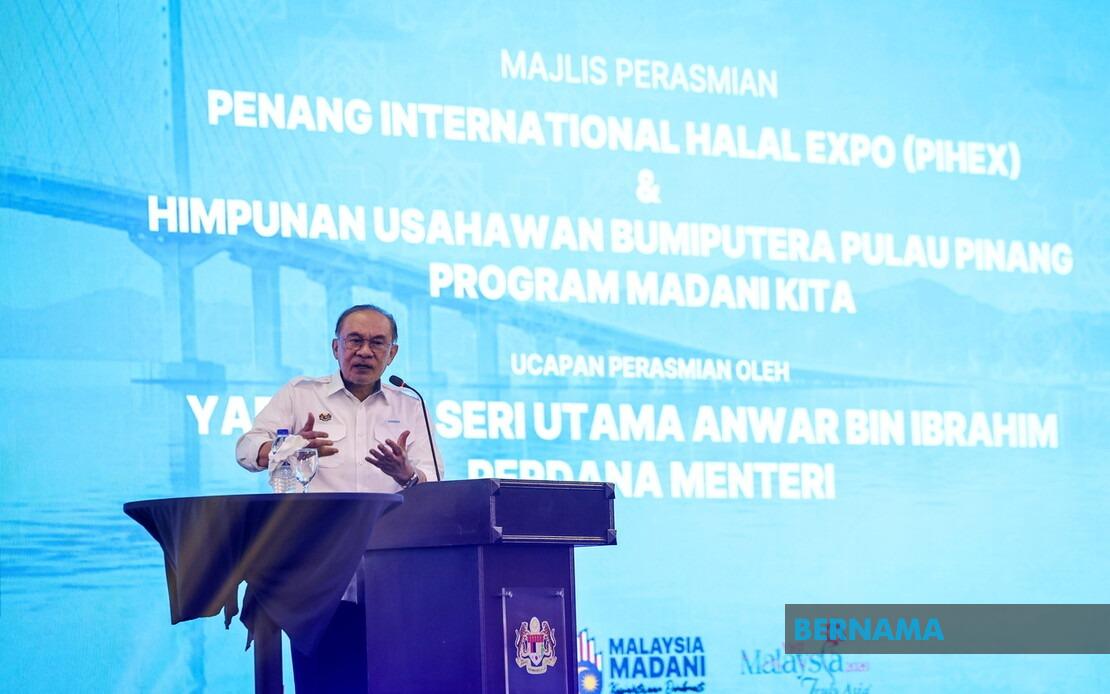
Prime Minister Datuk Seri Anwar Ibrahim has set ambitious expectations for Penang to emerge as one of Malaysia's strongest-performing states in Bumiputera economic participation, leveraging coordinated efforts across federal and state development agencies. Speaking at the opening of the Penang International Halal Trade Exhibition and the Penang Bumiputera Entrepreneurs Gathering in Permatang Pauh on July 25, Anwar sought to overturn the narrative that Bumiputera entrepreneurs in the island state face significant disadvantages compared to those in Malay-majority regions across Peninsular Malaysia.
The Prime Minister directly challenged what he characterised as a misperception regarding Muslim and Bumiputera economic activity in Penang. He presented empirical evidence suggesting that when measured objectively, Bumiputera economic participation in Penang actually outperforms most Malay-majority states in the peninsula, despite a widespread assumption that the state's Chinese-dominant demographics have marginalised community participation in the economy. This assertion carries particular significance given Penang's status as a developed state with a sophisticated commercial ecosystem that has historically been associated with non-Bumiputera business dominance.
Central to Anwar's vision is a structural reorganisation of Bumiputera development efforts within Penang. Rather than allowing multiple agencies to operate independently, he has instructed Penang Bumiputera Development Council chairman Tan Sri Khalid Ramli to consolidate all Bumiputera development initiatives under a single strategic framework. This consolidation addresses a longstanding criticism that government development programmes often fragment resources and contradict each other through uncoordinated implementation, diminishing overall effectiveness and creating confusion among intended beneficiaries.
The initiative represents a recognition that Penang's competitive advantages in technology and manufacturing require corresponding Bumiputera participation to ensure sustainable and inclusive economic growth. The state has positioned itself as Asia's semiconductor hub, hosting multinational chip manufacturers and attracting significant foreign direct investment in high-technology sectors. However, Anwar identified a critical gap: Bumiputera-owned companies remain underrepresented in the semiconductor industry's supply chain, a sector characterised by high-value activities and substantial profit margins.
To address this gap, Anwar announced an allocation of RM5 million directed specifically at the Bumiputera Semiconductor Action Plan. This fund aims to facilitate the entry of Bumiputera enterprises into the semiconductor industry's value chain, whether in component manufacturing, specialised services, or technology integration roles. The initiative explicitly seeks not to displace existing companies but to create space and capability for Bumiputera firms to establish themselves as legitimate, competitive participants within an industry that will likely remain central to Malaysia's economic trajectory over the coming decades.
The semiconductor focus reflects broader economic realities affecting Southeast Asia and Malaysia's position within global technology supply chains. Following trade tensions and supply chain disruptions of recent years, semiconductor manufacturing and related industries have shifted regional weightings, with Malaysia and Penang particularly benefiting from diversification away from single-source dependencies. For Bumiputera entrepreneurs, participating in this sector offers opportunities to capture value from this structural shift rather than remaining confined to traditional commerce or lower-technology services.
Alongside semiconductor initiatives, Penang continues developing its halal industry ecosystem, an area where Bumiputera participation naturally aligns with religious and cultural considerations. The state recorded growth in Malaysian Halal Certification holders, rising from 1,098 in 2024 to 1,191 in 2025, with an additional 853 certificates recorded by mid-July 2026. This expansion reflects both increasing awareness of halal certification requirements in global markets and growing recognition that halal industry participation offers Bumiputera entrepreneurs competitive advantages in markets across the Muslim-majority world, particularly in the Middle East and Southeast Asia.
Anwar's emphasis on correcting Penang's Bumiputera narrative holds significance beyond the state itself. Penang historically represents a model of meritocratic capitalism where educational attainment and entrepreneurial capability matter more than ethnic classification in determining economic success. Yet this model, while producing prosperity, has also created perceptions of exclusion among Bumiputera populations if their representation in advanced sectors appears disproportionately low. By demonstrating that Penang's Bumiputera population participates economically at competitive levels compared to other regions, Anwar seeks to reframe both external perceptions and internal confidence.
The timeline for demonstrating results appears compressed. Anwar indicated his expectation to receive progress reports within weeks, reflecting pressure to translate strategic announcements into measurable outcomes. This acceleration suggests recognition that economic perception shapes investment decisions, particularly among younger Bumiputera entrepreneurs deciding whether to establish businesses in Penang or migrate to other states perceived as more supportive of their aspirations. Rapid demonstration of government commitment through tangible support mechanisms becomes essential for maintaining confidence in the initiative's seriousness.
Implementing this coordinated approach requires navigating institutional complexity across Penang's multilevel governance structure. Federal agencies, state departments, and multiple development councils historically operate under different budget cycles, reporting lines, and performance metrics. Consolidating these under a single strategic framework demands not merely administrative coordination but genuine alignment of incentives and evaluation criteria. Success will likely depend on whether participating agencies receive clear mandates, adequate resources, and transparent accountability measures.
For Malaysian policymakers observing Penang's approach, the experiment carries implications for national Bumiputera policy more broadly. If successful coordination can genuinely accelerate Bumiputera participation in high-technology sectors, the model might apply to other states seeking to broaden ethnic inclusion while maintaining economic competitiveness. The Penang case will test whether modern development requires choosing between meritocratic standards and ethnic representation, or whether strategic coordination can achieve both simultaneously through targeted support for capability building rather than preference quotas.
The semiconductor initiative particularly warrants attention as Malaysia positions itself within semiconductor geopolitics. If Bumiputera enterprises can successfully integrate into supply chains supporting the island's semiconductor ecosystem, they gain access not merely to local opportunities but to multinational networks linking Penang to global technology systems. Such integration would represent meaningful economic upgrading extending far beyond state boundaries and offering wealth creation pathways transcending traditional sectors.

