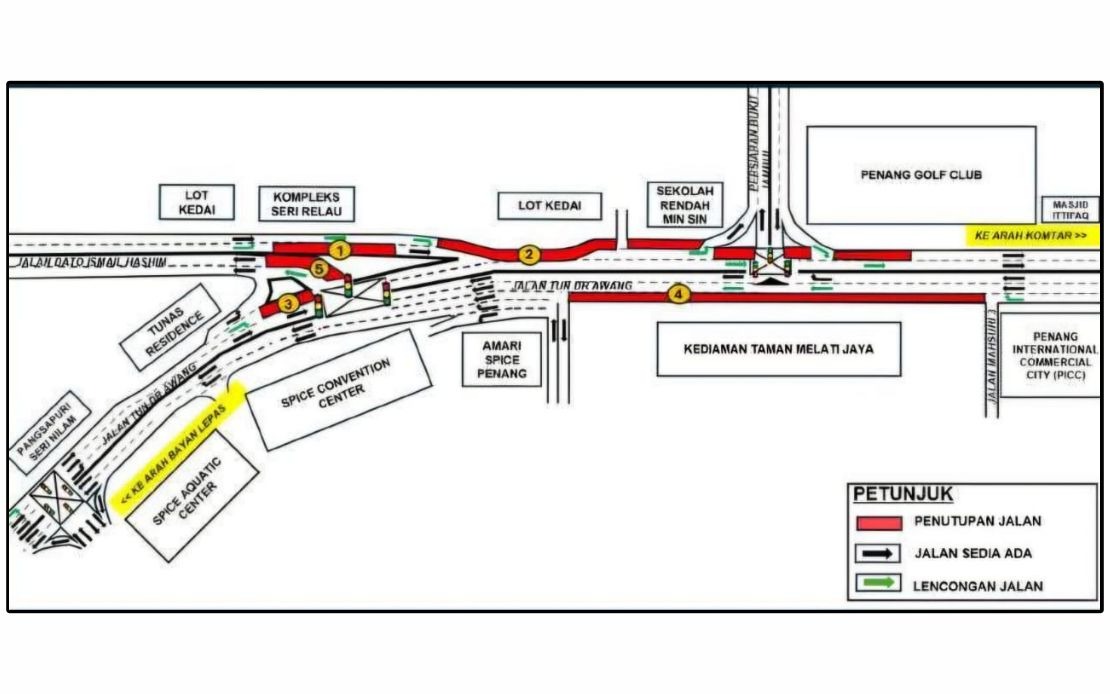
Penang motorists face an extended period of traffic disruptions as Malaysia Rapid Transit Corporation Sdn Bhd (MRT Corp) prepares to undertake essential preliminary construction works for the Mutiara Line Light Rail Transit project. The corporation announced on August 18 that a series of partial lane closures will be imposed along two major roads in George Town from August 20 through October 31, affecting traffic flow during peak business hours in the city centre.
The 72-day construction period will see controlled road restrictions operating between 8.30 am and 4.30 pm each day, creating a significant but time-limited bottleneck for commuters and commercial vehicles traversing this busy corridor. The affected stretches run between Sri Relau Complex and Penang Golf Club, two key landmarks that bracket one of the island's most congested thoroughfares. By limiting closures to daytime hours, MRT Corp appears to have balanced construction urgency with the need to maintain some traffic flow during morning and evening peak periods.
The closure strategy involves a multi-layered approach to lane management that requires careful navigation from drivers unfamiliar with the changing conditions. The right lane of Jalan Dato Ismail Hashim fronting the Sri Relau Complex in the direction of Komtar will be removed from service, while simultaneously the left lane from shop lots adjacent to SJK (C) Min Sin extending toward Penang Golf Club and continuing toward Komtar will also be closed. This dual approach to lane restrictions reflects the complexity of undertaking infrastructure works in an already densely populated urban environment.
Additional constraints will be imposed at the busy traffic light intersection where Jalan Dato Ismail Hashim meets Jalan Tun Dr Awang, where the left-turning lane heading toward Komtar will be unavailable. Further restrictions extend to the leftmost lane on Jalan Tun Dr Awang near Taman Melati Jaya residential area in the direction of Bayan Lepas. Importantly, despite these multiple simultaneous closures, MRT Corp has committed to maintaining at least one operational lane for general traffic circulation throughout the construction period.
The underlying works that justify these disruptions form part of Package CMC1 of the broader Mutiara Line initiative. Both drainage infrastructure improvements and road widening projects are scheduled concurrently, suggesting these preliminary works represent foundational preparation rather than the main civil construction that typically follows. For Penang's transportation planners, these drainage and road widening measures likely indicate that the MRT Corp has identified capacity and water management challenges that must be resolved before rail infrastructure installation can proceed safely and effectively.
The Mutiara Line represents a significant expansion of Penang's public transportation network and addresses long-standing concerns about traffic congestion in George Town and surrounding areas. This LRT initiative forms part of Malaysia's broader urban transit modernisation strategy, positioning Penang alongside Kuala Lumpur and other major urban centres investing in rail-based mobility solutions. However, the construction phase necessarily imposes short-term costs on the motoring public and local businesses that depend on unimpeded road access during these critical months.
MRT Corp has implemented comprehensive traffic management protocols to minimise chaos during the closure period. Signboards clearly marking lane closures, physical traffic cones delineating new traffic patterns, and on-site flagmen providing real-time direction will create a managed environment for drivers adapting to altered road configurations. This layered approach to traffic control reflects lessons learned from previous major infrastructure projects across Malaysia, where poor signage and inadequate traffic direction compounded commuter frustration during construction phases.
The geographic scope of these closures carries particular significance for George Town's commercial district and the numerous residents who rely on Jalan Dato Ismail Hashim and Jalan Tun Dr Awang for daily transit. Businesses along these corridors, particularly those near Sri Relau Complex and the various shop lots scheduled for lane closures, may experience reduced customer vehicle access during peak business hours. Delivery vehicles and service contractors will need to adjust their operational schedules or navigate alternative routes, potentially increasing logistics costs for businesses dependent on timely goods delivery.
For daily commuters, the closure period necessitates travel plan adjustments and potentially longer journey times for the 72-day duration. Those familiar with this corridor will need to identify alternative routes through George Town, many of which may themselves experience increased congestion as traffic redistributes away from the primary closed sections. Regional transport analysts note that construction-related traffic diversions often reveal existing capacity constraints in what drivers previously considered secondary routes, suggesting Penang's traffic network may face broader strain during this period.
MRT Corp has established communication channels for public enquiries regarding the closures, operating the MRT Careline at 1-800-88-6782 and maintaining a dedicated email address at [email protected]. These contact points provide mechanisms for residents and businesses to seek clarification on specific closure schedules, request exemptions or early access protocols for time-sensitive deliveries, and lodge complaints about traffic management implementation. Public feedback during this construction phase may inform how MRT Corp structures traffic management for subsequent phases of the Mutiara Line project.
The preliminary nature of these works suggests that more substantial and disruptive construction will follow once drainage systems are optimised and road widening is completed. Penang's transportation authorities and business community will be monitoring how effectively MRT Corp executes these initial phases, as implementation success will influence public and commercial acceptance of the more extensive disruptions anticipated during main-line construction. For Malaysian investors and developers tracking Penang's infrastructure modernisation, these preliminary works signal concrete progress on a project that has long remained in planning stages.
Motorised traffic in George Town will require enhanced patience and route flexibility from August onwards. Commuters who have not already done so should consider exploring alternative transportation modes during this period, while those dependent on vehicular access should factor additional travel time into their schedules. The temporary inconvenience represents an investment in Penang's long-term transportation infrastructure, yet the immediate challenge remains navigating the complex lane closures while maintaining traffic flow through Malaysia's oldest major city.

