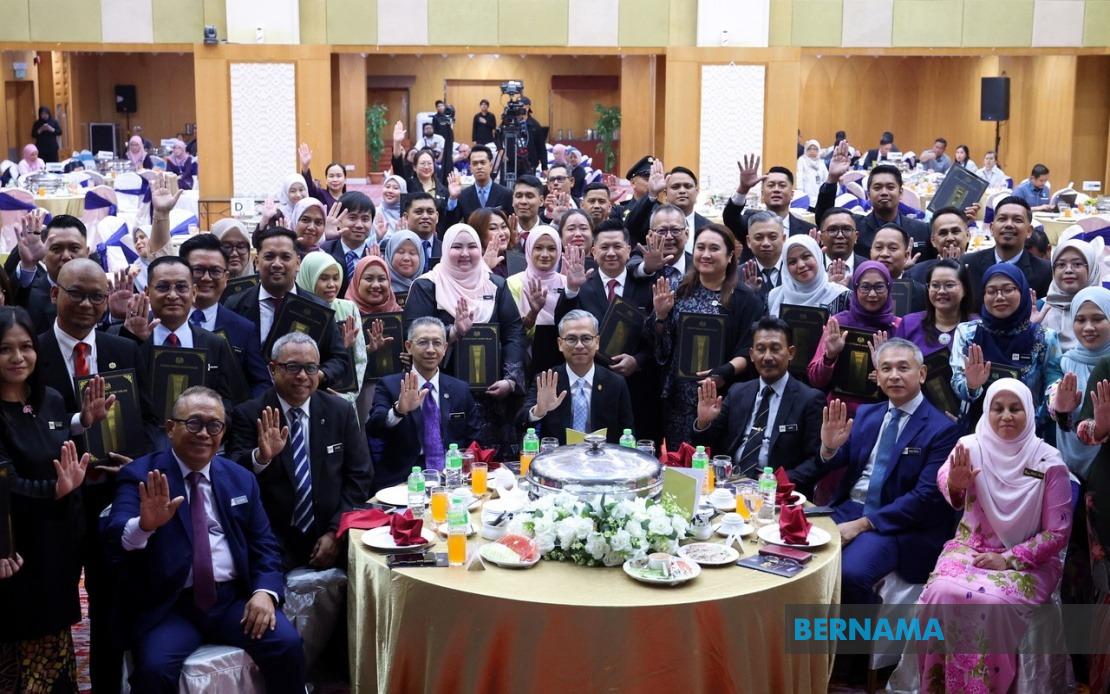
The MADANI Government's economic agenda hinges on a fundamental principle: national prosperity means little if ordinary Malaysians do not experience its benefits in their daily lives. This philosophy underpinned Communications Minister Datuk Seri Fahmi Fadzil's remarks during the Communications Ministry's Sabah and Labuan Zone Excellent Service Awards ceremony in Kota Kinabalu, where he articulated a clear distinction between headline economic figures and the lived reality of citizens.
While Malaysia's macroeconomic indicators present an encouraging picture—with robust growth across investment, government revenue, foreign reserves, gross domestic product and international trade—Fahmi insisted that these statistical achievements remain hollow without tangible impact on household finances. The gap between economic indicators and personal prosperity represents a critical vulnerability that threatens public confidence in government policy, regardless of technical success. This tension is particularly acute in a middle-income nation where rising costs of living have eroded consumer sentiment despite positive GDP growth.
Fahmi illustrated this principle through the example of diesel subsidy retargeting, an initiative branded as BUDI MADANI. The policy exemplifies how macroeconomic decisions must account for Malaysia's geographic and demographic realities. In Sabah and Sarawak, where inhabitants often must traverse extensive distances between districts, blanket subsidy policies require sophisticated geographic calibration. Prime Minister Datuk Seri Anwar Ibrahim and his cabinet have recognised this necessity, Fahmi noted, signalling that policymaking extends beyond capital-centric economic models to encompass the practical circumstances shaping people's purchasing power and mobility.
The retargeting of fuel subsidies demonstrates why the concept of "people's economy" transcends simple rhetoric. Malaysia's subsidy system historically consumed vast public resources while benefiting wealthier urban consumers disproportionately. However, rural and remote communities, where transportation costs consume a larger share of household budgets, required different policy consideration. By acknowledging geographic variance in subsidy impact, the government attempts to align economic policy with distributional equity—ensuring that policy benefits accumulate in wallets and pockets across diverse communities rather than concentrating in wealthy urban centres.
Fahmi emphasised that government ministries and agencies bear responsibility for more than policy implementation; they must ensure transparent communication about program rationale and design. Misinterpretation of economic policy—particularly subsidy changes—can generate public backlash regardless of underlying merit. The minister identified public communication as central to building consensus around potentially unpopular reforms, especially when policies require adjustment of benefits that citizens have grown accustomed to receiving. In an era of rapid information dissemination and social media amplification of discontent, poor communication strategy can undermine sound economic governance.
The emphasis on people's economy reflects broader recognition that Malaysia's political legitimacy depends increasingly on demonstrable improvements in household welfare. Previous administrations' focus on mega-projects and capital-intensive infrastructure—while generating impressive growth statistics—failed to translate into wage increases, affordable housing, or manageable cost-of-living trajectories for ordinary workers. The shift toward people-centric economics signals an attempt to reorient policymaking around issues directly affecting electoral constituencies: petrol prices, food costs, electricity bills, and employment quality.
For Southeast Asian observers, Malaysia's approach offers instructive lessons about the relationship between aggregate economic growth and political stability. Across the region, governments confront similar challenges: how to maintain social cohesion amid economic transition, technological disruption, and external shocks. The MADANI framework suggests that distributional concerns—ensuring growth benefits spread across geographic and income categories—warrant equal emphasis with aggregate output expansion.
The geographic emphasis on Sabah and Sarawak carries particular significance. These Malaysian states, separated from Peninsular Malaysia by the South China Sea, frequently experience policy implementation delays and adaptation challenges. Acknowledging their distinct transportation and logistics challenges signals renewed federal commitment to equitable regional development, a perennial concern in East Malaysian politics where perceived marginalisation has fuelled periodic tensions.
Implementing people-focused economics requires sustained attention to policy detail and local variation. Blanket national approaches often fail in diverse economies spanning urban centres, agricultural zones, and sparsely populated territories. The government's recognition that subsidy policy, infrastructure investment, and service delivery must account for these differences represents a more sophisticated governance approach than centralised, one-size-fits-all frameworks that characterised earlier periods.
Fahmi's framing of economic performance as fundamentally about lived experience—not merely statistical indicators—reflects growing global recognition that GDP growth divorced from household welfare improvements breeds political instability. Citizens increasingly scrutinise whether economic expansion translates into job security, wage growth, and affordable essential services. Government communicators must consequently bridge the gap between technical economic achievements and popular understanding, explaining how policy choices affect daily economic decisions.

