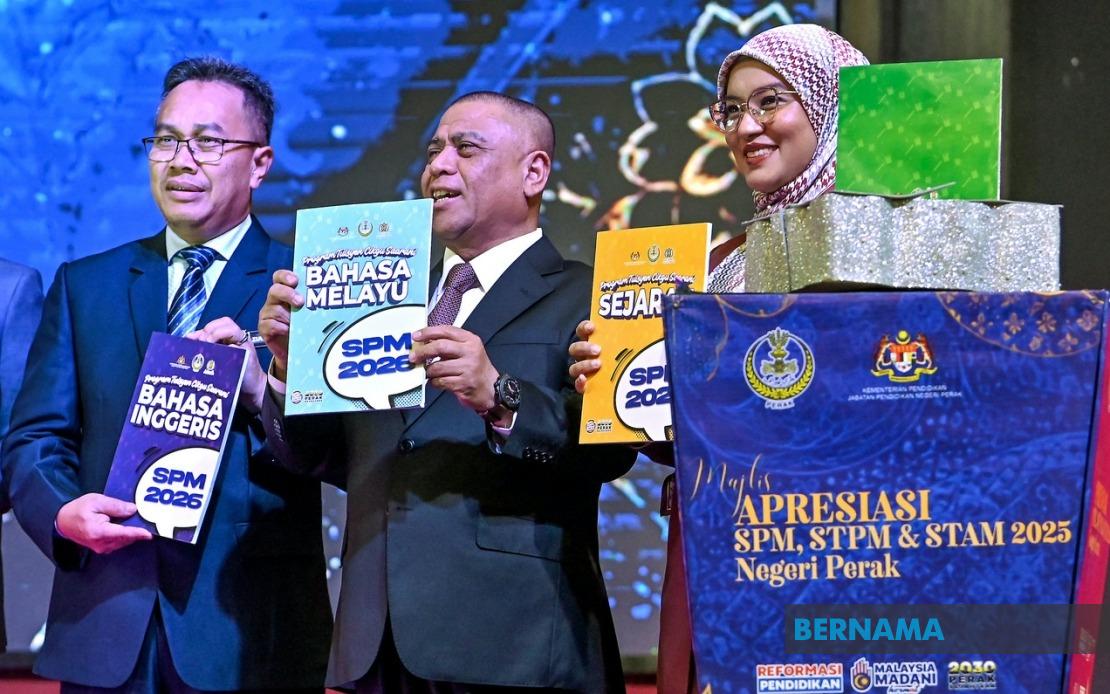
Perak has achieved its strongest performance in the Sijil Pelajaran Malaysia (SPM) examination in 13 years, with students attaining a State Average Grade (GPN) of 4.49 in the 2025 results announced this month. The accomplishment caps a sustained three-year improvement trajectory that underscores the state's commitment to raising educational standards across all demographics and geographic regions.
Menteri Besar Datuk Seri Saarani Mohamad attributed the breakthrough to coordinated efforts by educators, administrators, families, and community stakeholders working in concert to elevate the quality and accessibility of learning opportunities throughout the state. He framed the result not merely as a statistical milestone but as vindication of the strategic direction and investment decisions made by Perak's education sector in recent years. The recognition came at an official appreciation ceremony honouring top-performing students, educators, and institutions, attended by State Education Department director Zulkafli Mohamed Mokhtar and Yayasan Perak general manager Dr Nasreen Khanum Nawab Zadah Khan.
A particularly significant feature of the 2025 results lies in the narrowing of the achievement disparity between candidates in urban centres and those in rural localities. The gap now stands at merely 0.04 grade points, a dramatic tightening that reflects genuine progress toward equitable educational opportunity. For a state with Perak's geographic diversity and infrastructure challenges, this convergence suggests that policy interventions aimed at rural school improvement—whether through resource redistribution, teacher professional development, or facility upgrades—are yielding measurable returns. The implication extends beyond statistics: it demonstrates that excellence in public education is not an urban privilege but an achievable goal across varied socioeconomic contexts.
Beyond the flagship SPM examination, Perak demonstrated strength across other secondary and tertiary assessment frameworks. In the Sijil Tinggi Persekolahan Malaysia (STPM), the state achieved a Cumulative Grade Point Average of 2.91, marginally exceeding the national benchmark of 2.88. This performance assumes added weight given that STPM candidates represent the nation's most academically advanced secondary cohort, positioning themselves for university admission and professional pathways. Of particular note, 116 Perak-based candidates attained the perfect CGPA of 4.00—a distinction held by only 1,336 students nationwide—underscoring concentrated pockets of exceptional academic achievement within the state's education system.
Performance in Islamic studies qualifications also reflected breadth of excellence. Perak recorded a GPN of 3.03 in the Sijil Tinggi Agama Malaysia (STAM), with 36 candidates earning the Mumtaz distinction, the highest grade classification in that framework. This dimension of achievement is often overlooked in broader educational discourse but remains crucial for students pursuing Islamic scholarship, Islamic law, or religious education careers, reflecting the pluralistic educational ecosystem that Malaysia's examination system supports.
The Menteri Besar's remarks at the ceremony extended beyond celebrating numerical outcomes, explicitly acknowledging that examination grades represent only one dimension of a student's development and potential. He emphasised that academic success emerges from layered contributions—from classroom teachers delivering daily instruction, to parents providing home support, to broader school communities creating environments conducive to learning. This perspective guards against the reductionist tendency to treat examination results as the sole measure of educational quality or student worth, a caution particularly relevant in Southeast Asian societies where high-stakes testing sometimes overshadows holistic child development.
The ceremonial recognition of 266 recipients—comprising students, educators, schools, and District Education Offices—functioned as both celebration and incentive structure. By formalising recognition of top performers and supporting institutions, the state signals which efforts merit emulation and which outcomes warrant investment. For Malaysian educators and policymakers observing Perak's trajectory, the model suggests that sustained, coordinated focus on quality can generate measurable improvement even within a devolved education system where states operate with considerable autonomy in curriculum implementation and resource allocation.
From a regional perspective, Perak's achievement carries relevance beyond state boundaries. Malaysia's education sector has faced sustained scrutiny regarding international comparative performance, particularly concerning science and mathematics competency. State-level success stories provide proof-of-concept for approaches that higher-performing states might scale or that lower-performing states might adapt. The particular success in narrowing urban-rural gaps offers valuable evidence for regional neighbours grappling with similar geographic education challenges, notably in Indonesia and the Philippines where vast archipelagic terrain complicates equitable service delivery.
The three-year upward trend referenced by the Menteri Besar suggests underlying structural improvements rather than one-time fluctuations. Consistency across successive examination cycles indicates that policy reforms have achieved institutional embedding—teachers have integrated new pedagogical approaches, curricula have been refined, support systems have been institutionalised. This durability contrasts with temporary spikes that sometimes reflect favourable cohort composition rather than systematic improvement.
Looking forward, the challenge for Perak involves sustaining momentum while addressing any remaining inequities. The 0.04-point urban-rural gap, while dramatically compressed, still represents measurable disparity. Strategic analysis of which rural schools or districts lag behind highest performers could target further intervention. Additionally, the state might examine whether excellence clusters around certain schools or districts, potentially indicating that resource concentration or pedagogical innovation could be more broadly distributed.
For Malaysian students and families, Perak's results demonstrate that quality education across diverse contexts remains achievable within the public system. As private schooling expands and concerns about two-tier education deepen, evidence that state institutions can produce excellence and equity carries significance beyond Perak's borders, reinforcing the viability of strengthened public provision as an alternative to educational stratification.

