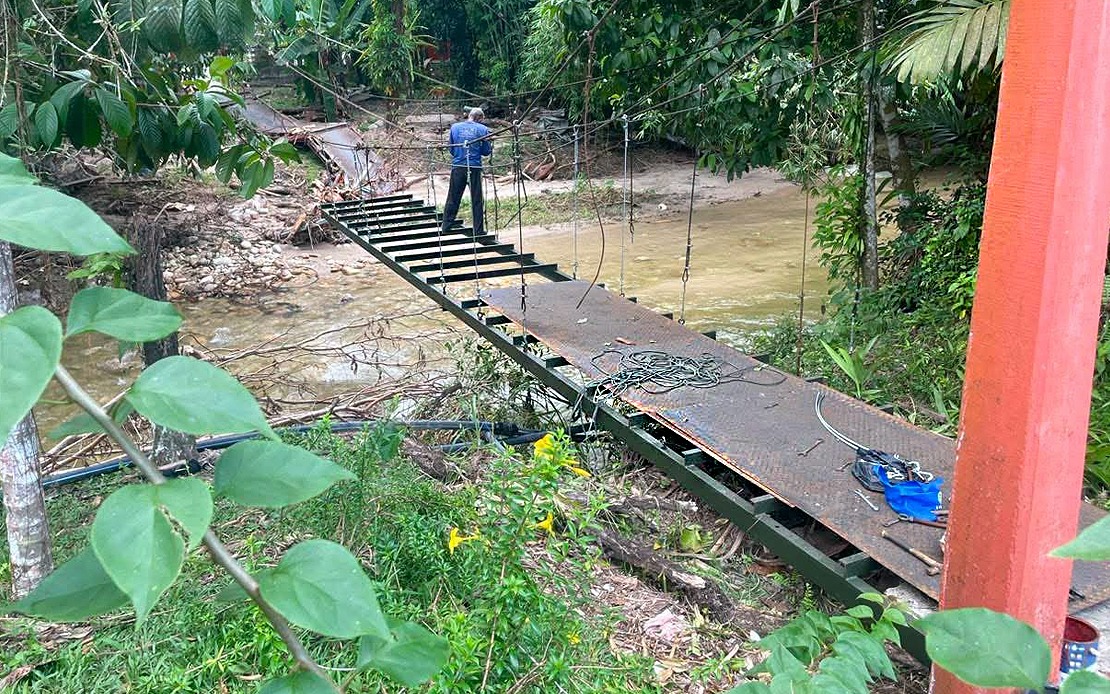
The Perak state government has committed RM500,000 towards constructing a permanent concrete bridge in Kampung Ulu Geruntum, Gopeng, rebuilding critical infrastructure destroyed when a powerful water surge swept away the village's main crossing on June 19. The allocation represents a substantial financial intervention aimed at restoring normal connectivity and economic activity to the rural settlement, which was cut off from surrounding areas after the disaster rendered its primary bridge impassable.
Sandrea Ng Shy Ching, the State Housing and Local Government Committee chairman and assemblyman for the Teja seat, announced the decision while praising the coordinated response of emergency personnel and government agencies. She emphasised that commencement of construction will proceed as soon as current remedial and stabilisation work concludes, indicating a phased approach designed to ensure site safety before major building operations commence. Her statement, issued via social media, underscored the government's commitment to accelerating the restoration timeline so affected residents can resume ordinary daily routines and reconnect with employment, commerce, and services in neighbouring towns.
The June 19 flooding event forced more than 50 inhabitants to evacuate to the Gopeng Town Hall relief centre as surging water overwhelmed the bridge structure, severing the sole vehicular route into the community. This isolation created immediate hardship—residents faced disrupted water supplies, blocked access to healthcare and markets, and economic disruption for those with livelihoods dependent on external trade. The dramatic nature of the bridge's destruction, with strong currents completely sweeping away the crossing, highlighted the vulnerability of rural infrastructure in Perak's river valleys to extreme weather events.
Recognising the urgency of the situation, authorities have pursued a dual-track recovery strategy combining emergency interim solutions with permanent reconstruction. Sandrea utilised RM45,000 from her personal constituency allocation specifically to repair damaged water pipes and restore the supply interrupted by the flood, demonstrating how local assemblyman funds can address pressing community needs beyond typical budgeting cycles. This allocation reflects a responsive governance approach where elected representatives mobilise available resources to mitigate immediate suffering while larger infrastructure projects advance through formal approval channels.
Parallel to the permanent bridge funding, the state government approved an emergency allocation of RM150,000 for construction of a temporary suspension bridge designed to reconnect the isolated settlement in the interim. This suspended structure, expected to open by mid-July, serves a critical function by restoring basic access before the concrete bridge enters its construction phase, which typically requires several months for design finalisation, material procurement, and on-site building. The suspension bridge represents a pragmatic intermediate solution acknowledging that villagers cannot remain disconnected from surrounding areas for the months required to complete permanent construction.
The total immediate investment—combining the RM500,000 permanent bridge, RM150,000 suspension bridge, and RM45,000 water infrastructure repairs—amounts to RM695,000, reflecting substantial state financial commitment to a single village crisis. For Malaysian standards, particularly in rural infrastructure development, this represents an accelerated funding decision that bypassed normal budgetary processes to address an emergency. The willingness to deploy resources rapidly signals recognition that destroyed bridges create cascading economic and social consequences extending well beyond the immediate disaster period.
Kampung Ulu Geruntum's situation exemplifies broader infrastructure vulnerabilities in rural Perak, where many communities remain dependent on single-crossing bridges over rivers prone to seasonal flooding. Climate change and increasingly volatile weather patterns have elevated risks for such isolated settlements throughout peninsular Malaysia, particularly in states where terrain concentrates populations in valleys served by limited road networks. The incident in Gopeng joins a pattern of flash-flood bridge damage across Malaysia, suggesting that infrastructure resilience and redundancy merit elevated priority in regional development planning.
The restoration project also highlights coordination between state-level government bodies and local assemblyman initiatives. Sandrea's dual role as both a Housing and Local Government Committee member and grassroots Teja representative enabled her to leverage both formal state channels for the large permanent allocation and discretionary funds for immediate water supply repairs. This multi-layered approach, combining ministerial-level decisions with constituency-level responsiveness, offers a model for how decentralised governance can address infrastructure emergencies more flexibly than purely centralised bureaucratic processes.
For residents of Kampung Ulu Geruntum, the approved funding represents both relief and a pathway toward restoration. The immediate suspension bridge opening reconnects them to markets, hospitals, schools, and employment within weeks rather than months. Simultaneously, the concrete bridge project signals that government views their settlement as meriting permanent infrastructure investment rather than temporary emergency patches. This commitment carries psychological weight beyond engineering specifications—it affirms that even remote rural communities affected by natural disasters warrant sustained institutional attention and material resources.
The recovery timeline remains provisional, contingent on weather conditions, material supply chains, and construction workforce availability—variables that have disrupted Malaysian infrastructure projects throughout 2024. However, the government's articulated commitment to expediting work, coupled with the dual-access strategy, demonstrates an intention to minimise the duration of village isolation. Success in completing both the suspension bridge by mid-July and the permanent concrete structure within a reasonable timeframe would establish a serviceable model for disaster recovery in rural areas, potentially informing protocols for future incidents across Perak and neighbouring states facing similar geographical vulnerabilities.

