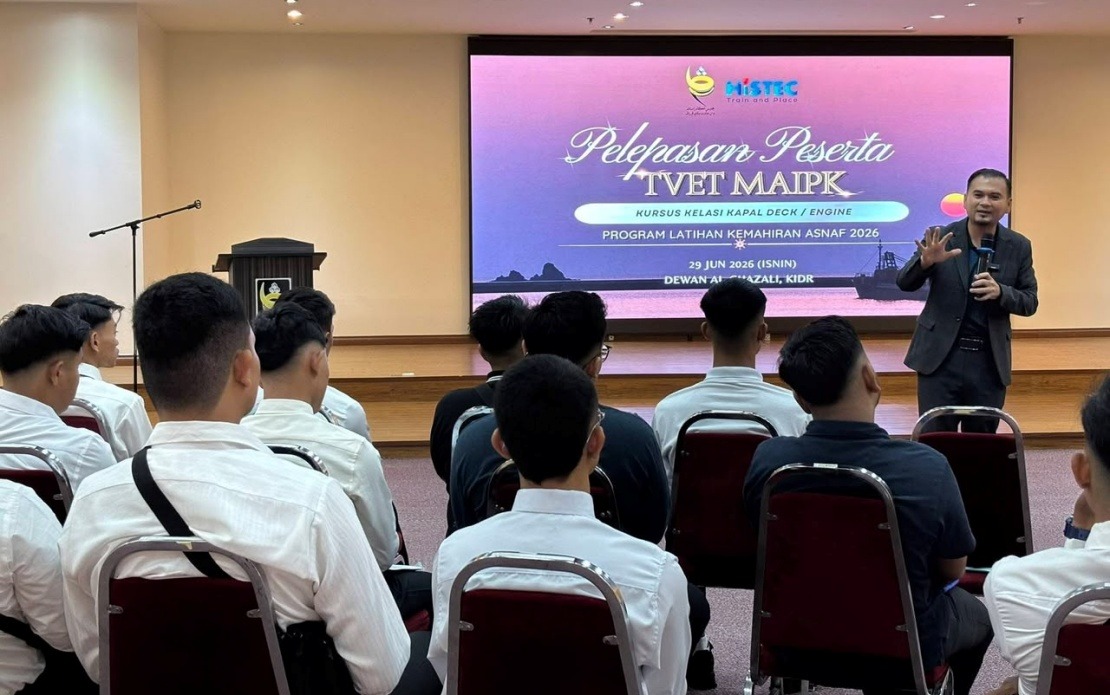
The Perak Islamic Religious and Malay Customs Council (MAIPk) is making a significant push into technical vocational education by committing RM470,000 to sponsor underprivileged youth pursuing careers in Malaysia's maritime sector. The funding will support 25 asnaf participants undertaking a specialized ship crew course covering both deck and engine operations, representing a strategic investment in human capital development within a traditionally labour-intensive industry.
The allocation—approximately RM18,800 per participant—underscores MAIPk's recognition that the maritime industry faces persistent skills shortages and that channelling funds toward vocational pathways can yield measurable socio-economic returns. Rather than focusing exclusively on university-pathway education, the council is positioning itself as a facilitator of alternative career routes that lead directly to employment and income generation, a particularly relevant approach for asnaf communities who may face financial barriers to extended tertiary study.
The three-month training programme will be conducted at the Ranaco Education and Training Institute in Chukai, Terengganu, combining classroom instruction with hands-on maritime operations. Participants will complete professional certifications and obtain a seaman's licence—credentials essential for formal entry into international and domestic shipping operations. This structured combination of theory and practical work reflects international maritime training standards and ensures graduates can compete in a globalised industry.
For Perak's asnaf population, the initiative addresses a critical gap in economic mobility. Many underprivileged communities lack exposure to skilled maritime roles, which typically offer competitive salaries and structured career progression. By removing financial obstacles and providing targeted training in a high-demand sector, MAIPk is potentially creating pathways to middle-income employment that would otherwise remain inaccessible to participants from disadvantaged backgrounds.
The employment guarantee embedded within the programme amplifies its value proposition. Upon completion, participants will transition directly into maritime positions rather than joining a crowded general job market. This placement mechanism—facilitated through MAIPk's industry partnerships—converts the training investment into concrete livelihoods, reducing post-graduation unemployment and accelerating participants' economic contribution to their families and communities.
The broader context reveals Malaysia's maritime sector facing competitive pressure from regional neighbours and international shipping operators. Investment in locally trained, skilled deck and engine crew strengthens the country's maritime competitiveness while reducing reliance on imported labour. For Southeast Asia more broadly, initiatives like MAIPk's reflect growing recognition that TVET pathways—long considered secondary to academic routes—drive inclusive economic development and address sectoral labour demands that degrees alone cannot satisfy.
MAIPk's framing of TVET as "a catalyst for socio-economic transformation" represents a philosophical shift within religious and community institutions toward identifying themselves as economic empowerment agents. Rather than limiting engagement to charitable relief, the council positions skills development as a sustainable intervention that builds human capital and dignity alongside material support. This aligns with contemporary development thinking emphasising capability building over passive assistance.
The send-off ceremony, officiated by MAIPk Asnaf Empowerment Division General Manager Amirudin Osman at Kompleks Islam Darul Ridzuan in Ipoh, provided public visibility and institutional endorsement to participants. Such ceremonial marking signals to recipients that their training is valued and formally recognized, potentially strengthening motivation and community support for the cohort.
From a Malaysian policy perspective, this initiative complements national efforts to expand TVET enrolment and address demographic trends where maritime employment increasingly attracts younger workers seeking stable, remuneration-competitive careers. Perak's investment aligns with broader state and federal priorities to diversify economic opportunities beyond manufacturing and services into skilled technical sectors critical for regional trade and logistics.
The partnership between a state religious council and a private training institution also demonstrates hybrid delivery models where public funding combines with private sector expertise. Such arrangements can scale more flexibly than purely government-operated programmes while maintaining accountability and accessibility standards. If successful, the model could serve as a template for other states and religious authorities seeking to operationalise TVET sponsorships.
Looking forward, the sustainability of such programmes depends on continued employer demand within the maritime sector and MAIPk's ability to cultivate sustained industry partnerships for placement. Market fluctuations affecting shipping volumes and crew recruitment cycles could influence future programme expansion. Nonetheless, the initial investment signals institutional confidence in both the sector's trajectory and the readiness of asnaf youth to compete in skilled maritime roles.

