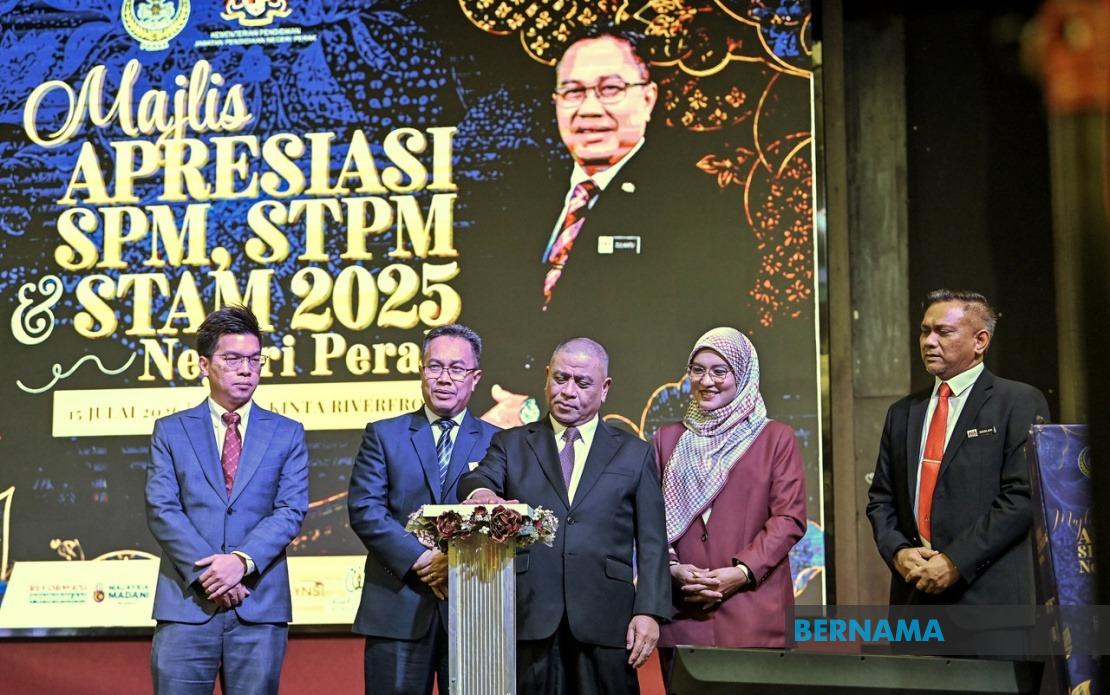
The Perak state government's Menteri Besar Scholarship programme is demonstrating tangible benefits for students navigating the financial challenges of secondary and tertiary education. The scheme, which distributes monthly assistance to qualifying candidates, has become instrumental in enabling academic achievement whilst alleviating pressure on household budgets across the state. At a state-level appreciation ceremony held in Ipoh on July 15, officials and scholarship recipients highlighted how targeted financial support catalyses educational excellence and prepares young people for university studies.
Yoong Lam, a 20-year-old graduate of Sekolah Menengah Kebangsaan Sultan Yussuff who attained a perfect Overall Grade Point Average of 4.00 in her Sijil Tinggi Persekolahan Malaysia examinations, exemplifies the programme's impact. She receives RM1,200 each semester, money she deploys strategically towards examination fees, educational texts, and private tuition. As the elder of two children with a self-employed father bearing sole responsibility for household income, Yoong Lam's scholarship represents material relief. She described the assistance as transformational for her family's finances and encouraged fellow students to pursue their studies diligently to access similar opportunities.
The scholarship's reach extends across diverse educational pathways and student backgrounds. Muhammad Haziq Hafit, 19, a graduate of Al-Ulum Al-Syar'Iyyah Religious Secondary School in Bagan Datuk, received RM1,000 assistance following exceptional Sijil Tinggi Agama Malaysia performance. He intends to channel the funds towards preparation for university entrance and subsequent studies in education at the University of Malaya. Similarly, his schoolmate Muhammad Taufiq Ikwan Mohammad Asri, also 19, views his RM1,000 award as essential groundwork for pursuing further education in Egypt. Both recipients emphasised that whilst the amounts may appear modest compared to other scholarship schemes, the assistance holds profound significance for students from middle-income households who otherwise struggle to accumulate resources for tertiary education.
Perak's educational outcomes have strengthened measurably alongside the expansion of financial and structural support mechanisms. Menteri Besar Datuk Seri Saarani Mohamad announced that the state achieved a Grade Point Average of 4.49 across the 2025 Sijil Pelajaran Malaysia results, marking the strongest performance in thirteen years and maintaining an upward trajectory for three consecutive examination cycles. Equally encouraging is the narrowing of geographic disparities. The performance gap between urban and rural candidates now stands at merely 0.04 points, suggesting that access to quality education and opportunities for excellence are becoming increasingly equitable across Perak's diverse communities.
Beyond direct scholarship payments, Perak has cultivated complementary educational interventions addressing specific learning deficits. The Tuisyen Cikgu Saarani Programme, overseen by Yayasan Perak in collaboration with the state education department, distributes specially developed reference materials designed by experienced educators. These materials synthesise curriculum analysis with practical pedagogical insight, emphasising conceptual mastery and examination technique. The programme identifies students most likely to struggle with core subjects and provides them with reinforced learning resources, concentrating support where impact is greatest.
The scale of this reference book initiative has expanded notably. Nearly 63,567 copies have been distributed to standard secondary school students statewide, with a particular focus on candidates identified as requiring supplementary guidance. This distribution benefits approximately 25,000 students preparing for the 2026 SPM examinations. Critically, the programme's scope has broadened this year to encompass tahfiz schools and Islamic religious secondary institutions, reaching students within faith-based educational streams traditionally served by distinct institutional frameworks. This expansion, executed under the Perak Islamic Religious Department's oversight, signals a coordinated strategy to raise achievement standards uniformly across all secondary pathways.
Education director Zulkafli Mohamed Mokhtar attributed portions of recent SPM improvements to these structured interventions. The reference materials represent informed responses to localised learning challenges within Perak's student population rather than generic solutions. Their development process involved systematic analysis of examination performance data, identification of recurrent conceptual weak points, and pedagogically sound remediation strategies. By anchoring support to evidence-based assessment of student needs, rather than imposing one-size-fits-all approaches, Perak has cultivated more effective academic infrastructure.
The scholarship programme's existence reflects broader state recognition that financial barriers significantly constrain educational attainment among capable students. Households where parents engage in self-employment, informal commerce, or receive modest wages frequently lack reserves to meet schooling costs—examination fees, textbooks, tuition fees, and university application charges accumulate substantially. Without intervention, students from such backgrounds may forego tuition, restrict their subject choices, or abandon further education despite demonstrating academic capability. By removing or substantially reducing these financial obstacles, Perak directly addresses a critical impediment to educational mobility and talent development.
The implications extend beyond individual student success. Regional educational competition has intensified across Southeast Asia, with national governments competing to develop skilled workforces capable of attracting high-value investment and driving economic diversification. States that systematically identify and support academically talented students—irrespective of family income—gain cumulative advantages. Perak's approach, concentrating resources on students with demonstrated potential across all socioeconomic strata, represents rational investment in human capital development. The narrowing urban-rural achievement gap particularly suggests that dispersed, deliberate investment in peripheral communities yields measurable outcomes.
For Malaysian policymakers observing Perak's trajectory, the state's integration of direct financial assistance with targeted academic support offers instructive lessons. Scholarship programmes alone, without accompanying pedagogical interventions, may prove insufficient if underlying capability deficits remain unaddressed. Conversely, tuition and reference materials require adequate student engagement, which may falter if participants battle concurrent financial anxiety. The strategic pairing of income support, specialised learning materials, and programme coordination across educational institutions appears to generate synergistic effects exceeding isolated initiatives' impact.
The long-term significance of Perak's achievements depends partly on sustained commitment and resource allocation as programmes mature. Maintaining 13-year performance records requires continued investment and ongoing refinement based on emerging data. The expansion into religious educational pathways signals responsiveness to constituencies previously receiving differentiated policy attention. These institutions educate substantial student populations within Perak and nationwide; their systematic inclusion within excellence initiatives represents both practical policy adjustment and symbolic acknowledgment of diverse educational values across Malaysian society.
As other Malaysian states contemplate educational enhancement strategies, Perak's experience demonstrates that targeted, multi-dimensional approaches addressing financial, pedagogical, and systemic barriers simultaneously yield measurable results. The scholarship recipients—Yoong Lam, Muhammad Haziq Hafit, and Muhammad Taufiq Ikwan Mohammad Asri—represent success emerging from deliberately designed institutional support. Their testimonies underscore how strategic state investment transforms abstract policy objectives into tangible life prospects, enabling capable students to fulfil academic potential and transition successfully towards productive adult roles.

