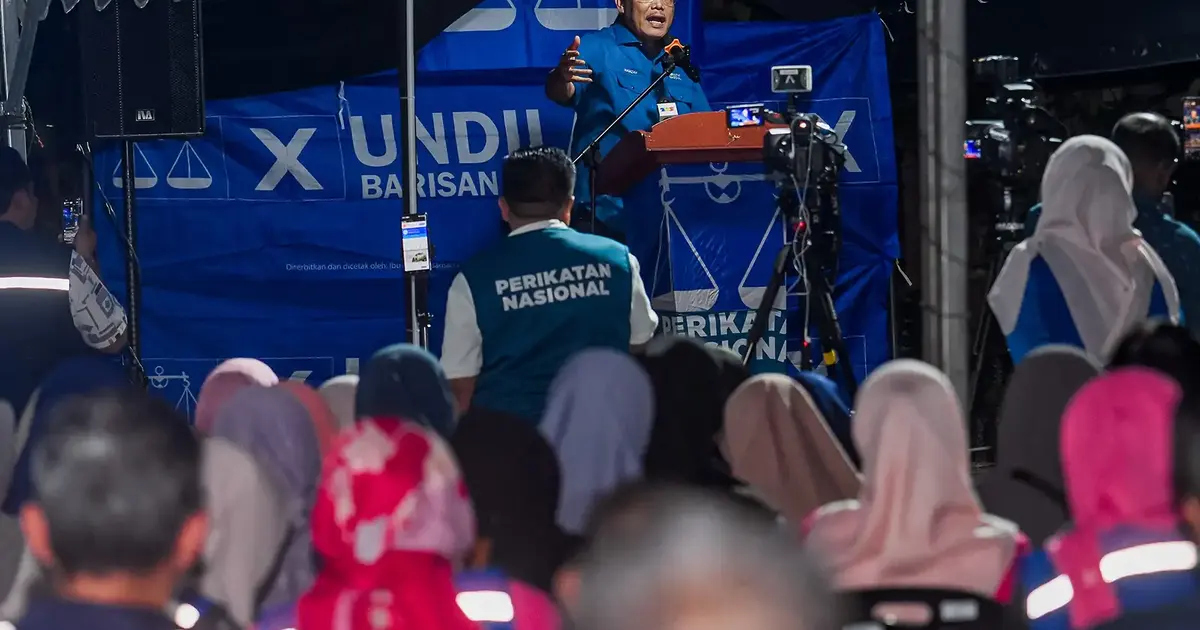
Perikatan Nasional president Hamzah Zainudin has suggested branding the coalition between his party and Barisan Nasional as "Perikatan Barisan Nasional" ahead of their joint bid in the Negeri Sembilan state election scheduled for August 1. The proposal aims to present a unified front under a single identity while respecting the institutional roles of both blocs, with PN signalling its willingness to cede the chief minister's post to BN should their combined campaign prove victorious.
The nomenclature reflects an evolving political landscape in Malaysia where traditional rivals have increasingly found common ground at state and national levels. Rather than competing separately, the two coalitions have opted for strategic cooperation, a move that underscores the pragmatic calculations dominating contemporary Malaysian electoral politics. This arrangement in Negeri Sembilan follows similar patterns observed in other state governments where both PN and BN components govern together in varying configurations.
For Negeri Sembilan specifically, the electoral arithmetic appears to favour a coordinated approach. The state assembly comprises 36 seats, and neither coalition individually commands sufficient strength to govern comfortably without the other. By presenting themselves as a single entity under the "Perikatan Barisan Nasional" banner, they eliminate vote-splitting risks that could allow a third force to emerge as kingmaker. This consolidation strategy has become increasingly common across Malaysian states as political fragmentation grows.
The agreement regarding BN's leadership of the state government, should they prevail, represents a calculated concession by PN. By publicly acknowledging this arrangement beforehand, PN demonstrates flexibility and a commitment to power-sharing that may appeal to voters concerned about political instability. It also allows BN, still the numerically larger coalition despite recent electoral setbacks, to maintain its historical claim to lead the state after Negeri Sembilan has been a BN stronghold for decades.
For Malaysian voters, particularly those in Negeri Sembilan, this development signals that traditional party loyalties have become subordinate to coalitional mathematics. The creation of a joint identity suggests both parties view the upcoming election less as an ideological contest and more as a competition for state resources and federal funding access. This transactional approach reflects broader governance realities where state administrations increasingly depend on federal support for infrastructure and development programmes.
The PN-BN pact also carries implications for the broader national political balance. By demonstrating cooperation at the state level, both coalitions reinforce their ability to work together when necessary, potentially influencing negotiations around federal support and parliamentary stability. This flexibility contrasts with the more adversarial positioning during federal-level contests, highlighting how Malaysian politics now operates across multiple competitive arenas simultaneously with varying cooperative arrangements.
From a regional perspective, Negeri Sembilan's election represents a testing ground for similar coalitional arrangements that may be replicated elsewhere. Southeast Asian political systems generally have moved toward coalition-building given increasingly fragmented electorates, and Malaysia's experience provides a case study in how diverse political actors can navigate power-sharing agreements. The "Perikatan Barisan Nasional" branding itself demonstrates the creative institutional engineering required to maintain political viability in such environments.
The timing of this announcement matters strategically as campaigning intensifies. By establishing the chief minister arrangement upfront, the PN-BN coalition removes a potential source of dispute that could undermine voter confidence or party morale. Voters who support either component party can be assured about post-election governance structure, reducing uncertainty that might otherwise drive them toward opposition alternatives promising clearer mandates and streamlined administration.
However, the success of this arrangement depends heavily on implementation. Should the "Perikatan Barisan Nasional" win the August 1 election, the actual functioning of state government will reveal whether such power-sharing can operate smoothly or whether underlying tensions between PN and BN resurface. The stability of any coalition government relies on both parties respecting agreed protocols, maintaining sufficient ideological flexibility, and prioritising collective governance goals over factional interests—a challenging balance in Malaysian politics where party machinery often responds more readily to central leadership signals than to coalition discipline.
The Negeri Sembilan contest thus becomes more than a local electoral exercise. It represents a statement about how Malaysian politics is evolving: toward institutionalised coalitions that transcend traditional rivalries, toward pragmatic power-sharing arrangements that prioritise stability, and toward branding strategies that attempt to paper over diverse political identities under unified nomenclature. Whether "Perikatan Barisan Nasional" becomes a permanent fixture in Malaysian political terminology or merely a temporary election-time construct will depend on how effectively the coalition operates post-August 1.

