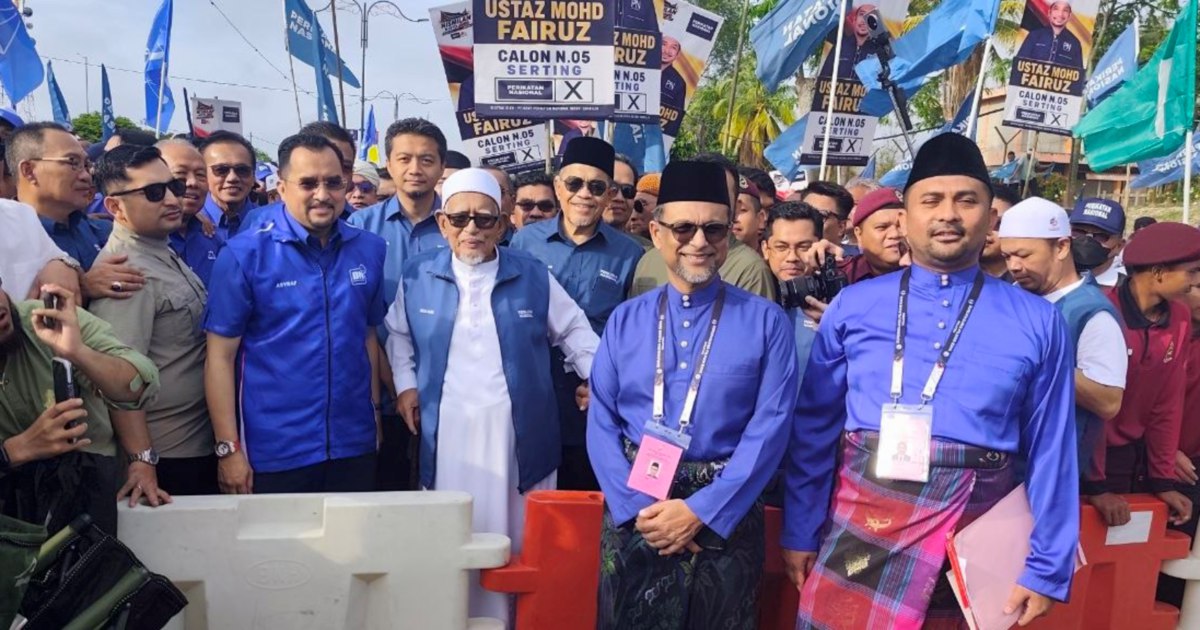
Perikatan Nasional will throw its organisational muscle behind Barisan Nasional's campaign efforts in the forthcoming Negri Sembilan state election, PAS president Tan Sri Abdul Hadi Awang announced whilst campaigning in Jempol. The commitment signals a continuation of the electoral alliance between the two coalition blocs that has shaped Malaysian politics since the 2023 general election, with PAS leaders prepared to mobilise their party apparatus across the central state to strengthen BN's position during the polls.
The pledge represents a tactical decision by the Islamist party to maintain cohesion within the broader reform-oriented coalition that currently dominates federal governance. Since the realignment of Malaysian politics following the 2023 national elections, which saw the unexpected emergence of a Unity Government bringing together traditional rivals, the dynamics of state-level competition have become increasingly complex. Negri Sembilan, a relatively compact state with significant Klang Valley commuter influence, presents both opportunities and challenges for incumbent administrations seeking to maintain voter confidence.
From a strategic perspective, Perikatan Nasional's commitment to assist BN reveals the degree to which these two entities now view themselves as complementary rather than competitive forces in mainstream Malaysian politics. The decision carries particular weight given that PAS commands substantial grassroots organisation throughout the peninsula, with volunteer networks and community connections that have historically proven effective in mobilising support during elections. This ground-level infrastructure could prove decisive in swaying marginal constituencies where traditional party machinery may face fatigue or reduced resources.
The announcement also reflects calculations within Perikatan Nasional regarding the sustainability of the current political settlement. Malaysian state elections typically serve as mid-term assessments of federal government performance, and maintaining BN's position in Negri Sembilan would provide crucial momentum heading toward the next general election. A reversal in BN's control of the state would signal broader dissatisfaction with the current federal coalition and potentially embolden opposition parties seeking to portray the Unity Government as vulnerable to grassroots rejection.
For Barisan Nasional itself, the external support from Perikatan Nasional provides meaningful relief to campaign operations that must stretch limited resources across multiple constituencies. BN's traditional organisational strength has faced erosion over successive electoral cycles, with younger voters increasingly receptive to alternative political messaging and demographic shifts creating new electoral challenges in urban and semi-urban areas. Partner support effectively extends BN's campaign reach whilst allowing the coalition to concentrate its own resources on constituencies deemed most competitive or vulnerable.
The Negri Sembilan context merits particular attention given the state's economic profile and voting patterns. Located within Malaysia's manufacturing heartland and serving as a commuter basin for workers travelling to Kuala Lumpur and Selangor, the state encompasses diverse constituencies with competing political interests. Urban-based voters demonstrate different electoral preferences compared to residents in rural and semi-rural areas, requiring campaigns capable of addressing hyperlocal concerns whilst articulating broader state-level development priorities.
Within PAS specifically, the decision to assist BN reflects the party's positioning as a stabilising force within the Unity Government framework. Unlike the opposition, which benefits from projecting cohesion against an incumbent coalition, Perikatan Nasional must continually demonstrate that collaborative governance produces tangible benefits for voters. By visibly supporting BN during state elections, PAS leaders reinforce messaging that the broader federal coalition operates as an integrated entity capable of delivering governance dividends across multiple jurisdictions.
The campaign assistance announcement also carries implications for Perikatan Nasional's internal politics and its relationship with other coalition members. The provision of grassroots support signals PAS's commitment to the stability of the current federal arrangement, potentially dampening intra-coalition tensions and reinforcing discipline among party members who might otherwise contemplate electoral experimentation. In Malaysian politics, where coalition dynamics prove notoriously fluid, such public displays of loyalty serve important functions in binding coalition partners to shared objectives.
Looking forward, the effectiveness of this cross-coalition campaign assistance will likely influence calculations regarding future electoral cooperation. Should BN perform well in Negri Sembilan with visible Perikatan Nasional support, the success may validate further collaboration in upcoming state elections and strengthen the case for extending the Unity Government framework. Conversely, disappointing results could trigger reassessments regarding the utility of such partnerships and potentially accelerate discussions about future political realignment as the next general election approaches.

