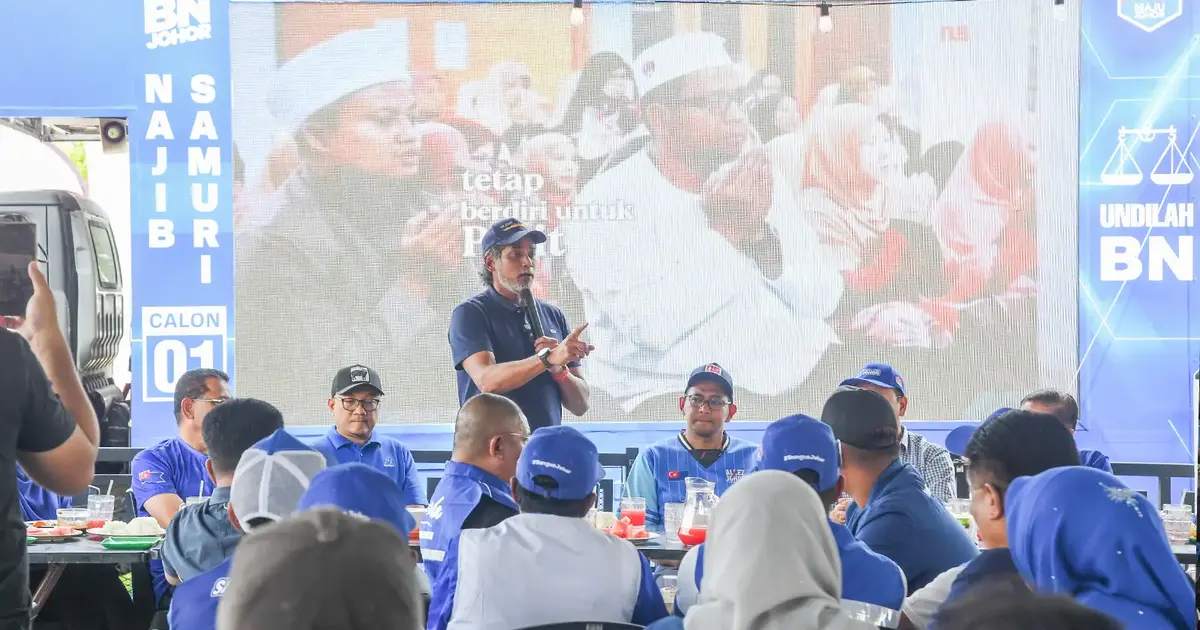
Khairy Jamaluddin has set a notable precondition for any televised confrontation between Johor's political leadership, asserting that Pakatan Harapan must nominate its prospective menteri besar candidate if the coalition wants Johor Barisan Nasional chairman Onn Hafiz Ghazi to participate in a public debate. The former Umno Youth chief's position underscores the significant protocol expectations surrounding high-level political engagements in Malaysia, where candidate selection and symbolic positioning carry substantial weight in campaign narratives and voter perception.
The demand reflects a broader principle in Malaysian electoral politics: debates between senior party figures typically involve contenders of parallel political stature and claimed legitimacy. By insisting that Pakatan Harapan field its designated menteri besar hopeful, Khairy is essentially framing Onn Hafiz as Johor's incumbent or presumptive leader whose authority warrants engagement only with an equivalent counterpart. This positioning strategy serves multiple purposes—it establishes Onn Hafiz as the state-level focal point of Barisan Nasional's electoral machinery whilst simultaneously questioning whether Pakatan Harapan has a clearly identified, credible alternative leader ready to articulate the coalition's vision for Johor's governance.
The statement carries particular significance in the context of Johor's political landscape, where the state has traditionally been viewed as a Barisan Nasional stronghold, though recent electoral cycles have demonstrated increasing electoral volatility across Malaysia. Johor held elections in 2018, and the political terrain has shifted considerably since then. By raising the bar for debate participation, Khairy is implicitly challenging Pakatan Harapan to demonstrate institutional clarity about its leadership direction in the state—a vulnerability that opposition coalitions frequently face in multi-ethnic, competitive constituencies where voters seek assurance about alternative governance arrangements.
The debate framework also highlights how Malaysian political contests operate through carefully calibrated symbolic exchanges. Television debates, though not yet as institutionalised as in Western democracies, have become increasingly important mechanisms for candidates to establish credibility and differentiate policy platforms. Khairy's insistence on matching seniority levels reveals how political parties strategically deploy such forums to either elevate or marginalise rival candidates. If Pakatan Harapan fields a lower-ranking figure, it risks appearing secondary or lacking confidence; conversely, fielding the prospective menteri besar validates both the candidate's stature and the coalition's seriousness about contesting Johor.
For Malaysian voters and political analysts, this development signals intensifying preparations for potential state-level contests. Although no election date has been announced, political manoeuvrings in Johor typically precede formal campaign periods by several months. Such preliminary positioning—including debate negotiations—allows parties to gauge public appetite, test messaging, and identify candidate vulnerabilities before the official campaign commences. Khairy's statement therefore functions as an early signalling device, communicating Barisan Nasional's confidence in Onn Hafiz's candidacy whilst simultaneously prodding Pakatan Harapan to clarify its own electoral strategy and leadership choices.
The regional implications merit consideration as well. Johor's political trajectory influences broader Malaysian electoral dynamics given the state's size, population, and historical significance as a Barisan Nasional bastion. Any meaningful shift in Johor's political complexion could reshape federal coalition calculations and parliamentary mathematics. By establishing stringent debate protocols, Khairy is subtly reinforcing narratives of Barisan Nasional strength and organisational readiness, implicitly suggesting that the ruling coalition operates from a position of institutional confidence and established hierarchy—factors that candidates and political strategists believe resonate with voters seeking stability and clear governance frameworks.
Khairy's background as a prominent Umno intellectual and former ministerial figure lends particular weight to his statements. His intervention in the debate discussion is not merely procedural commentary but rather a calculated political message from someone with considerable party authority and public platform visibility. Through this demand, he shapes media narratives, sets expectations for Pakatan Harapan's response, and demonstrates Umno's continued focus on state-level political consolidation even as federal political arrangements remain subject to ongoing coalition negotiations.
The debate condition also reflects evolving sophistication in Malaysian campaign strategy. Rather than simply refusing engagement or dismissing opposition challenges, Khairy frames a conditional acceptance that serves Barisan Nasional's strategic interests. This approach—establishing criteria for participation rather than declining outright—appears more collaborative whilst effectively controlling the parameters of public discourse. It places the onus on Pakatan Harapan to either accept the terms, thereby legitimising Onn Hafiz's position and demonstrating the coalition's leadership clarity, or to reject the debate framework, potentially inviting accusations of electoral reluctance or internal disorganisation.
Moving forward, Pakatan Harapan's response to this demand will provide important signals about the coalition's confidence levels, internal decision-making processes, and strategic priorities in Johor. Whether the opposition designates a prospective menteri besar candidate, counters with alternative debate proposals, or declines engagement will shape initial perceptions of the competing visions for state governance. In Malaysia's increasingly competitive electoral environment, such preliminary negotiations frequently foreshadow substantive policy contests and reveal the depth of each coalition's preparation and organisational readiness for upcoming electoral contests.

