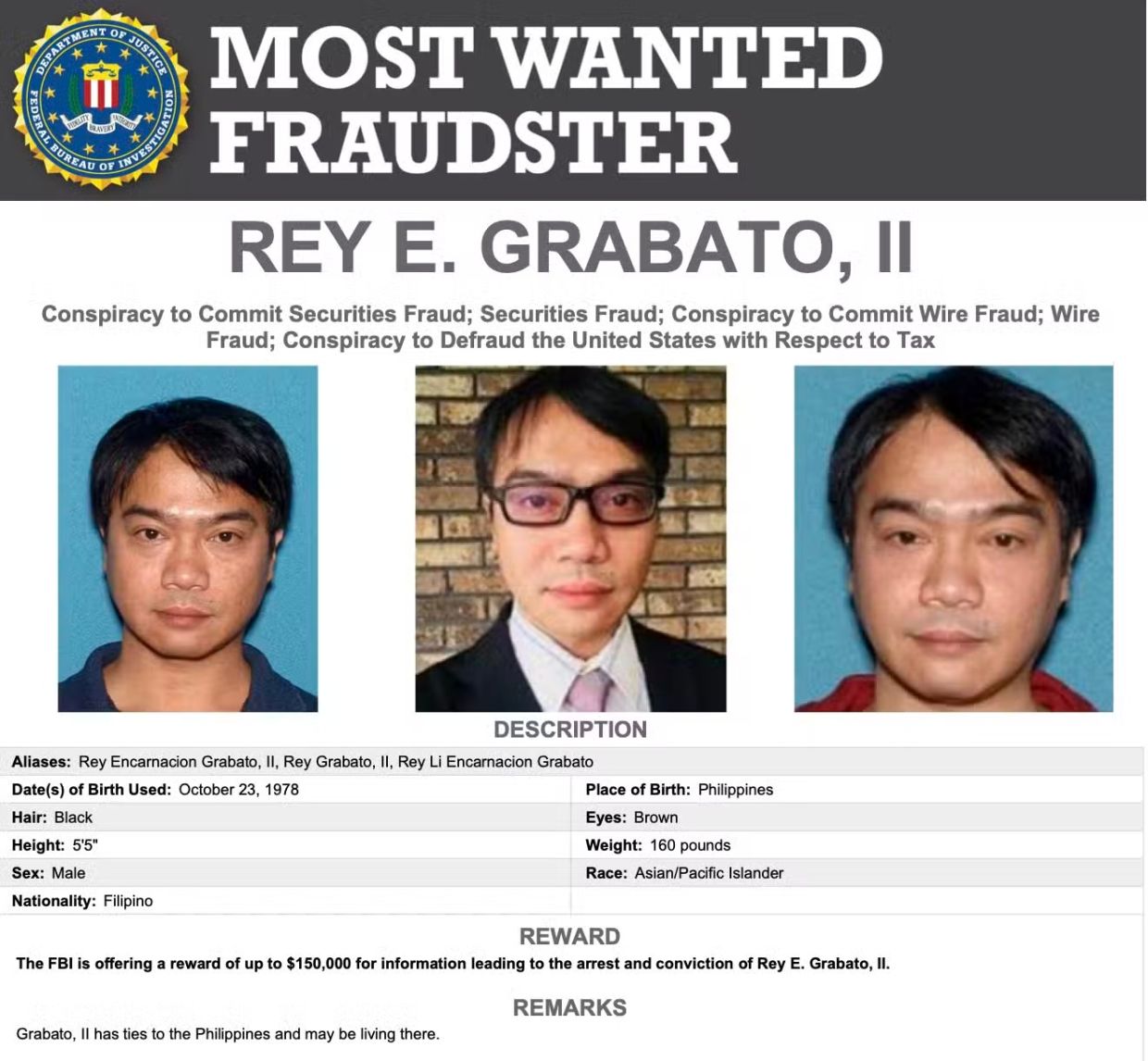
An American-based fugitive with ties to the Philippines has become one of the most prominent faces in the Federal Bureau of Investigation's crackdown on international fraud, highlighting the growing challenge of combating large-scale investment scams that cross borders and jurisdictions. Rey E. Grabato II, whose father served as mayor of Mina in Iloilo province and whose mother also held the same municipal position, now appears on the FBI's Most Wanted Fraudsters list following allegations that he orchestrated one of the largest Ponzi schemes in recent memory, defrauding approximately 2,000 investors of more than US$650 million between February 2018 and January 2022.
The scale of the alleged conspiracy extends far beyond a single state, with federal prosecutors documenting how Grabato and his co-conspirator Thomas Nicholas Salzano deployed sophisticated marketing techniques to lure victims across the United States, including hundreds specifically targeted in New Jersey. The marketing apparatus underlying the scheme reveals the methodical nature of the operation: thousands of emails combined with television advertisements, radio spots, and billboard campaigns created a veneer of legitimacy that convinced investors the enterprise was sound and profitable. Promotional presentations and investor roadshows further cemented an image of a thriving real estate fund, when the reality was far more sinister.
According to federal prosecutors, the structure of the scheme followed the classic Ponzi model, whereby National Realty Investment Advisors LLC, or NRIA, generated minimal profits but maintained the illusion of success by using capital from newly enrolled investors to pay earlier participants. This mechanism, which has plagued investors since Charles Ponzi's scheme nearly a century ago, remained devastatingly effective in this case because it exploited both technological sophistication and basic human trust. As the scheme deteriorated, Grabato and his associates allegedly siphoned millions in investor funds for their own use, compounding the fraud with outright theft.
Grabato's alleged malfeasance extends beyond investment fraud into the realm of tax obstruction, according to the indictment filed in the US District Court for the District of New Jersey. Federal prosecutors allege that from November 2007 through August 2022, Grabato participated in a separate conspiracy to impede the Internal Revenue Service's collection efforts on approximately US$26 million in tax liabilities owed to the federal government. This dual-track criminal enterprise suggests a pattern of systematic defiance of American legal and financial systems rather than isolated wrongdoing.
The fugitive, identified at the time of arrest warrant issuance in October 2022 as residing in Hoboken, New Jersey, has utilised multiple aliases to obscure his identity and movements. The FBI documentation lists him as Rey Encarnacion Grabato II, Rey Grabato II, and Rey Li Encarnacion Grabato, reflecting an apparent strategy to compartmentalise his criminal activities and complicate law enforcement tracing. His Philippine connections, combined with residency in the United States, have likely afforded him opportunities to exploit gaps in international cooperation and extradition protocols, contributing to his ability to remain at large despite the federal warrant issued over two years ago.
While his co-conspirator Thomas Nicholas Salzano was apprehended in October 2022, Grabato evaded capture and subsequently earned placement on the FBI's Most Wanted Fraudsters list, a roster that the bureau formally launched in June 2024 to heighten public awareness of major fraud fugitives. The FBI's decision to create this dedicated watch list underscores the agency's determination to elevate fraud cases to the same investigative priority previously reserved for violent crimes and terrorism offences. By offering a reward of up to US$150,000 for information leading to Grabato's arrest and conviction, federal authorities hope to leverage public engagement in apprehending high-profile financial criminals.
Grabato's inclusion on the Most Wanted Fraudsters list places him alongside other individuals with Filipino heritage and connections, including Michael Lizaso Marasigan, a dual Filipino-American citizen with ties to Guam, who was convicted in May 2025 on charges spanning illegal gambling, money laundering, and wire fraud. The pattern reflects both the sophistication of perpetrators operating across the Pacific and the vulnerability of diaspora communities to exploitation by fellow ethnic networks that cultivate trust through cultural affinity and perceived legitimacy.
The Grabato case carries particular significance for Southeast Asian readers given the proliferation of investment schemes marketed throughout the region, often leveraging connections to overseas Filipino workers and their remittances. Philippine authorities and their regional counterparts in Malaysia, Singapore, and Indonesia have grown increasingly concerned about transnational fraud rings that exploit cultural and familial networks to distribute fraudulent investment products. The case demonstrates how individuals with municipal or political connections can leverage perceived legitimacy to establish criminal enterprises that operate at scales far exceeding traditional financial fraud.
For investors who may have encountered NRIA solicitations or marketing materials, the discovery that the enterprise was fraudulent vindicates concerns about the organisation's sustainability and profit claims. Federal prosecutors documented that the company's aggressive marketing strategy—particularly its nationwide campaign targeting New Jersey specifically—masked the absence of genuine revenue generation mechanisms. The predatory nature of the scheme becomes evident when considering that the largest losses often fell upon middle-class investors, retirees, and small-business owners seeking reliable returns through apparently legitimate vehicles.
The ongoing investigation into Grabato's whereabouts remains active through the FBI's field offices and through diplomatic channels including US embassies and consulates throughout the world. Given his apparent access to resources and international mobility, investigators suspect he may be residing in jurisdictions with weak extradition treaties or enforcement cooperation mechanisms. The alleged sophistication of his previous operations—including the tax evasion conspiracy spanning fifteen years—suggests Grabato possesses both the financial means and operational knowledge to evade detection in multiple countries simultaneously.
As the FBI continues its pursuit of Grabato, the case underscores the necessity for enhanced international cooperation on financial crimes, particularly those involving diaspora communities and cross-border networks. Malaysian and other Southeast Asian authorities should note the investigative findings, which reveal how investment schemes can operate at scale while maintaining a facade of legitimacy through strategic marketing and the exploitation of community trust. The US$150,000 reward offered by American authorities for actionable intelligence represents an opportunity for individuals possessing information about Grabato's whereabouts to contact either local FBI offices or the nearest US embassy or consulate with knowledge that could facilitate his apprehension and the commencement of his trial.

