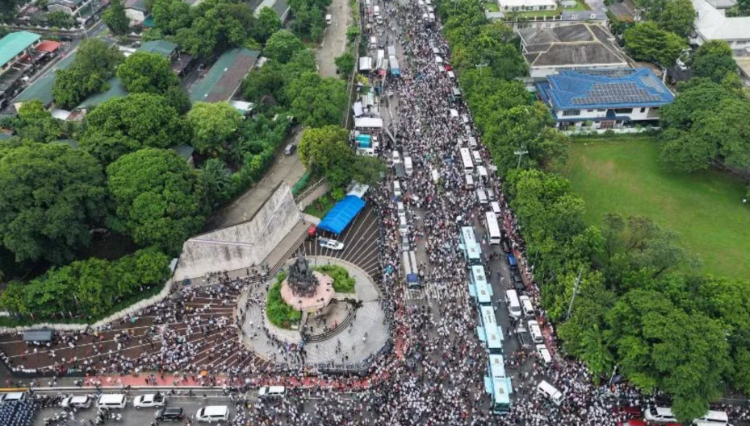
Thousands of followers of the Iglesia Ni Cristo descended on Manila's main thoroughfare on Tuesday, creating gridlock across the metropolitan area as the influential religious group staged a show of force against planned legal action targeting one of their own. The demonstration, which drew at least 8,000 people with police anticipating further growth throughout the day, paralysed traffic on the EDSA corridor and hampered the morning commute for workers and students alike. The timing of the rally carried unmistakable political significance, arriving just hours after government authorities announced that Senator Rodante Marcoleta would face graft charges relating to his alleged failure to declare 75 million pesos in unspent campaign funds.
Marcoleta's predicament sits at the intersection of legal accountability and factional politics within the Philippines' complex power structure. As a longtime member of the Iglesia Ni Cristo and steadfast supporter of impeached Vice President Sara Duterte, the senator occupies a crucial position heading into Duterte's Senate trial, scheduled to commence on 6 July. In a chamber of 24 senators, prosecutors require 16 votes to convict and remove her from office, and political observers widely regard Marcoleta as virtually certain to vote against conviction. His potential imprisonment before or during the trial would alter the numerical calculus significantly, a calculation that likely explains the INC's urgent mobilisation of its membership.
The Iglesia Ni Cristo has wielded considerable electoral influence throughout Philippine politics, particularly maintaining deep connections to the Duterte political dynasty across multiple election cycles. The sect's decision to organise a major public demonstration reflects the high stakes involved in protecting one of its members while simultaneously sending a message about the political consequences of pursuing legal cases against individuals aligned with their preferred candidates. By mobilising its supporters visibly and disruptively, the organisation demonstrated both its operational capacity and its willingness to employ grassroots pressure as a political tool.
In a Facebook message, INC spokesman Edwil Zabala framed the gathering as a defence of justice principles rather than partisan politics, claiming the rally aimed to highlight concerns about selective prosecution. Zabala declared that even imprisonment would not silence demands for impartial justice, and asserted that the group would not tolerate what it characterised as unequal application of legal standards. This rhetorical positioning allowed the sect to present its political interests as principled advocacy for broader notions of fairness, though the selective nature of the sect's mobilisation—concentrating specifically on one senator's case—suggested more focused factional motivations.
The charges against Marcoleta form part of a broader pattern affecting Duterte-aligned politicians facing legal jeopardy. Government Ombudsman Jesus Remulla initiated the case based on undeclared campaign contributions, adding another layer to mounting legal troubles for the former president's political network. Senator Jose Estrada faced separate corruption charges the previous month related to a massive flood control scandal that provoked widespread public outrage. Meanwhile, another prominent Duterte ally, Senator Ronald Dela Rosa, had fled the country to escape arrest on an International Criminal Court warrant stemming from his involvement in the drug war conducted during Rodrigo Duterte's presidency. This cumulative legal pressure on the former president's supporters suggested a deliberate prosecutorial strategy to weaken Duterte's political foundation.
For Malaysian observers, the INC's mobilisation offers instructive parallels regarding how religious organisations can function as political entities in Southeast Asian democracies. The sect's previous activism demonstrates its capacity to organise rapidly around political causes: in November, the INC had rallied hundreds of thousands to address the flood control scandal, and in January, they staged an enormous gathering opposing Duterte's impeachment. These demonstrations suggest that religious organisations in the region possess organisational infrastructures and member loyalty networks that rival or exceed conventional political parties, creating alternative channels through which political interests can be advanced and public opinion shaped.
The escalating legal vulnerabilities facing Duterte's allies must be understood within the broader context of her public dispute with President Ferdinand Marcos. Once united within a political coalition, the two leaders have experienced a dramatic falling out that has transformed the legislature into an arena of factional struggle. Duterte's impeachment by the House of Representatives last month, following the Supreme Court's reversal of an earlier impeachment attempt in November, demonstrates how parliamentary mechanisms have become instruments of factional competition. Her trial beginning 6 July will essentially determine whether the Marcos faction possesses sufficient legislative support to permanently remove a rival from office.
Marcos himself recognised the trial's volatility by cancelling a scheduled luncheon with foreign journalists to focus on managing the unfolding situation. This decision suggested presidential concern about the potential for further disruptions or the revelation of political intelligence regarding senatorial alignments. The demonstration's immediate impact on urban traffic and infrastructure served as a tangible reminder of the INC's disruptive capacity and its willingness to impose costs on the general public when advancing factional objectives.
The broader implications for Philippine governance extend beyond this particular confrontation. The INC's mobilisation demonstrates how powerful organised interests can leverage their constituencies to create political pressure around specific legal proceedings. When religious organisations possess millions of adherents organised under centralised leadership structures, they function as alternative power centres operating somewhat independently from electoral or legislative institutions. This raises fundamental questions about whether individual prosecutorial decisions can proceed uninfluenced by the political consequences of antagonising such mobilised constituencies.
For Southeast Asian democracies more broadly, including Malaysia with its own significant religious constituencies and history of religion-based political mobilisation, the Philippine example illustrates both the benefits and challenges of allowing organised interests substantial scope to exercise political influence. The INC's capacity to halt metropolitan traffic and demonstrate hundreds of thousands of supporters underscores the organisational power wielded by coordinated religious movements. Simultaneously, their use of such power specifically to obstruct legal accountability against their members raises concerns about whether legal systems can function impartially when powerful organisations stand ready to mobilise disruptive pressure against prosecutorial decisions.
The trial beginning 6 July will ultimately reveal whether Marcoleta's vote proves decisive or whether prosecutors succeed in securing sufficient convictions despite his presence in the chamber. The INC's Tuesday demonstration served notice that they would employ all available mechanisms to protect their ally's interests, but the outcome will depend on factors beyond the sect's direct control. The institutional strength of prosecutorial institutions, senatorial willingness to cross factional lines, and public tolerance for political interference in legal proceedings will collectively determine whether accountability or political interest ultimately prevails.

