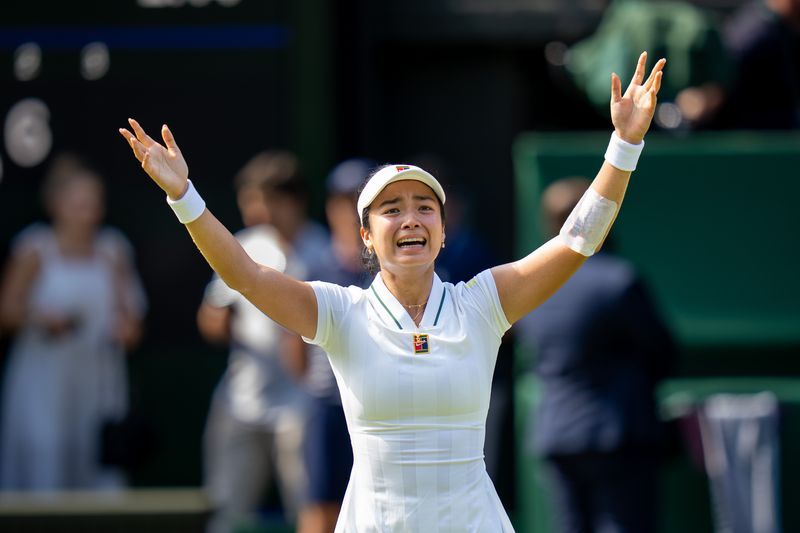
Alexandra Eala etched her name into Philippine sporting history on Saturday at Wimbledon by overcoming defending champion Iga Swiatek in a dramatic fourth-round encounter that showcased remarkable composure and technical excellence. The 29th-seeded Filipino claimed a 7-6(9) 6-2 victory in a match that saw her save a set point in a gripping opening-set tiebreaker before dominating the second frame, marking a watershed moment for tennis in Southeast Asia and the broader Asia-Pacific region.
The significance of Eala's achievement extends beyond the scorecard. She became the first player from the Philippines to reach the fourth round of any Grand Slam tournament, a milestone that resonates deeply in a nation with a burgeoning interest in professional tennis. Her emotional address to the Centre Court crowd, delivered in Tagalog, revealed the personal weight of this accomplishment: "For someone who grew up in the Philippines... I went to training with my brother and my grandfather every day after school with my ruffled socks and my light-up shoes and chubby cheeks, so... to her, this is everything." The raw authenticity of that moment underscored how major international sporting breakthroughs carry profound meaning far beyond the tournament itself, particularly for emerging tennis nations.
Eala's victory was built on a foundation of tactical discipline and fearlessness against one of the world's elite players. The opening set demanded nearly 90 minutes of intense rallying, with Swiatek mounting considerable pressure throughout. However, at the crucial juncture in the tiebreaker, when the Polish third seed held set point, Eala's composure never wavered. Swiatek's subsequent forehand error proved decisive, and the momentum shift proved irreversible. Rather than being deflated by escaping that predicament, Eala accelerated her game in the second set, sprinting clear with dominant baseline play and holding firm under pressure to seal the upset.
Swiatek's elimination represented a significant shock to the women's draw, particularly given her status as the defending champion and world-ranked third seed. The Pole offered a candid assessment of her struggles, stating: "Honestly, I don't care anymore about the results. I've been so focused on them that it's hard to continue like that. So I'm really trying to let it go." Her comments hinted at the psychological toll that sustained pressure at the elite level of professional tennis can inflict, suggesting that performance anxiety may have undermined her typically dominant baseline game.
Swiatek was not alone in faltering on Saturday, as the women's draw was further disrupted when second seed Elena Rybakina succumbed to Belgium's Elise Mertens 7-6(4) 6-1. The 2022 Wimbledon champion and Australian Open winner this year appeared unable to recover after losing a competitive opening set, ultimately collapsing in the second frame. For Rybakina, the implications were particularly stinging: a quarter-final run would have positioned her to ascend to world number one, making this an opportunity cost of substantial magnitude. In her post-match reflection, Rybakina acknowledged the need for fundamental change: "Definitely I need to analyse and change something because it's not working."
The American contingent experienced mixed fortunes on July 4th, a day of particular national significance. On the positive side, 26th-seeded Madison Keys, riding momentum from her Eastbourne title triumph, engineered a stunning upset of sixth-seeded Amanda Anisimova 3-6 6-2 6-3 in an all-American blockbuster. Keys' grass-court prowess was on full display as she recovered from a sluggish opening set to impose her powerful serving game and aggressive baseline play. Qualifier Ashlyn Krueger also enjoyed success, dispatching Ukraine's Daria Snigur 6-3 6-2 with clinical efficiency. However, the day carried a bittersweet edge for American tennis when Serena Williams, the nation's greatest ever athlete, withdrew from her highly anticipated doubles partnership with sister Venus due to injury, describing herself as "heartbroken" at the necessity of stepping aside despite having returned to competitive action following a four-year absence.
Contrastingly, the men's draw proved far more stable, with top seeded players largely navigating their fourth-round encounters without significant drama. Alexander Zverev, the newly crowned French Open champion and second seed, maintained his commanding form with a 6-2 7-6(4) 6-4 victory over American Marcos Giron, underscoring his current status as one of the tournament's most formidable threats. The men's competition also offered Italy hopes of an historically significant milestone: with defending champion Jannik Sinner already advanced, the nation harboured expectations of placing four men in the last 16, an achievement not attained since the 1947 French Open. French Open runner-up Flavio Cobolli, seeded ninth, exemplified Italian resilience by rallying from a catastrophic first-set loss (0-6) against Karen Khachanov to engineer an improbable five-set comeback victory 7-6(4) 6-7(5) 6-2 6-2, demonstrating the mental fortitude required at the highest levels of professional tennis.
However, Italy's aspirations of a four-player last-16 appearance were tempered when Lorenzo Sonego fell to American sixth seed Taylor Fritz 4-6 6-3 6-4 7-6(5) despite mounting initial resistance. The tournament also produced moments of distinctive local drama when British competitor Arthur Fery engineered the longest match of Wimbledon to date against Belgium's Zizou Bergs on a raucous Court 18, fighting back from two sets down and a double break at 4-1 in the final set to claim victory in a deciding-set tiebreaker—a feat accomplished while suffering three separate nosebleeds that underscored the physical toll of five-set matches.
Eala's ascent adds a compelling narrative layer to the 2024 tournament, particularly for Malaysian and Southeast Asian audiences observing the emergence of regional sporting talent on the world's grandest stages. Her progression to the quarter-finals will pit her against 13th seed Jasmine Paolini, the 2024 French Open runner-up, who comprehensively dismantled Greece's Maria Sakkari 6-1 6-2. Eala's motto, inscribed in Tagalog on her tournament cap—"once it grows, it cannot be stopped"—appears increasingly prophetic as she continues her improbable run, while her victory over Swiatek sends shockwaves through expectations for the remainder of the women's championship.

