The impeachment trial of Philippine Vice President Sara Duterte entered a critical phase this week as her legal team mounted a fundamental constitutional challenge to the charges against her, asserting that even if the alleged threats were proven, they would not constitute the category of "other high crimes" necessary to justify removal from office under the 1987 Constitution. The defence strategy signals a calculated pivot from disputing facts to attacking the legal foundations of the entire proceeding, a tactic that could have significant implications for future Philippine impeachment cases and the scope of high crimes doctrine in the region.
During Wednesday's proceedings before the Senate impeachment court, defence counsel Mark Vinluan focused his cross-examination of National Bureau of Investigation senior agent John Mark Calilung on establishing critical evidentiary gaps in the prosecution's case. Rather than engage in a point-by-point rebuttal of witness testimony, the defence team systematically questioned the investigative methodology itself, drawing admissions from Calilung that none of the alleged victims—President Marcos, First Lady Liza Araneta-Marcos, or former Speaker Martin Romualdez—had filed formal criminal complaints or personally provided statements to investigators. This line of questioning strips away the assumption that the case rests on solid foundational evidence and suggests the prosecution may be proceeding without the explicit backing of those most directly affected by the alleged threats.
The heart of the defence argument turns on a semantic and constitutional distinction that could resonate far beyond this single trial. Vinluan contended that Duterte's November 23, 2024 remarks during an online press briefing, in which she made statements interpreted by prosecutors as threatening assassination, should not be classified as "other high crimes" under Article XI, Section 2 of the Constitution. The Constitution explicitly lists specific impeachable offences: culpable violation of the Constitution, treason, bribery, graft and corruption, betrayal of public trust, and the catch-all category of "other high crimes." By arguing that grave threats—even if proven—do not fall within this category, the defence team is essentially asking the court to establish boundaries around what constitutes a high crime, potentially limiting the expansion of impeachment grounds.
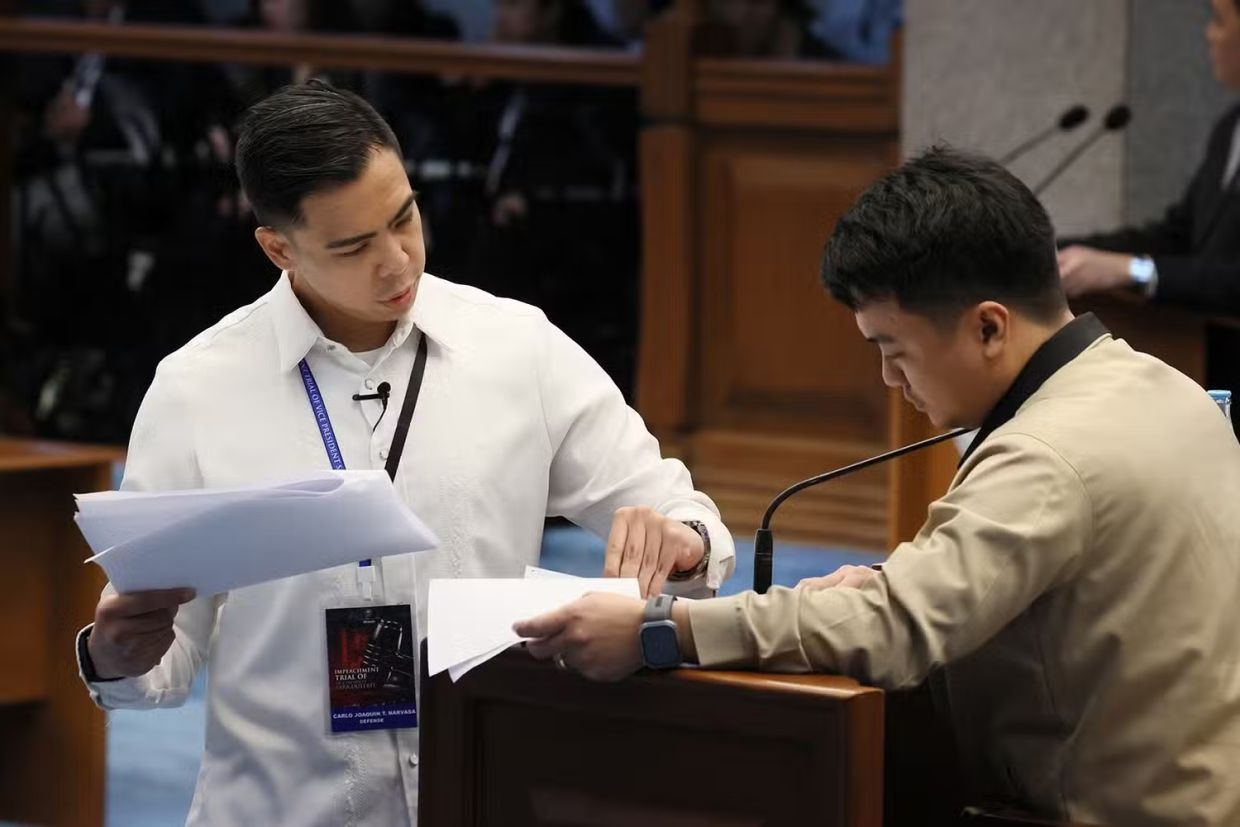
Central to the defence narrative is the assertion that Duterte's statements must be understood within a broader context of alleged government harassment and security threats targeting her and her family. Defence lawyer Carlo Narvasa introduced evidence suggesting that Duterte and her staff had experienced what he characterised as "systematic oppression" by House investigators, including the detention of her chief of staff Zuleika Lopez. The defence presented video footage showing Lopez's emotional distress during her detention and cited instances where her lawyer was allegedly prevented from accompanying her. According to this framing, Duterte's disputed remarks were not unprovoked attacks on the presidential family but rather defensive reactions to what her team claims was a coordinated campaign of harassment.
The defence also made much of allegations concerning "Operation Romanov," which Vinluan described as unauthorised intelligence and surveillance operations targeting Duterte's family. He cited classified reports profiling her homes in both Davao and Manila, and claimed that trusted security personnel had been removed, creating conditions of acute vulnerability. This argument attempts to reposition Duterte not as a threatening aggressor but as a desperate family member responding to genuine security concerns. For Malaysian observers, this dimension of the case echoes regional concerns about the weaponisation of state security apparatus for political purposes, a persistent issue across Southeast Asia.
A significant crack in the prosecution's case emerged during Tuesday's questioning when Senator Risa Hontiveros directly asked whether Duterte's statements proved she had actually contracted an assassin. Prosecution counsel Amando Ligutan acknowledged that the recordings did not conclusively establish this fact but argued they demonstrated her intent. The defence seized on this concession, with Vinluan arguing that since the prosecution could not prove Duterte hired an assassin, the statements alone could not constitute a high crime. This exchange highlights a fundamental problem with the prosecution strategy: the gap between what the statements show on their face and what intent can be reliably inferred from them.
Vinluan further argued that the term "assassin" itself was interpolated into Duterte's remarks by others who interpreted her words out of context. He maintained that when Duterte made her controversial statements, she was speaking not in her official capacity as Vice President but as "Sara Duterte the wife, mother, daughter and sister" seeking to protect her family. This distinction between personal and official capacity raises intriguing questions about the scope of impeachment authority. Can the Senate remove a vice president for statements made in a personal capacity, even if made during an official press conference? The answer has significant implications for how future Philippine administrations might constrain their predecessors through impeachment mechanisms.
The NBI's investigation itself became a focus of scrutiny when Narvasa questioned whether a proper investigation had actually occurred. Calilung was forced to acknowledge that his bureau had conducted the investigation "motu proprio," meaning without a formal complaint from any of the three alleged victims. More damaging still, he admitted that the revised NBI affidavit dated February 10, 2025, contained no statements from Marcos, Araneta-Marcos, or Romualdez, nor from journalists who attended the November press briefing. When asked directly whether he had really investigated the case, Calilung demurred after prosecutors objected. These admissions suggest the investigation may have been initiated and pursued through executive channels rather than through the standard criminal complaint procedure, raising questions about chain of custody and investigative integrity.
The procedural question of whether grave threats constitute impeachable offences represents a doctrinal matter with regional significance. In Malaysia and other Commonwealth-influenced jurisdictions, impeachment procedures have similarly struggled to define the boundaries of removable conduct. The Philippine Constitution's inclusion of "other high crimes" as a catch-all category was intended to prevent the enumeration of specific offences from limiting the Senate's removal power, yet it simultaneously creates uncertainty about what qualifies. The Duterte defence is essentially asking the court to impose meaningful limits on this category, which could constrain future impeachment prosecutions regardless of the current trial's outcome.
Senator Francis Escudero, the trial's presiding officer, at one point explicitly noted that the proceedings had reached their central issue: whether Duterte's acts constituted impeachable offences. This observation suggests that the trial may ultimately turn less on factual disputes and more on legal interpretation. The defence strategy of challenging constitutional grounds rather than facts creates a pathway for acquittal even if some of the prosecution's allegations are substantiated. By forcing the court to grapple with definitional and constitutional questions, the defence team has shifted the battleground to terrain more favourable to their client.
The trial has also exposed tensions about the scope of questioning permitted in impeachment proceedings. When Hontiveros pressed whether grave threats could be justified if legitimate reasons existed, defence lawyer Narvasa retreated from such a broad position, yet the exchange illustrated the difficulty in maintaining clean distinctions between factual investigation and legal conclusion-drawing. Escudero subsequently reminded senator-judges to refrain from posing questions requiring counsels to draw legal conclusions, noting that such matters belonged in closing arguments. This procedural development suggests the court is conscious of the need to maintain clear boundaries in an increasingly adversarial proceeding.
For observers across Southeast Asia, the Duterte impeachment trial represents a critical moment in defining the relationship between executive power and legislative oversight. As democracies in the region have matured, impeachment mechanisms have become increasingly deployed as political tools, and the question of what conduct justifies removal from office has grown ever more contentious. The Philippine court's resolution of whether threatened statements constitute "other high crimes" will likely influence how neighboring jurisdictions calibrate their own removal procedures. The outcome will signal whether impeachment remains a broad political remedy or whether it is being constrained by more rigorous constitutional interpretation.

