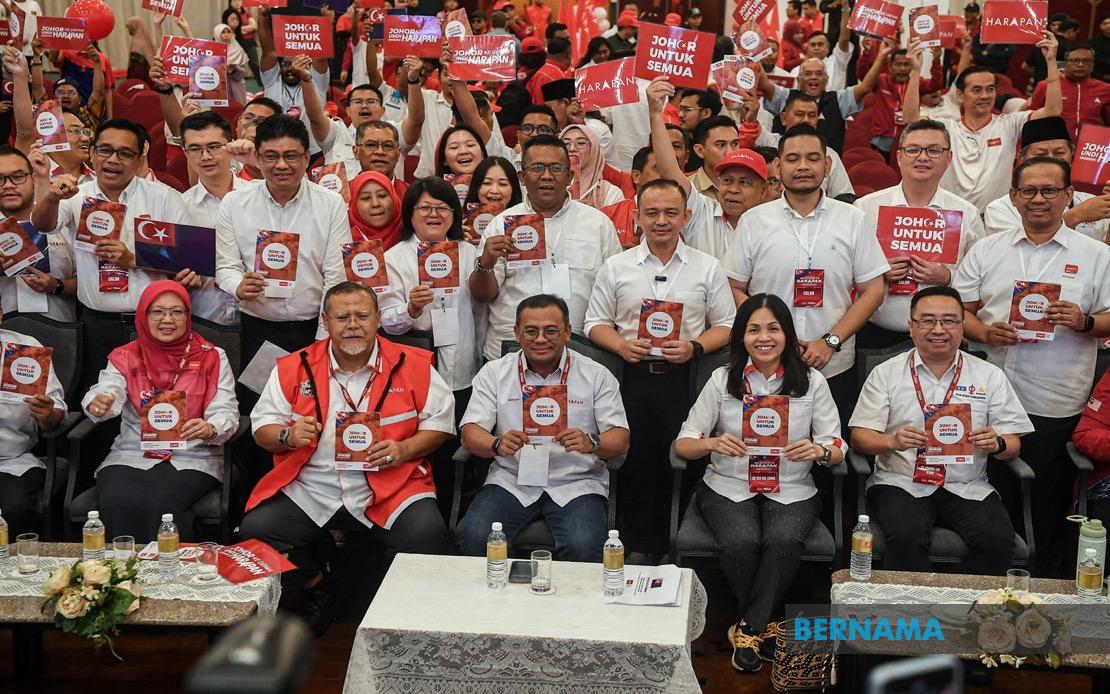
Pakatan Harapan launched its 'Johor Untuk Semua' (Johor For All) manifesto in Johor Bahru today, positioning the platform as a substantive response to the state's economic challenges rather than mere campaign posturing. Johor DAP chairman Teo Nie Ching, who serves as Deputy Communications Minister at the federal level, stressed that the ten-point manifesto represents concrete commitments shaped by what residents actually need and what Johor's economy can realistically support, with voting scheduled for July 11 and early polling on July 7.
The manifesto's comprehensiveness reflects an attempt to appeal across demographic lines, addressing concerns that span generational divides. Teo highlighted that the package considers youth prospects, maternal welfare, and childhood development priorities, suggesting an inclusive rather than narrow political calculus. This breadth signals PH's recognition that a winning coalition in Johor requires assembling diverse voter segments rather than relying on traditional strongholds alone. The inclusion of such varied concerns indicates internal coalition discussions about which issues resonate most strongly among undecided voters in the state.
Education emerges as a flagship priority within the manifesto, underscoring persistent anxieties about schooling standards and accessibility across Johor's diverse communities. For Malaysian readers, education consistently ranks among top voter concerns, particularly among parents navigating the transition between primary and secondary systems. The emphasis here suggests PH's campaign strategists believe education represents fertile political ground, especially in suburban and semi-urban constituencies where quality schooling directly influences property values and family decisions about settling locations.
The border efficiency pledge carries particular significance for a state whose geography makes it pivotal for Malaysia-Singapore relations and cross-border commerce. Proposing a 50 per cent reduction in waiting times at Johor-Singapore crossings addresses genuine frustration among daily commuters, logistics businesses, and retailers dependent on seamless regional trade. This commitment signals that PH, should it gain state power, intends engaging constructively with Home Ministry officials in Kuala Lumpur to streamline procedures—a recognition that solving border bottlenecks requires vertical coordination across federal and state governments.
Teo's invocation of Selangor's health scheme precedent introduces a practical governance argument into the campaign conversation. By pointing to an existing, functioning model operated by a PH-led state administration, the opposition coalition counters skepticism about implementation capacity. For Johor voters evaluating which coalition can deliver services, such references provide reassurance that proposed schemes rest on proven foundations rather than untested theory. Selangor's successful track record becomes transferable political capital, suggesting that PH's institutional knowledge in one state can translate into competence elsewhere.
The Johor Health Scheme represents healthcare expansion at the state level, addressing access disparities that continue affecting rural and smaller urban centres. The proposed deposit assistance for first-time homebuyers directly targets affordability challenges that have priced younger Malaysians out of property ownership, a frustration that translates readily into electoral punishment if left unaddressed. These housing and health measures suggest campaign research indicating that pocketbook issues—what ordinary families actually spend money on—matter more than abstract policy philosophies.
The RM500 million youth empowerment fund signals recognition that Johor's younger demographics require investment in skills, employment pathways, and entrepreneurial support. This cohort, now entering their peak earning and voting years, has experienced economic disruptions from the pandemic and faces uncertainty about career prospects. By committing substantial resources specifically to youth development, PH attempts to prevent this demographic from gravitating toward incumbent governing parties that might be seen as neglecting generational renewal.
Teo's emphasis on federal-state coordination underscores a political reality often overlooked in state election coverage: local governments cannot operate in isolation from Kuala Lumpur's resource allocation and policy frameworks. Her confidence that the Home Ministry would cooperate on border matters reflects the peculiar position of a major metropolitan area whose prosperity depends on cross-border integration. This interdependence between federal and state authorities means that campaign promises must account for cooperation dynamics between administrations of potentially different political colours—a complexity that distinguishes Malaysian politics from systems with clearer federal-state separation.
The manifesto's framing as 'balanced' and all-encompassing attempts to inoculate PH against charges of favouring particular groups or regions within Johor. By emphasizing inclusivity—'Bangsa Johor' as Teo references it—the coalition positions itself as representing the state's diverse population rather than sectional interests. This messaging matters particularly in Johor, where Malay-Muslim majorities coexist with significant Chinese and Indian communities, and where intra-communal divisions around economic opportunities can be politically decisive.
The timing of this launch within the formal election campaign period reflects standard opposition strategy: introduce comprehensive policy platforms early to establish narrative momentum and demonstrate seriousness about governance. Rather than emerging piecemeal throughout the campaign, presenting a unified ten-point package suggests a coherent vision and administrative readiness. For voters fatigued by election rhetoric, such comprehensiveness offers something substantive to evaluate beyond personality-driven politics.
Crucially, Teo's repeated emphasis on deliverability—contingent on federal cooperation—introduces an important caveat into PH's campaign messaging. By qualifying commitments with the condition of strong federal support, the opposition hedges against future accusations of non-delivery should they win but face an unsympathetic federal government. This preemptive framing, while perhaps politically prudent, also signals anxiety about implementation challenges that state administrations genuinely face when ambitions exceed their constitutional powers or funding capacity.
The manifesto represents PH's calculation about which issues mobilize Johor voters sufficiently to overcome incumbent advantages and voter inertia. That education, healthcare, housing, border efficiency, and youth opportunity dominate the agenda suggests campaign research identified these as both genuinely important to residents and areas where the opposition believes it can credibly promise improvements. Whether voters ultimately find these commitments persuasive will become clear on July 11, but the manifesto's substance indicates PH's confidence that governance-focused appeals can compete effectively against incumbent parties in Malaysia's most economically significant state.

