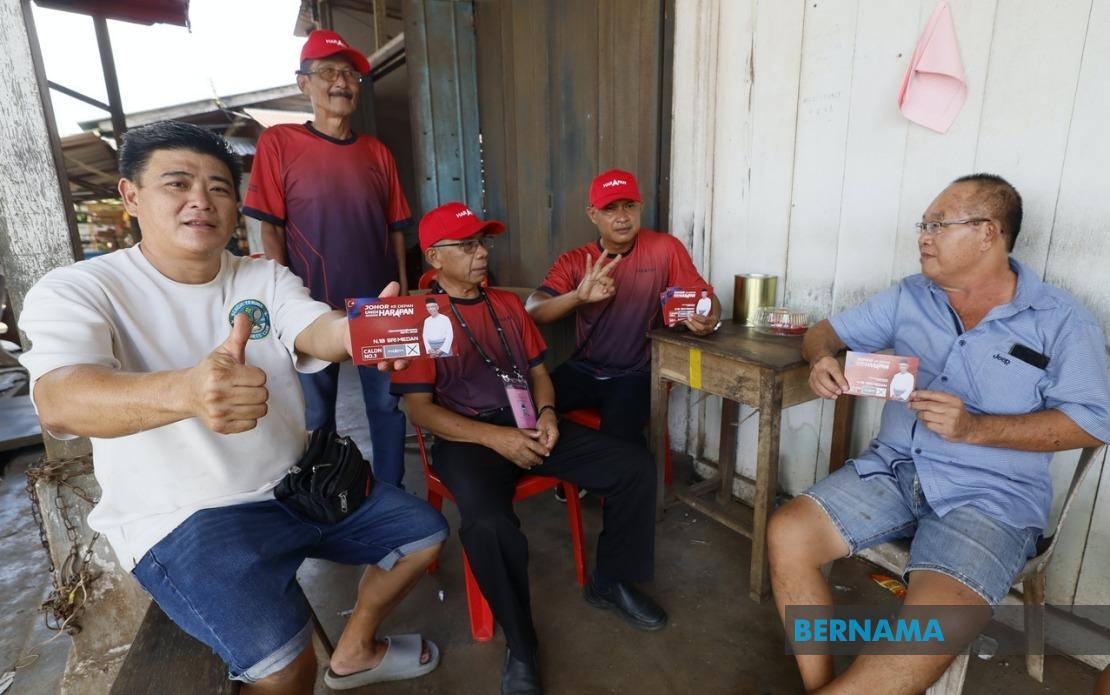
Hishamudin @ Misrin Ishak, the Pakatan Harapan candidate contesting the Sri Medan seat in the upcoming 16th Johor State Election, has grounded his campaign in direct engagement with voters, adopting a methodology that prioritises listening to community grievances before formulating responses. Speaking in Batu Pahat during a constituency walkabout, the former mathematics educator, popularly known as "Cikgu Misrin", articulated a vision centred on tangible improvements to residents' living standards rather than grandiose electoral promises. His approach reflects a deliberate strategy to build credibility in a seat traditionally considered a Barisan Nasional stronghold, where a challenger candidate must demonstrate both conviction and actionable policy ideas.
The flooding problem that recurrently disrupts life in Sri Medan has emerged as a focal point in Hishamudin's campaign messaging. Rather than offering vague assurances, he has positioned infrastructure remediation as a priority requiring sustained administrative focus. This resonates particularly with rural and semi-urban constituencies in Johor, where drainage failures and seasonal inundation remain persistent sources of frustration. By anchoring his campaign to a locally-felt pain point, he seeks to differentiate himself from competitors who may present broader economic or governance narratives divorced from immediate household concerns. The emphasis on this issue also signals to residents that their accumulated experiences of disruption have registered with the candidate and warrant concrete intervention.
Beyond flood management, Hishamudin has articulated commitments spanning education, skills development, and economic opportunity. His proposal to organise Technical and Vocational Education and Training programmes reflects awareness that Johor's youth face an evolving employment landscape where traditional pathways increasingly require hybrid competencies. By pledging to provide exposure to digital education alongside TVET certification, he implicitly acknowledges that rural and semi-urban constituents cannot remain dependent on legacy skill sets. This dimension of his platform speaks to anxieties across Malaysia regarding brain drain and youth unemployment in less-developed constituencies.
Small and medium enterprise development forms another pillar of his campaign. Hishamudin has identified market access constraints as a limiting factor for local entrepreneurs, many of whom rely predominantly on domestic demand. His commitment to help SMEs expand beyond parochial customer bases addresses a structural challenge in Malaysia's economic ecosystem, where regional disparity in business growth correlates strongly with proximity to major urban centres. For Sri Medan residents engaged in commerce, this pledge carries practical implications regarding their capacity to scale operations and achieve sustainable income growth.
The candidate's background as a village head provides operational experience in administering welfare distribution, managing local infrastructure, and serving constituents irrespective of their political leanings. Hishamudin has leveraged this tenure to construct a narrative of pragmatic service delivery divorced from partisan considerations. This positioning holds particular appeal in constituencies where voters have grown weary of political cycles characterised by campaign promises followed by post-election neglect. His principle of "work first, talk later" attempts to establish differentiation from political competitors through emphasis on action over rhetoric.
Hishamudin's commitment to balanced infrastructure development across urban, semi-urban, and rural zones speaks to chronic grievances within Johor's less-developed constituencies regarding resource allocation. Voters in peripheral areas frequently perceive that development expenditure concentrates disproportionately in municipal centres, leaving village populations with deteriorating facilities and reduced access to quality services. By explicitly pledging to address this imbalance, he signals awareness of distributive fairness as a governance concern, not merely an electoral talking point.
The candidate faces a competitive three-way contest against Barisan Nasional incumbent Datuk Zulkurnain Kamisan and Perikatan Nasional's Ahmad Rosdi Bahari. The presence of three candidates with distinct political affiliations reflects ongoing fragmentation in Johor's political landscape, where BN's historical dominance has faced incremental erosion from both opposition coalitions. As a newcomer to electoral politics, Hishamudin occupies an unusual position: he must overcome lack of parliamentary profile while leveraging perceived freshness as an advantage over entrenched incumbents associated with past governance records.
His assessment that voter response during early campaign phases proved encouraging warrants careful interpretation. In Malaysian electoral contexts, initial enthusiasm for opposition candidates often does not translate proportionally into poll-day results, particularly in constituencies with strong BN institutional machinery. The genuinely competitive character of Sri Medan's contest, however, depends partly on whether Hishamudin's emphasis on incremental improvements resonates more powerfully with voters than BN's record of service delivery or PN's positioning as an alternative establishment force.
The Johor state election scheduled for July 11, with early voting on July 7, arrives at a moment when Malaysian voters across multiple states are reassessing political alignments amid concerns regarding cost-of-living pressures, employment insecurity, and governance effectiveness. In this context, candidates who can articulate concrete solutions to neighbourhood-level problems while demonstrating administrative competence stand to benefit from shifting electoral sentiment. Hishamudin's platform, grounded in community service philosophy rather than ideological pronouncements, may appeal particularly to swing voters in semi-urban constituencies where pragmatism often outweighs factional loyalty.
For Pakatan Harapan's broader electoral strategy in Johor, the performance of candidates like Hishamudin in traditionally challenging constituencies will provide crucial data regarding the coalition's capacity to expand its foothold beyond strongholds concentrated in particular districts. Sri Medan's outcome could indicate whether PH's messaging has penetrated rural voter bases or whether BN's organisational advantages remain decisive in constituencies beyond major urban centres.

