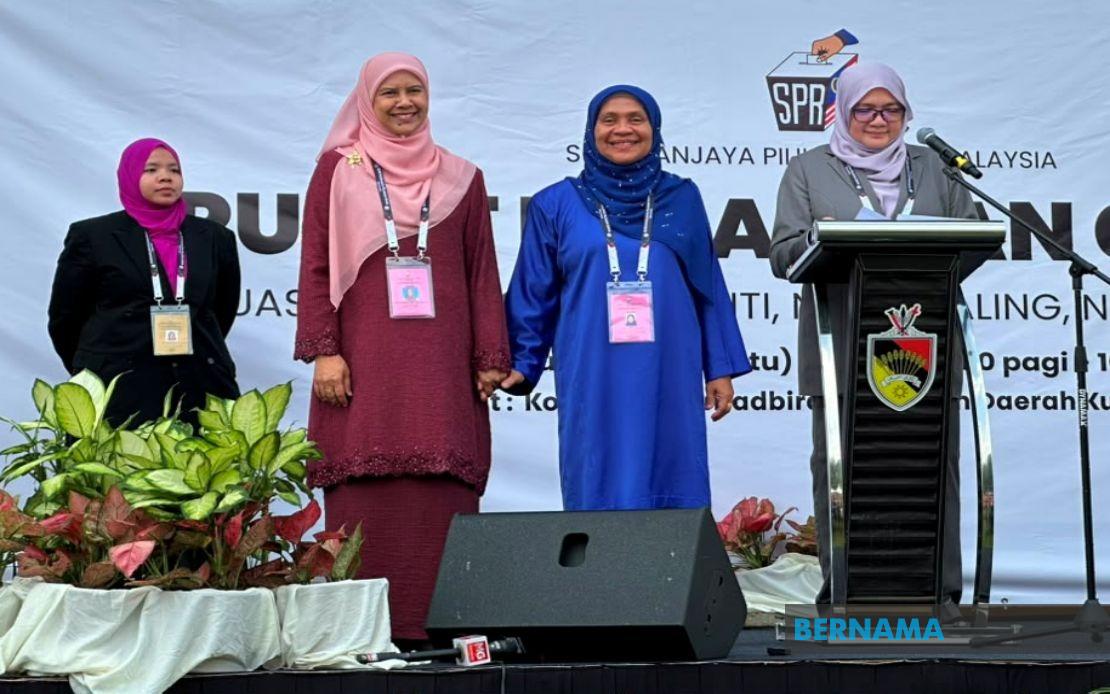
The Pilah state seat has been confirmed as a straight contest between two female candidates following the close of nominations for the 16th Negeri Sembilan State Election. Incumbent Datuk Noorzunita Begum Mohd Ibrahim, representing Pakatan Harapan, will face off against Barisan Nasional's S. Leza Md Yasin in what marks a significant gender composition development for the state assembly. The returning officer for Kuala Pilah, Nawal Mohammed Amin, made the official announcement after the nomination process concluded on July 18, confirming both candidates had successfully submitted their papers within the morning window.
The nomination submissions themselves occurred in rapid succession, with Noorzunita Begum filing her forms at 9.03 am, followed closely by S. Leza at 9.09 am. This efficient processing reflected the administrative readiness of the Electoral Commission as Negeri Sembilan moved toward its scheduled polling date. The presence of senior political figures accompanying the candidates underscored the competitive nature of multiple contests across the state, with PKR Wanita chief and Education Minister Fadhlina Sidek overseeing PH submissions alongside other party leaders including Youth and Sports Minister Dr Mohammed Taufiq Johari and Deputy Investment, Trade and Industry Minister Sim Tze Tzin.
Beyond Pilah, the electoral landscape across Negeri Sembilan presents varied competitive dynamics that will test party performance across different voter bases. Three state seats—Juasseh, Seri Menanti, and Senaling—have been confirmed as three-cornered contests, while the Johol seat will feature a two-way battle between coalition partners. The complexity of these arrangements reflects the fragmented political situation emerging in Malaysian state politics, where Bersatu's presence as an additional contender has transformed traditional two-party competitions into more unpredictable multi-way races.
In Juasseh, Pakatan Harapan's Mohd Aidil Abdullah will contend against incumbent Datuk Ismail Lasim of Barisan Nasional and Bersatu's Mohd Zuhami Md Yusof. This three-cornered configuration potentially fragments opposition support, though the outcome will depend heavily on local constituency dynamics and voter sentiment toward Bersatu's breakaway faction. The presence of Bersatu candidates across multiple constituencies suggests a deliberate strategy to establish footholds in Negeri Sembilan, where the party has historically maintained weaker organizational structures compared to longer-established political entities.
The Seri Menanti contest introduces another dimension of competitive complexity, featuring PH's Mohd Kamarul Arifin Mohd Wafa, incumbent Muhammad Sufian Maradzi of Barisan Nasional, and Bersatu's Datuk Seri Megat D. Shahriman Zaharuddin. The involvement of a prominent Bersatu figure in this particular seat suggests targeted resource allocation by the newer political formation, possibly indicating constituencies where internal polling suggested competitive viability. Such concentrated efforts in select seats represent a shift from broader campaign dispersal strategies, concentrating campaign resources where statistical models suggest realistic victory probabilities.
Senaling similarly presents a three-way contest between Mohd Hanis Mohd Alimin of Pakatan Harapan, Mohamad Qayyum Abd Jalil representing Barisan Nasional, and Bersatu's Mohd Izzafi Khan. The repetition of this three-cornered pattern across multiple constituencies creates strategic complications for both major coalitions, as vote-splitting risks intensifying. Barisan Nasional candidates, traditionally positioned as the establishment preference in state-level elections, may find themselves vulnerable to fragmentation, while Pakatan Harapan's performance will depend on consolidating opposition support against competing alternatives.
The Johol seat stands apart as the only confirmed straight fight besides Pilah, with Pakatan Harapan's Mohd Zailan Mohd Munawar challenging incumbent Datuk Saiful Yazan Sulaiman of Barisan Nasional. This two-way configuration provides clearer strategic parameters for both camps and represents electoral terrain where Bersatu has chosen not to contest, possibly reflecting assessment of unfavorable winning probabilities or prioritization of other constituencies within limited campaign resources. The absence of additional candidates in this seat may indicate consensus among political actors regarding realistic competitive outcomes.
Barisan Nasional's nomination process benefited from visible support from Deputy Home Minister Datuk Seri Dr Shamsul Anuar Nasarah and Perak Menteri Besar Datuk Seri Saarani Mohamad, signaling high-level party commitment to the Negeri Sembilan electoral contest. Such deployment of senior ministerial figures during nomination announcements traditionally communicates party hierarchy's confidence levels and resource commitments to particular state elections. The attendance of these senior figures alongside candidates projects organizational cohesion while simultaneously reinforcing the federal-state political linkages that characterize Malaysian electoral contests.
The Electoral Commission has established July 28 as the early voting date and August 1 as the main polling day, providing a compressed campaigning window of approximately two weeks for parties to mobilize voters. This accelerated timeline compared to some historical state elections requires campaigns to operate at heightened intensity immediately following nomination closure. The concentrated schedule advantageous to well-organized machinery working from existing electoral databases, potentially benefiting established parties over newer formations still building grassroots infrastructure.
From a regional perspective, Negeri Sembilan's election results carry implications extending beyond the state boundary. As a traditionally competitive state with no single party commanding overwhelming dominance, outcomes here serve as important indicators of broader coalition strength across central Malaysia. The performance of Bersatu candidates particularly merits close observation, as successful seat captures would validate the party's electoral viability outside its core Kedah stronghold, while repeated third-place finishes would question sustainability of its expansion strategy into unfamiliar political terrain.
The all-women contest in Pilah represents a notable development in Malaysian state electoral composition, reflecting gradual shifts toward greater female candidate representation at state assembly level. Whether this stems from deliberate party strategies to increase female political participation or coincidental nomination decisions remains unclear, though the outcome will likely be scrutinized through gender representation frameworks by civil society observers. The result in Pilah may consequently carry significance beyond immediate seat control, influencing broader discussions regarding women's advancement in Malaysian electoral politics.
The fragmented candidate field across multiple seats suggests voters will face increasingly complex balloting decisions, with ramifications for traditional coalition support patterns. Negeri Sembilan's status as a historically pivotal state in Malaysian politics means these electoral outcomes will be analyzed nationally for clues regarding shifting voter preferences and coalition viability heading into potential federal-level contests. The interplay between coalition discipline and localized political dynamics will fundamentally shape whether parties manage to maintain organizational cohesion or fracture under pressure from competing alternatives offering voters genuinely distinct policy or leadership propositions.

