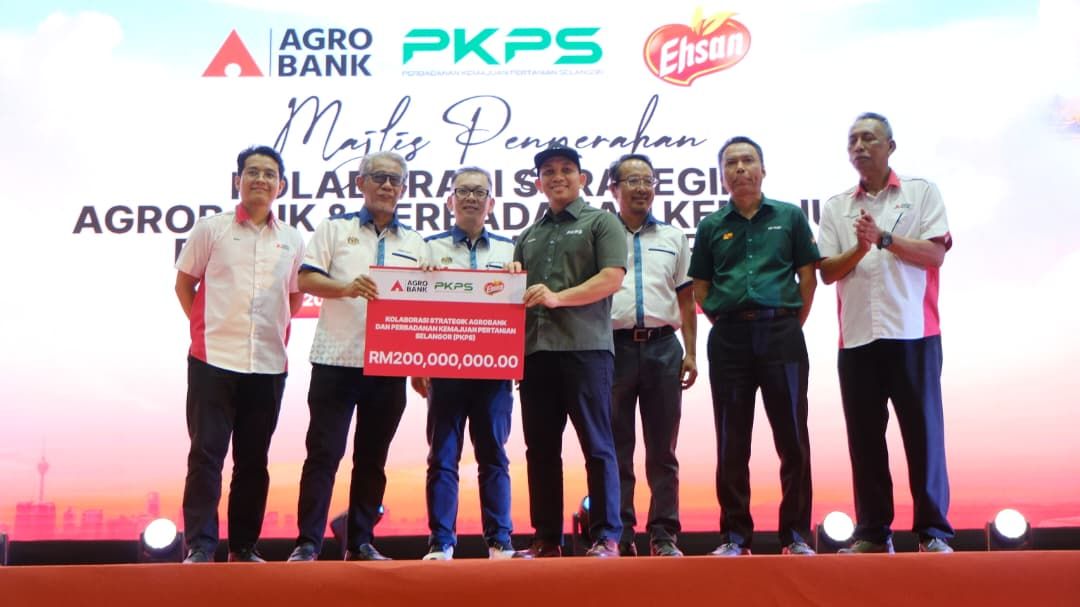
The Selangor Agricultural Development Corporation (PKPS) has secured a RM200 million trade financing facility through a landmark collaboration with Agrobank, marking a significant boost to the state's food security agenda and agricultural competitiveness. The partnership was formally announced at the Malaysia Agriculture, Horticulture and Agrotourism Exhibition (MAHA) 2026 at the Malaysia Agro Exposition Park (MAEPS) Serdang on August 29, where Agrobank group president and chief executive officer Datuk Tengku Ahmad Badli Shah Raja Hussin presented a symbolic cheque to PKPS group chief executive officer Datuk Dr Mohamad Khairil Mohamad Razi in the presence of Deputy Agriculture and Food Security Minister Datuk Chan Foong Hin.
The arrangement represents a calculated investment in Selangor's agricultural infrastructure and operational backbone, addressing both immediate capital requirements and longer-term structural improvements within the state's agrifood ecosystem. Rather than a one-off grant, the facility functions as a structured trade financing mechanism designed to support project development, working capital replenishment, and capacity-building initiatives across multiple dimensions of agricultural production and distribution. The financing will become operative in March 2027, allowing organisations and stakeholders adequate time for project preparation and regulatory alignment.
The inaugural undertaking under this facility is construction of a dedicated halal food warehouse that will serve as a centralised storage and logistics nerve centre for Selangor's expanding food supply chain. This facility addresses a critical infrastructure gap in the state's distribution network, enabling efficient product movement from production sites to retail and institutional buyers whilst maintaining stringent halal certification standards and cold-chain integrity. Beyond this flagship project, the financing envelope extends to several complementary initiatives that together form a comprehensive modernisation strategy for the sector.
Planned investments include establishment of a dedicated halal chicken processing centre, development of an Ehsan-branded product processing facility, and construction or renovation of central distribution warehouses strategically positioned across Selangor's districts to enhance last-mile delivery capabilities. Each of these components targets specific bottlenecks within the current system, whether related to species-specific processing expertise, value-added manufacturing capacity, or geographical distribution inefficiencies that have historically constrained smaller producers' market access.
Beyond bricks-and-mortar infrastructure, the RM200 million commitment allocates substantial resources to operational advancement and research acceleration. The Ehsan Agricultural Research Centre will intensify investigations into precision farming techniques, climate-adaptive crop varieties, and resource-efficiency innovations that can reduce production costs whilst improving yields and environmental outcomes. Simultaneously, the Ehsan Agricultural Training Centre will develop human capital through skills upgrading programmes targeting farmers, technicians, and supply-chain managers, directly addressing the sector's perennial talent gap.
The financing also covers production and commercialisation of ready-to-eat and ready-to-heat food products marketed under the Ehsan brand, diversifying PKPS's revenue streams beyond commodity sales into higher-margin processed foods. This strategic pivot towards value-addition reflects global trends in agricultural development where forward integration into manufacturing and branding creates competitive advantage and pricing power. By positioning Ehsan-branded products in premium and convenience segments, PKPS can capture consumer dollars willing to pay for quality assurance, traceability, and convenience factors.
Disbursements under the facility will be calibrated to project progress rather than distributed as lump sums, ensuring disciplined cash management and accountability throughout the partnership. This milestone-based approach protects both PKPS's financial position and Agrobank's asset quality, aligning incentives such that funds flow only as tangible progress occurs. The facility operates within defined standard operating procedures and governance frameworks designed to maintain transparency and prevent misallocation or inefficient deployment of capital.
Also integrated into the financing scope is support for the Ehsan Resort and Convention Centre's agritourism development, reflecting recognition that Malaysia's agricultural sector increasingly encompasses experiential offerings that diversify income and build brand awareness. Visitors engaging in farm stays, workshops, and educational programmes become ambassadors for Selangor's produce and agricultural innovations, whilst generating direct revenue and extending the economic value chain beyond primary production.
This collaboration aligns strategically with MAHA 2026's overarching theme of "Value Creation for Food Security," emphasising that agricultural resilience depends not merely on production volume but on technological sophistication, infrastructure adequacy, and value-chain integration. By channelling investment toward modernisation and capacity-building rather than subsidising commodity production, the partnership pursues structural improvements with longer-lasting impact on competitiveness and sustainability.
For Malaysian policymakers and agricultural stakeholders, the PKPS-Agrobank arrangement demonstrates viable mechanisms for mobilising private-sector financing toward food security objectives. Rather than relying exclusively on government budgets, the model leverages banking expertise and capital markets to accelerate infrastructure deployment whilst maintaining commercial discipline. This template carries implications for other Malaysian states and regions contemplating agricultural modernisation, suggesting that public-private partnerships centred on defined development corridors can unlock financing volumes and implementation capabilities otherwise constrained by budget limitations.
The facility's March 2027 activation timeline provides PKPS and Agrobank with several months to establish governance protocols, validate project specifications, and ensure regulatory compliance across halal certification, environmental standards, and labour frameworks. This deliberate preparation phase reduces implementation risk and positions the partnership for effective execution once disbursements commence.
Selangor's agricultural sector stands to benefit substantially from improved infrastructure, enhanced processing capabilities, and strengthened research capacity, ultimately improving product quality, consistency, and market positioning. As the state confronts rising living costs and consumer demand for locally sourced, traceable food products, investments in cold-chain infrastructure, halal processing, and brand-building create competitive advantages that can sustain price premiums and consumer loyalty, contributing measurably to food security outcomes across Malaysia's most urbanised state.

