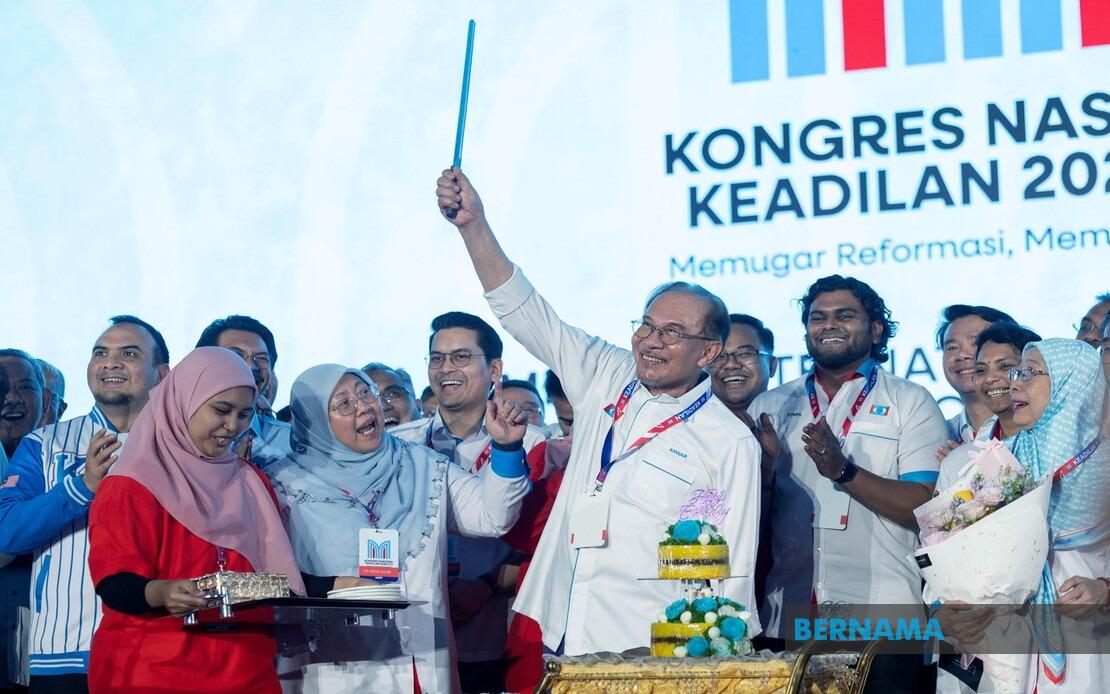
The PKR National Congress 2026 in Melaka concluded with party leadership presenting a carefully balanced vision: maintaining the political stability underpinning Malaysia's current governing arrangement whilst preserving the reform impulses that have defined the party since its establishment. The dual emphasis reflects a fundamental tension within PKR's role as a major coalition partner in government—the need to consolidate gains and prevent political turmoil whilst continuing to push for the systemic changes that motivated its supporters through decades of opposition.
Prime Minister Anwar Ibrahim used his closing address to underscore PKR's commitment to the Unity Government framework, stating that his continued support for the coalition rested on ensuring both political stability and sustained economic growth benefiting ordinary Malaysians. However, Anwar candidly acknowledged that the longevity of this cooperation ultimately depends on decisions made by UMNO and Barisan Nasional leadership, effectively signalling that PKR views itself as a stakeholder rather than architect of the current arrangement. This framing is significant for Southeast Asian observers tracking Malaysia's political trajectory, as it suggests PKR has accepted a secondary role in determining the coalition's future—a pragmatic but potentially constraining position.
The Prime Minister also took the opportunity to warn all parties against destabilising actions, emphasising that the Unity Government was established on principles of national interest rather than partisan advantage. This language carries weight in Malaysia's fractious political context, where coalitions have historically been vulnerable to defection and manoeuvring. By positioning stability as a collective responsibility, Anwar appears to be attempting to create shared ownership of the arrangement whilst simultaneously cautioning against the kind of brinksmanship that nearly destabilised the government in previous years.
PKR's deputy president Nurul Izzah Anwar articulated perhaps the congress's most substantive message: that reform must continue notwithstanding the party's governmental responsibilities. She argued that abandoning the reform agenda would betray the principles underlying PKR's founding and rob future generations of its legacy. This intervention by Anwar's daughter carries particular weight, as it suggests younger party leadership views the risk of institutional calcification as genuine and pressing. The congress proceedings indicate genuine internal tension between those prioritising coalition stability and those fearing that PKR risks becoming merely another conventional party within a conventional structure.
The party cited the repeal of the Universities and University Colleges Act (AUKU) 1971 as evidence that meaningful reform remains achievable within government. The AUKU repeal represents a symbolic victory for progressive constituencies and student movements, signalling that PKR has delivered on a longstanding campaign promise despite coalition pressures. However, Anwar's subsequent assurance that no replacement legislation would unduly restrict student freedoms suggests ongoing negotiations within government circles over how far institutional changes can proceed without destabilising the broader coalition. This dynamic will be closely watched by civil society organisations and student bodies across Southeast Asia, many of which face similar restrictions on campus activism.
Anwar's emphasis that existing criminal law provisions suffice to address student misconduct—and that students should face the same legal standards as ordinary citizens—represents a significant declaratory commitment. Positioning students within the normal legal framework rather than under separate institutional disciplinary regimes would constitute a modest but meaningful expansion of institutional freedoms. The fact that Anwar felt compelled to make this assurance at Cabinet level suggests resistance from more conservative coalition partners, illustrating how even incremental reforms require sustained pressure and high-level advocacy.
Beyond education policy, the congress reflected broader PKR concerns about organisational vitality and political readiness. The party signalled determination to maintain internal cohesion and preparedness without waiting for formal parliamentary dissolution or candidate nomination announcements. This forward-looking posture suggests PKR is preparing for possible electoral contests or shifting political alignments in the relatively near term, implying underlying uncertainty about how long the Unity Government framework will remain viable. Malaysian political observers have long noted the fragility of multi-racial coalitions dependent on maintaining delicate inter-party balance; PKR's emphasis on preparedness may reflect awareness that stability, however desirable, cannot be guaranteed indefinitely.
Women's representation featured prominently in congress deliberations, with PKR Wanita chief and Education Minister Fadhlina Sidek calling for expanded spaces for women in leadership and decision-making roles. Her simultaneous emphasis on openness to criticism and willingness to improve governance suggests PKR leadership recognises that institutional reform requires cultural shifts within party and governmental structures. Fadhlina's dual portfolio—bridging party and ministerial roles—illustrates the mechanisms through which reform agendas are supposed to be mainstreamed across government, though translating stated commitments into actual practice remains challenging in hierarchical institutional contexts.
The Angkatan Muda Keadilan youth wing's focus on Bumiputera participation in technology sectors including artificial intelligence, semiconductors and biotechnology reflects broader strategic thinking about economic positioning and generational opportunity. By highlighting opportunities in advanced technology rather than traditional sectors, PKR's youth wing signals awareness that Malaysia's economic future depends on capabilities in emerging fields where demographic advantages matter less than knowledge and innovation capacity. This positioning also implicitly challenges potentially protectionist impulses within coalition partners, framing technological advancement and inclusive participation as compatible objectives.
AMK's agenda addressing Generation Z concerns—encompassing gig economy recognition, enhanced social protection, skills development, mental health and wellbeing—identifies genuine gaps in Malaysia's current institutional architecture. The gig economy has expanded rapidly across Southeast Asia without corresponding regulatory or social protection frameworks; PKR's willingness to flag this suggests openness to unconventional policy solutions. However, translating youth wing advocacy into concrete government action requires navigating coalition partners with varying ideological orientations and competing constituent interests, a persistent challenge for reform-minded parties within conservative coalitions.
The congress ultimately depicted PKR at a critical inflection point: sufficiently embedded in government to influence outcomes, yet constrained by coalition dynamics that limit unilateral action. The party is attempting to square a difficult circle—consolidating stability necessary for economic governance whilst maintaining the reform credentials that distinguish it from conventional parties. Whether this balancing act proves sustainable depends partly on external factors beyond PKR's control, particularly coalition partner behaviour and broader economic conditions. Malaysian political dynamics will continue reflecting this underlying tension between stability imperatives and reform ambitions.
For regional observers, the congress highlighted how coalition governance in diverse societies requires constant negotiation between competing objectives. PKR's experience offers instructive lessons about both the possibilities and limits of reform within multi-party arrangements, particularly when progressive parties must accommodate more conservative partners. The coming months will test whether PKR can meaningfully advance its reform agenda whilst maintaining the political stability that coalition partners demand—a challenge increasingly relevant across Southeast Asia as region navigates between democratic deepening and institutional consolidation.

