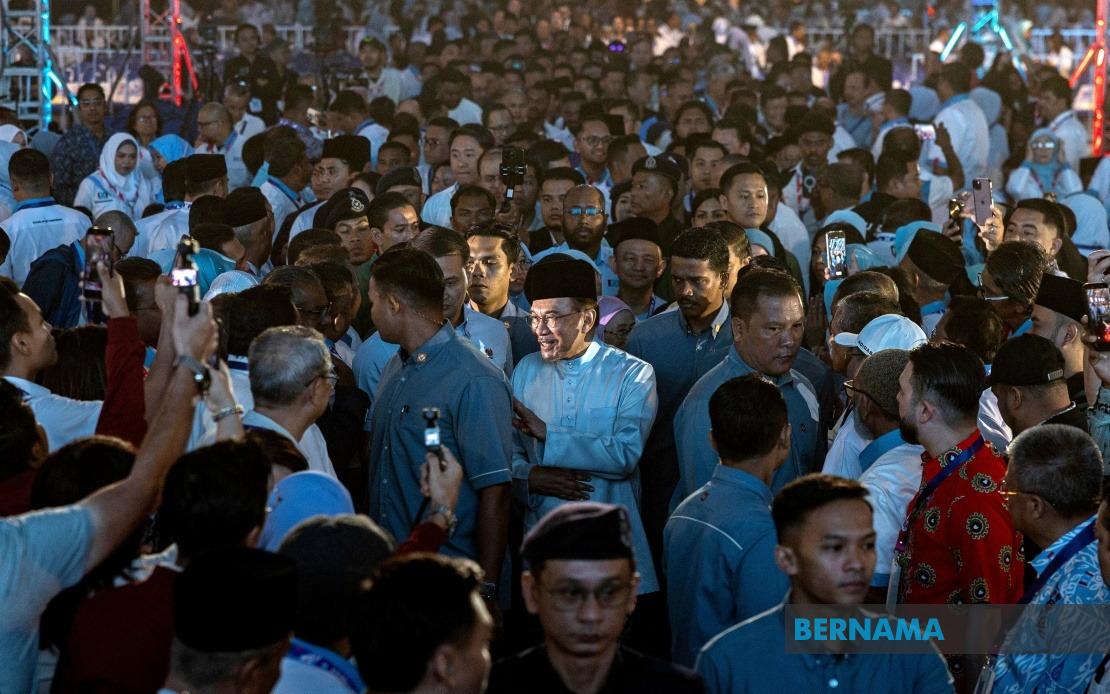
Malaysia's ruling People's Justice Party (PKR) needs to use its 2026 National Congress as a moment to consolidate its position and restore public confidence, according to Tengku Datuk Seri Zafrul Tengku Abdul Aziz, the Prime Minister's senior political adviser and an ex-officio member of the party's Political Bureau. Speaking in Melaka on August 15, Tengku Zafrul framed the upcoming congress not merely as a procedural gathering but as an essential opportunity for the party to conduct honest self-examination and chart a course toward renewed electoral viability.
The timing of these remarks is significant. Recent state elections have delivered mixed results for PKR and its coalition partners in the Unity Government, creating palpable pressure within the party to demonstrate that it can deliver tangible improvements. Rather than deflecting blame onto coalition allies, Tengku Zafrul's message emphasises that PKR must focus on what remains within its control: its own organisational performance and effectiveness. This represents a tacit acknowledgement that the party's recent performance has fallen short of expectations and that internal recalibration is overdue.
Tengku Zafrul explicitly called upon all party members to undertake a comprehensive assessment of existing weaknesses across the organisation. This diagnostic exercise is intended to extend beyond the party's central leadership to encompass its entire machinery, from grassroots divisions to state and federal structures. The implication is that inefficiencies or disconnects exist at multiple levels, preventing the party from translating policy achievements into voter satisfaction. Without structural improvements and clearer operational protocols, he suggested, PKR risks remaining a party perceived as administratively weak despite holding significant political office.
The adviser's comments touch on a perennial challenge facing ruling coalitions in Malaysia: the difficulty of converting governmental performance into sustained electoral support. PKR's difficulties are not unique to the party but reflect broader coalition dynamics within the Unity Government. However, Tengku Zafrul was explicit that the party cannot spend energy attempting to correct the shortcomings of its coalition partners. This pragmatic boundary-setting is crucial because it directs internal energy toward areas where PKR has agency and responsibility, rather than dissipating resources in recriminations or attempts to manage external actors.
A central theme in Tengku Zafrul's message is the gap between what the government and PKR have accomplished and public perception of those achievements. He acknowledged that voters may not yet see concrete results from the administration's efforts, and attributed this partly to inadequate communication and messaging. This suggests that PKR may be underperforming in translating policy wins into voter narratives, or that the party's communication machinery is not sufficiently resourced or coordinated to break through competing information sources. For a ruling coalition in an era of social media fragmentation, such messaging gaps can prove politically fatal if left unaddressed.
The adviser also made a broader point about political listening and engagement. He advocated that party members cultivate a posture of genuine receptiveness to public grievances rather than adopting a defensive or argumentative stance. The caution against becoming so absorbed in responding to criticism that party members lose sight of underlying concerns represents a shift in emphasis: from reactive defence to proactive understanding. This reflects lessons that ruling parties across the region have learned about voter alienation, where excessive messaging discipline or top-down communication can breed resentment among constituencies feeling ignored or misunderstood.
Tengku Zafrul distilled this philosophy into a three-word directive: "Listen, acknowledge what remains unresolved, then deliver." The simplicity of this formulation masks a sophisticated understanding of political psychology. The instruction to listen first and acknowledge unresolved problems directly counters the perception that ruling parties are indifferent to public concerns. Many voters in Malaysia have expressed frustration that their grievances disappear into bureaucratic black holes, acknowledged neither by politicians nor incorporated into policy response. By contrast, a framework that explicitly acknowledges what remains unresolved creates space for continued dialogue and signals that the party recognises its own limitations in the present moment.
For PKR specifically, this message carries particular weight because the party positions itself as a reform-oriented and democratic force within Malaysian politics. If PKR is perceived as a ruling party that ignores public input or fails to listen, it undermines the very narrative that distinguished it from its predecessors. The emphasis on listening and acknowledgement is thus not merely tactical advice but a means of reinforcing PKR's ideological identity as a party committed to genuine engagement rather than top-down governance.
The 2026 National Congress will occur at a specific juncture in Malaysia's political cycle. By 2026, the coalition government will have nearly completed two full years in office, and federal elections must be held by late 2027 or early 2028. The congress therefore serves as a critical preparation point for another electoral cycle. How effectively PKR addresses the concerns that Tengku Zafrul has articulated—weak internal organisation, messaging gaps, and insufficient responsiveness to public input—may well determine whether the party can reverse recent setbacks and improve its position in the coming general election.
The remarks also carry implications for coalition stability. If PKR fails to strengthen internally and regain public trust, its position within the Unity Government could weaken, potentially jeopardising the coalition's ability to govern effectively or win future elections. Conversely, if the party successfully executes the internal reforms being outlined, it could emerge as a more competitive player in Malaysian politics. For Malaysian voters and political observers, Tengku Zafrul's message thus signals that PKR recognises it stands at a critical juncture and that the coming months will be devoted to internal reconstruction rather than external blame-shifting.
The emphasis on honest self-reflection and internal strengthening suggests a leadership aware that ruling parties must constantly earn and re-earn public confidence. In Malaysia's context, where voter volatility has increased and coalition governments face ongoing legitimacy questions, Tengku Zafrul's call for a more disciplined, responsive, and internally coherent PKR may prove foundational to any comeback strategy the party pursues in the years ahead.

