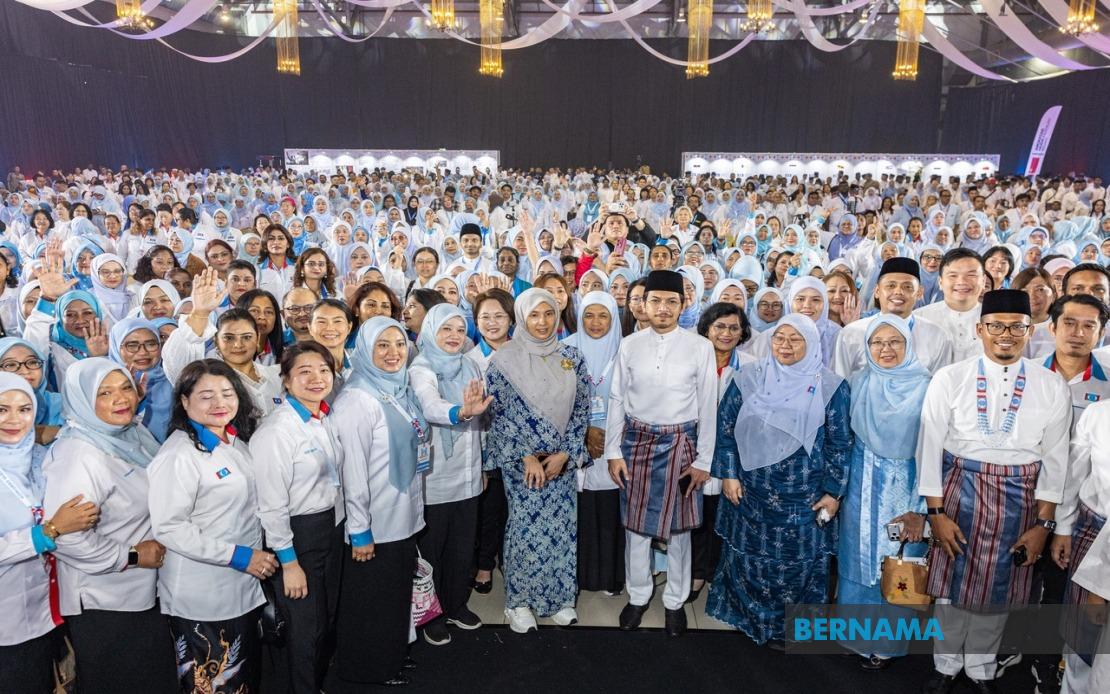
Parti Keadilan Rakyat must move beyond mere popularity and construct a more persuasive political narrative to reclaim public trust, according to Muhammad Kamil Abdul Munim, chief of the party's youth wing Angkatan Muda Keadilan. Speaking at the 2026 AMK National Congress in Melaka on August 14, he identified a critical weakness in PKR's capacity to convert grassroots enthusiasm into electoral victories, a persistent challenge that has plagued the reformist party even as it now holds government office.
The challenge facing PKR reflects a broader transformation in Malaysian politics. Unlike the era since 1998 when the party rode waves of spontaneous public sympathy—when ordinary citizens voluntarily became part of its machinery—the landscape has fundamentally shifted. Muhammad Kamil's assessment suggests that the party cannot rely on historical goodwill or protest voting to carry it through future elections. The disappointing outcomes in the Sabah, Johor, and Negeri Sembilan state elections have exposed an uncomfortable truth: the party's formal organisational structures remain insufficiently developed to capitalise on whatever public support still exists.
This diagnosis carries particular significance for Malaysia's political future. PKR, as the largest component of the Pakatan Harapan coalition, faces mounting pressure to demonstrate that it can sustain governance and retain electoral competitiveness. The party's evolution from opposition outsider to government participant has created new demands and expectations. Citizens and party members alike now evaluate PKR not primarily through the lens of reform aspirations but through the practical lens of administrative performance, resource distribution, and tangible policy outcomes. This transition requires a fundamentally different political approach than the one that built the party's reputation in the 1990s and 2000s.
Muhammad Kamil's call for organisational renewal reflects recognition that PKR must rebuild its internal machinery with greater sophistication and discipline. Party leadership and grassroots members alike must internalize that managing government is fundamentally different from advocating for change from the opposition benches. The strategic challenges, operational complexity, and stakeholder management all demand higher levels of coordination, messaging discipline, and grassroots mobilization capacity. Without these improvements, the party risks finding itself vulnerable in the next general election, despite controlling significant portions of the federal and state bureaucracies.
The youth wing chief implicitly critiqued PKR's current communication strategy, suggesting that the party's public positioning lacks compelling coherence. In competitive democracies, political parties succeed by articulating clear narratives about their vision, achievements, and future direction. A fragmented or unconvincing message, no matter how well-intentioned the underlying policies, fails to mobilise voters and inspire activist participation. For a party that has historically attracted idealistic supporters, this messaging challenge may prove particularly damaging if it allows voters to question whether PKR has genuinely transformed Malaysia or simply replaced one set of political operators with another.
Fadhlina Sidek, chief of PKR's women's wing, amplified these themes during her address to the congress, urging delegates to use the gathering as an exercise in honest self-assessment. Her emphasis on acknowledging weaknesses and shortcomings suggests that PKR's leadership recognises the need for introspection rather than defensive posturing. This intellectual honesty, if translated into concrete organisational changes, could prove valuable. However, the gap between acknowledging problems and implementing solutions remains substantial. Many political parties have conducted similar self-critical exercises without producing meaningful institutional change.
The congress itself, held at the Melaka International Trade Centre, represented an important moment for PKR's mid-level and grassroots leadership to contribute their perspectives and recommendations. Opened by PKR deputy president Nurul Izzah Anwar and attended by vice-president Datuk Seri Dr Zaliha Mustafa, the gathering encompassed the party's formal hierarchy and organisational structure. Yet the effectiveness of such congresses depends entirely on whether leadership genuinely incorporates grassroots feedback into policy and strategy or merely tolerates dissenting voices without acting upon them.
The timing of this organisational reckoning matters considerably for Malaysia's political trajectory. The next general election, scheduled for 2026, looms as a critical test of whether the ruling Pakatan Harapan coalition can retain power or whether voter dissatisfaction will sweep it from office. PKR, as the coalition's largest Malay-Muslim party, bears particular responsibility for electoral performance in peninsular Malaysia. If the party cannot strengthen its grassroots organisation and develop more compelling messaging within the next two years, it risks repeating the disappointing results it experienced in the recent state polls.
The underlying challenge extends beyond mere tactical concerns. Voters throughout Southeast Asia increasingly expect political parties to deliver specific improvements in living standards, public services, and economic opportunity. Protest voting—the phenomenon that sustained PKR through much of its opposition phase—has limited durability in systems where voters can actually evaluate government performance. This reality demands that PKR develop both superior organisational capacity and genuine policy achievements to showcase to the electorate. Without both elements, rhetorical appeals to reform and change will ring hollow.
Muhammad Kamil's remarks also highlighted the paradox facing any opposition-turned-government party. The very qualities that made PKR effective as a reform movement—decentralisation, participatory decision-making, anti-establishment messaging—can become liabilities once that party assumes responsibility for the state apparatus. Conversely, the hierarchical discipline and centralised messaging that effective governments require often conflict with the participatory culture that attracted PKR's most dedicated activists. Resolving this tension requires sophisticated organisational thinking and principled leadership willing to make difficult choices about institutional evolution.
Looking forward, PKR's ability to execute the renewal programme implicitly outlined in these congress speeches will substantially influence Malaysian politics over the coming years. The party's 2026 trajectory will signal whether the current government coalition represents a genuine new chapter in Malaysian governance or merely a temporary interregnum before electoral pendulum swings return power to opposition forces. For Malaysian voters and the broader Southeast Asian region observing democratic governance patterns, the stakes of PKR's institutional development should not be underestimated.

