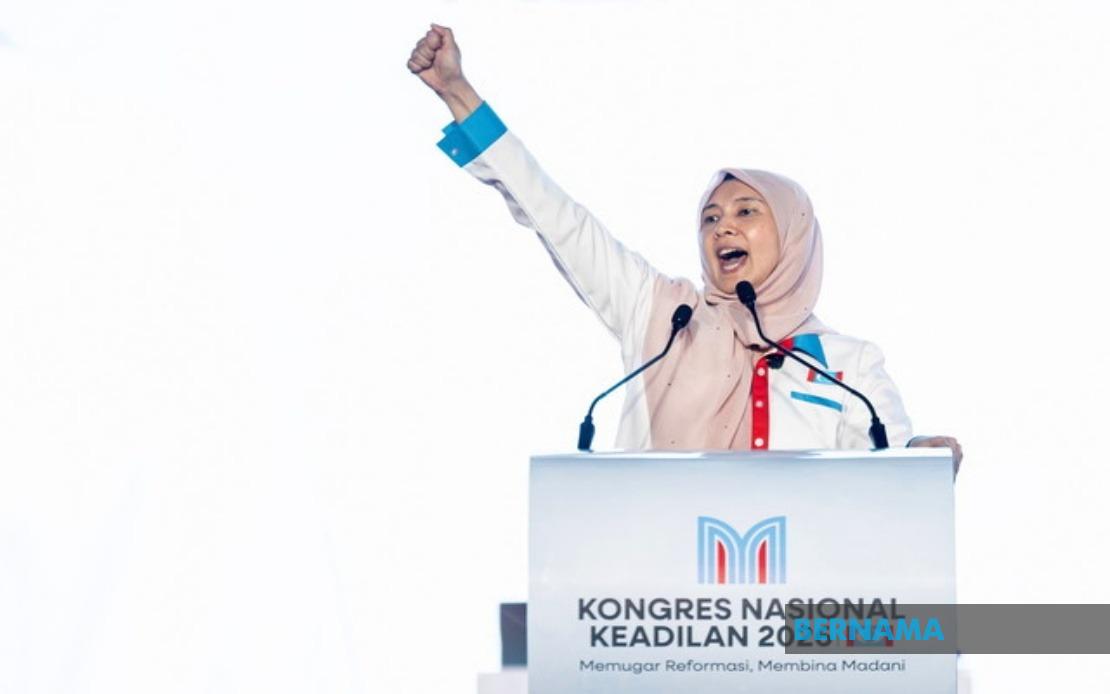
At the PKR 2026 National Congress in Melaka on August 16, deputy president Nurul Izzah Anwar delivered a forceful message that the party's foundational commitment to systemic reform cannot be abandoned simply because PKR now holds ministerial positions. Speaking during her closing remarks at the Melaka International Trade Centre, she framed the challenge facing the coalition as maintaining the vigour that defined PKR's emergence as a political force while simultaneously translating that momentum into tangible governance outcomes.
Nurul Izzah's intervention addresses an ongoing tension within reformist parties worldwide: the risk that governing responsibilities dilute the ideological edge that propelled them into office. She argued that party members must continue championing structural change at every level, from internal party democracy to policy implementation across government agencies. The principle, she suggested, should guide not merely symbolic gestures but substantive institutional transformation that extends across multiple administrations and outlasts individual leaders.
The deputy president cited the repeal of the Universities and University Colleges Act 1971 as a concrete example of how PKR's long-standing advocacy translated into legislative achievement once the party gained executive influence. AUKU, which had restricted student activism and political expression on campuses, had been a focal point of PKR's reform narrative for decades. Its repeal represented not a destination but validation that sustained pressure, coupled with political power, could dismantle restrictive colonial-era legislation. She presented this accomplishment as a template: reform agendas do not become redundant upon assumption of office; rather, they acquire new pathways for realisation.
However, Nurul Izzah emphasised that economic growth metrics alone cannot satisfy the party's reform obligations. Under the MADANI Government framework, Malaysia has recorded respectable gross domestic product expansion, yet she warned that headline figures obscure whether ordinary citizens experience improved living standards. This distinction between macroeconomic performance and household economic reality is particularly salient for Southeast Asia, where rapid growth has frequently coincided with wage stagnation and widening inequality. PKR, she implied, must ensure that the benefits of national economic expansion reach workers through better employment opportunities, fairer salary structures, and expanded entrepreneurial avenues for underrepresented groups.
Nurul Izzah identified specific constituencies requiring targeted economic policy intervention. Small and medium enterprises, which constitute the backbone of Malaysia's informal and semi-formal economy, need structural support mechanisms beyond periodic credit schemes. Women's economic participation remains constrained by both institutional barriers and family-care obligations that disproportionately burden female workers. Young people face entry barriers into stable employment and asset-building opportunities as property prices and credential inflation create generational disadvantages. These groups, she suggested, must receive deliberate policy prioritisation rather than incidental inclusion in generic growth strategies.
The emphasis on wage structure reform addresses a fundamental economic grievance across Malaysia and the broader region. Productivity gains have not proportionally translated into worker compensation, creating a disconnect between national economic expansion and household purchasing power. Nurul Izzah's call for salary structures that reflect productivity improvements suggests PKR should champion wage-setting mechanisms, potentially including sectoral minimum wage frameworks and negotiating space for organised labour, to ensure workers capture a fair share of economic gains.
Crucially, Nurul Izzah cautioned the party leadership against viewing government positions as personal prerogatives rather than public trusts. This warning reflects ongoing concerns about patronage networks and power consolidation within Malaysian politics, where ministerial appointments frequently become vehicles for individual or factional advancement. She reminded senior figures that titles prove ephemeral while legacies endure; the work accomplished and values demonstrated define whether leaders are remembered positively by successors and the public.
Her framing invokes classical conservative political philosophy while serving reform objectives. The notion that power constitutes a temporary stewardship rather than personal property traditionally anchors arguments for institutional responsibility and succession planning. Applied to a reform-oriented party, however, it becomes a mechanism for preventing reform energy from calcifying into self-serving bureaucratic management. Values embedded in institutional practices, she suggested, persist long after individuals depart, making the careful cultivation of principled governance culture essential for any party claiming transformative intent.
The 2026 Congress setting is significant for Malaysian politics. With the next general election potentially within two to three years, PKR faces strategic choices about deepening reform commitments or consolidating incremental gains. Nurul Izzah's intervention signals that at least a substantial faction within PKR leadership believes the party's legitimacy and internal cohesion depend on continuing the reform trajectory that launched it as a political challenger. This positioning also creates implicit pressure on PKR's coalition partners and government leadership to demonstrate sustained commitment to systemic change rather than merely rotating incumbents.
For Malaysian observers, Nurul Izzah's message carries broader implications for governance quality. She effectively argues that reform must become institutionalised rather than personality-dependent, embedded within structures and practices that survive leadership transitions. This addresses a recurrent pattern in Southeast Asian politics where reformist movements lose momentum once initial changes occur, degenerating into conventional patronage networks. Her emphasis on continuous reform as a legacy commitment suggests PKR aspires toward becoming a fundamentally different type of governing party—one that treats systemic improvement as an ongoing obligation rather than a completed mandate.
The convergence of economic and institutional reform themes in her address reflects sophisticated political strategy. By connecting wage justice and SME support to the broader framework of principled governance, Nurul Izzah presents reform not as a collection of discrete policy items but as an integrated commitment to distributing both political agency and economic opportunity more equitably across Malaysian society. Whether PKR's broader leadership demonstrates equivalent commitment to these principles during the government's remaining term will substantially determine the party's credibility among reform-minded voters heading into the next electoral cycle.

