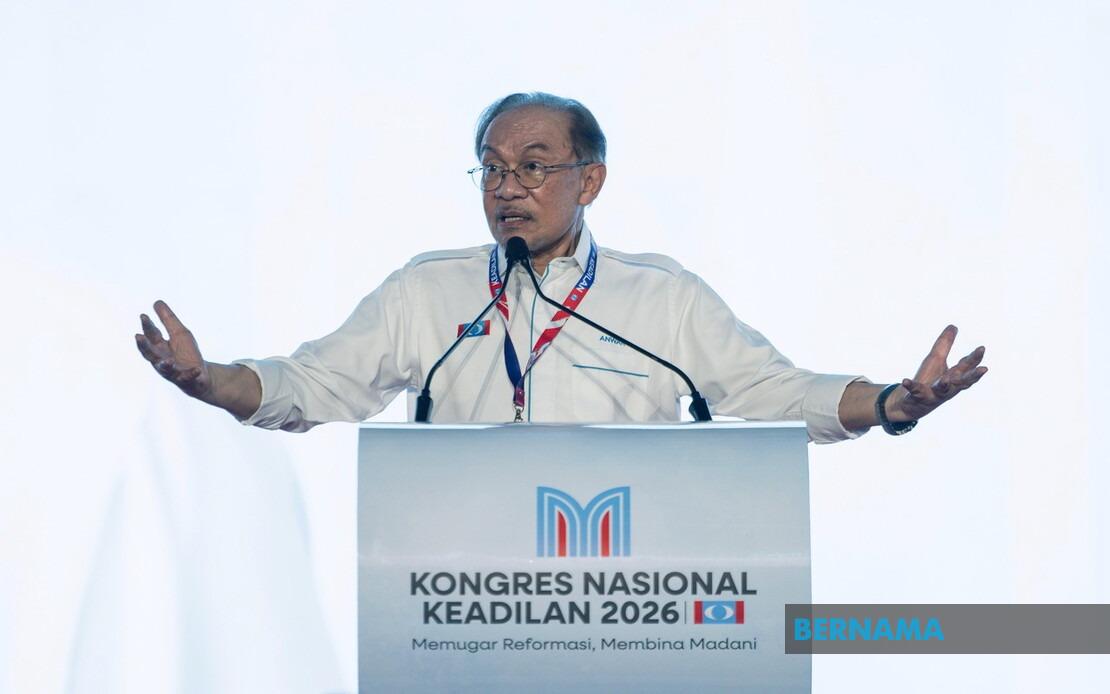
Prime Minister Datuk Seri Anwar Ibrahim announced on August 16 that the government has approved an additional RM1 million allocation directed to each of Malaysia's parliamentary constituencies, with funds flowing directly to communities to tackle immediate local priorities. The initiative targets welfare needs, fundamental infrastructure, and grassroots concerns that require rapid intervention without layers of administrative delay. Making the declaration during his closing address at the 2026 PKR National Congress in Melaka, Anwar framed the measure as reflective of the MADANI Government's dedication to delivering tangible support at the community level.
The additional funding represents a strategic shift towards decentralised assistance, enabling elected representatives and local officials to respond to constituent concerns with greater agility. By circumventing conventional bureaucratic channels, the allocation permits swifter deployment of resources to address pressing issues such as basic services, community welfare programmes, and local infrastructure gaps. This approach acknowledges that grassroots needs are often time-sensitive and that centralised decision-making can impede prompt resolution, a recognised challenge in governance that the government has now moved to address through this direct allocation mechanism.
Anwar, who concurrently serves as Finance Minister, positioned this announcement within the broader framework of the government's existing social protection architecture. The additional RM1 million per constituency complements programmes including Sumbangan Tunai Rahmah (STR) and Sumbangan Asas Rahmah (SARA), initiatives that collectively command a RM16 billion budget. Together, these mechanisms form a comprehensive safety net intended to address economic hardship across income brackets, from the B40 lower-income segment to the M40 middle-income group. The layering of national programmes with constituency-level flexibility creates multiple entry points for assistance, theoretically ensuring that households facing financial strain have accessible avenues for support.
Poverty reduction stands as a centrepiece of the administration's economic narrative. The Prime Minister highlighted that the nation's hardcore poverty rate has declined to 0.09 per cent, a figure that officials cite as evidence of successful policy intervention. While absolute poverty has contracted considerably, the focus on poverty-adjacent pressures—particularly the rising cost of living—reflects acknowledgment that many households remain economically vulnerable despite no longer meeting formal poverty thresholds. The constituency allocation directly targets this cohort, providing local administrators with resources to implement targeted relief measures responsive to regional cost structures and specific community vulnerabilities.
Translating macroeconomic achievements into tangible microeconomic improvements remains a central challenge for developing economies. Anwar's emphasis on this translation reveals awareness that national-level growth statistics often mask uneven distribution of benefits and persistent household financial stress. School assistance schemes, subsidised Rahmah retail operations, and housing finance support represent attempts to channel growth dividends downward, but their effectiveness depends critically on awareness and accessibility. By empowering local constituencies with direct allocation authority, the government presumably hopes to overcome gaps between policy intent and actual citizen benefit realisation.
The RM1 million per constituency represents a substantial aggregate commitment, with 222 parliamentary seats multiplying this base figure to approximately RM222 million in fresh allocations. While significant, this expenditure remains modest relative to annual government budgets, suggesting the funding serves as an catalytic mechanism for local action rather than a comprehensive funding overhaul. The true value proposition hinges on how efficiently constituencies deploy these resources and whether local leadership possesses the capacity and incentive structures to direct funds toward optimal outcomes. In well-administered constituencies with responsive leadership, the allocation could unlock meaningful improvements; in others, institutional weaknesses might limit impact.
Political mobilisation forms an implicit dimension of this announcement. By granting parliamentary representatives direct control over RM1 million annually, the government enhances their capacity to deliver visible benefits to constituents, potentially strengthening political loyalty and electoral positioning. Anwar explicitly called on party machinery at branch and grassroots tiers to disseminate information about government initiatives and ensure citizens actualise available assistance. This emphasis underscores recognition that programme existence alone proves insufficient; citizens must possess knowledge and capability to access benefits, and intermediaries play crucial roles in bridging information gaps.
For Malaysian voters, particularly those in lower and middle-income brackets, the announcement signals executive prioritisation of grassroots concerns. The allocation arrives amid sustained public discourse around cost-of-living pressures, from food prices to housing affordability, issues that daily affect household budgets. Constituency-level flexibility permits responses calibrated to local economic conditions; a rural agriculture-dependent district might deploy funds differently than an urban manufacturing hub. This geographic responsiveness addresses a legitimate governance critique that centralised policies often inadequately account for regional economic variation.
Regionally, Malaysia's approach to grassroots fiscal allocation reflects broader Southeast Asian trends toward decentralisation and local empowerment, though implementation robustness varies considerably across the region. Singapore's town councils and Indonesia's village funds represent alternative models with distinct institutional histories and capacities. Malaysia's new initiative positions itself between these poles—more decentralised than highly centralised systems, yet retaining parliamentary rather than municipal authority. How effectively this hybrid framework functions will inform regional debates about optimal fiscal federalism design.
The sustainability and scalability of the RM1 million allocation depend on Malaysia's fiscal trajectory and competing budgetary pressures. If economic growth continues and government revenues expand, annual renewal becomes feasible. Conversely, economic downturns could necessitate reduction or reallocation, potentially disappointing constituencies and communities expecting continuing support. The reversibility of the measure introduces inherent political risk, as constituencies receiving one year's allocation may regard its absence in subsequent years as a loss rather than a forgone gain.
Implementation challenges will substantially determine whether this initiative meaningfully improves grassroots conditions. Constituencies must develop transparent, merit-based allocation mechanisms to prevent fund misappropriation or political favouritism. Monitoring and accountability mechanisms must prevent funds flowing to connected contractors or ineffective projects. Corruption risks persist particularly in constituencies with weak institutional cultures. The government's success depends partly on establishing oversight frameworks that balance local autonomy with national accountability standards, a challenging institutional balance in any governance context.
Moving forward, the effectiveness of this allocation will become apparent through monitoring of project implementation, community feedback, and comparative assessment across constituencies. Constituencies achieving demonstrable improvements in local amenities and service delivery will provide models for others, while poorly-performing constituencies may warrant intervention or capacity building. The announcement also creates opportunities for civil society monitoring, enabling citizen groups to track fund deployment and outcomes, potentially enhancing accountability beyond formal government mechanisms.

