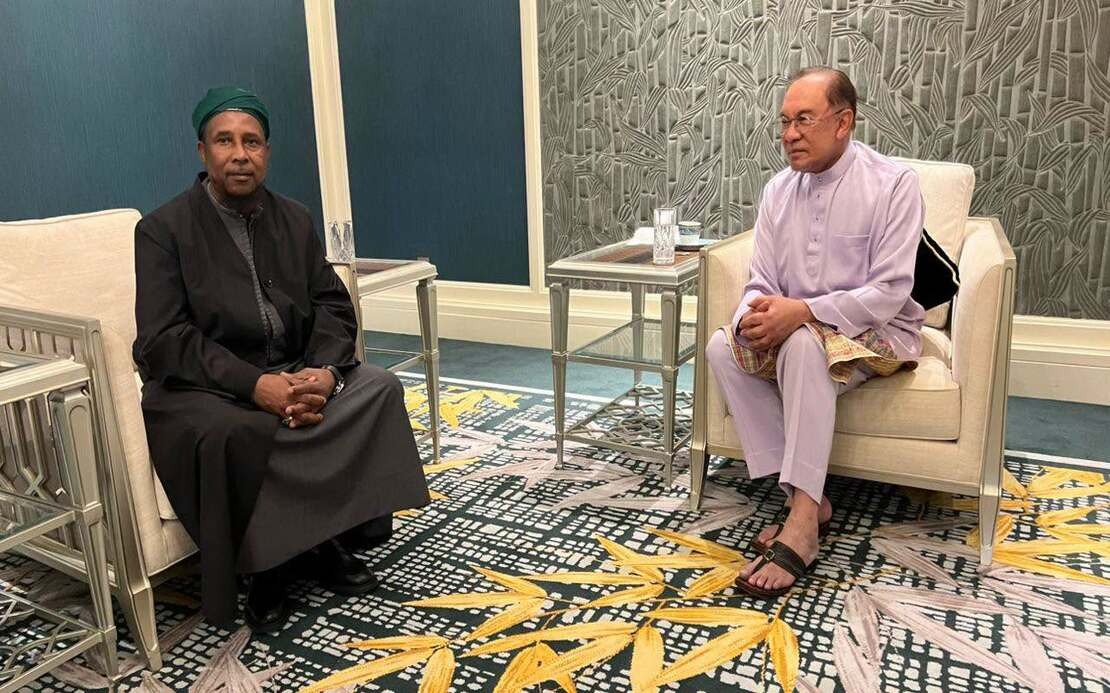
Prime Minister Datuk Seri Anwar Ibrahim hosted a final audience with Gambian Islamic scholar Sheikh Muhammad Haydara Al-Jilani on June 26, marking the conclusion of the religious leader's month-long sojourn in Malaysia. The meeting, documented through the Prime Minister's official social media, underscored Malaysia's continuing role as a hub for Islamic scholarship and interfaith religious programming in Southeast Asia.
During his extended stay, Sheikh Muhammad Haydara Al-Jilani traversed Malaysia to conduct a comprehensive series of knowledge-dissemination and dhikr gatherings at multiple venues nationwide. The scholar's itinerary reflected the widespread demand for Islamic education and spiritual enrichment across Malaysian communities, demonstrating how visiting religious personalities continue to draw substantial audiences keen to engage with international Islamic teaching traditions. The structured nature of the tour, spanning several locations, suggests careful coordination with local Islamic institutions and community organisations.
The timing of the farewell audience carried particular spiritual significance, as it coincided with the Day of Ashura, a solemn occasion in the Islamic calendar commemorating the tenth day of Muharram. Anwar seized this moment to request the scholar's supplications for Malaysia's collective welfare, explicitly asking for prayers targeting national prosperity, domestic peace, and the continuation of divine blessings upon the country. This practice of seeking special intercessions from visiting religious scholars reflects deep-rooted traditions within Malaysian Islamic culture, where respected spiritual leaders are often approached for their prayers during significant religious observances.
Anwar's engagement with the Gambian scholar extends beyond mere ceremonial courtesy, reflecting the Malaysian government's strategic interest in fostering intellectual and spiritual exchanges with the broader Muslim world. The Prime Minister's public acknowledgement of the visit through his Facebook post amplifies the significance of such visits, signalling to both domestic constituencies and the international community Malaysia's openness to religious scholarship from diverse Muslim-majority nations. The West African connection, represented through The Gambia, also illustrates Malaysia's soft power reach across continents and its role in maintaining cross-regional Islamic networks.
The dakwah programme—the comprehensive religious outreach initiative—that framed Sheikh Muhammad Haydara Al-Jilani's visit represents a significant dimension of Malaysia's Islamic institutional landscape. Such programmes typically blend traditional Islamic learning with contemporary spiritual practice, offering practitioners opportunities to deepen their understanding of Quranic teachings, hadith sciences, and mystical dimensions of Islamic spirituality. The dhikr sessions, communal remembrance of God through structured recitation and meditation, particularly resonate with Malaysian Muslim communities seeking spiritual renewal and deeper connection to Islamic practice.
The selection of Sheikh Muhammad Haydara Al-Jilani as a visiting scholar suggests careful vetting by Malaysian Islamic authorities and organisations. His standing as a recognised scholar from The Gambia, a West African nation with deep Islamic traditions, indicates the international reach of Islamic scholarly networks. Such exchanges contribute to the intellectual vitality of Malaysian Islam, exposing local students and practitioners to various schools of Islamic thought and interpretive traditions. The month-long duration of the visit allowed for substantive engagement rather than superficial ceremonial appearances.
Malaysia's receptivity to international Islamic scholars reflects the country's position as a regional centre for Islamic learning and practice. The consistent flow of visiting scholars, educators, and spiritual leaders through Malaysian cities demonstrates the robustness of institutional frameworks supporting Islamic education and community engagement. Universities, mosques, Islamic centres, and community organisations regularly facilitate such visits, creating pathways for knowledge transfer and spiritual enrichment. This infrastructure positions Malaysia as an attractive destination for scholars seeking to disseminate their teachings to receptive Southeast Asian audiences.
The Prime Minister's participation in bidding farewell to such scholars also carries diplomatic dimensions. It signals respect for international Islamic personalities and reinforces Malaysia's commitment to fostering warm relations with Muslim-majority nations globally. The public nature of Anwar's engagement, through social media documentation, ensures that the significance of such exchanges reaches wider audiences, including those outside formal Islamic institutional structures. This approach democratises access to information about Malaysia's Islamic programmes and reinforces the government's narrative of promoting religious harmony and spiritual development.
Looking forward, Sheikh Muhammad Haydara Al-Jilani's departure concludes one chapter in the ongoing story of transnational Islamic knowledge networks operating across Asia and Africa. The relationships forged during his month in Malaysia, whether between himself and local scholars, community leaders, or individual practitioners, will likely persist through written correspondence, recorded teachings, and the memories of those who attended his sessions. Such personal and intellectual connections strengthen the fabric of global Islamic communities and provide Malaysian practitioners with direct linkages to respected international teachers.
The farewell visit ultimately encapsulates Malaysia's dual commitment to nurturing robust domestic Islamic institutions while simultaneously engaging meaningfully with the international Islamic scholarly community. By hosting and honoring visiting scholars like Sheikh Muhammad Haydara Al-Jilani, Malaysia affirms its identity as both a regional Islamic centre and a participant in broader transnational religious movements. These interactions, while sometimes overlooked in secular media coverage, constitute important soft power activities that shape Malaysia's international standing and deepen its integration into global Islamic networks.

