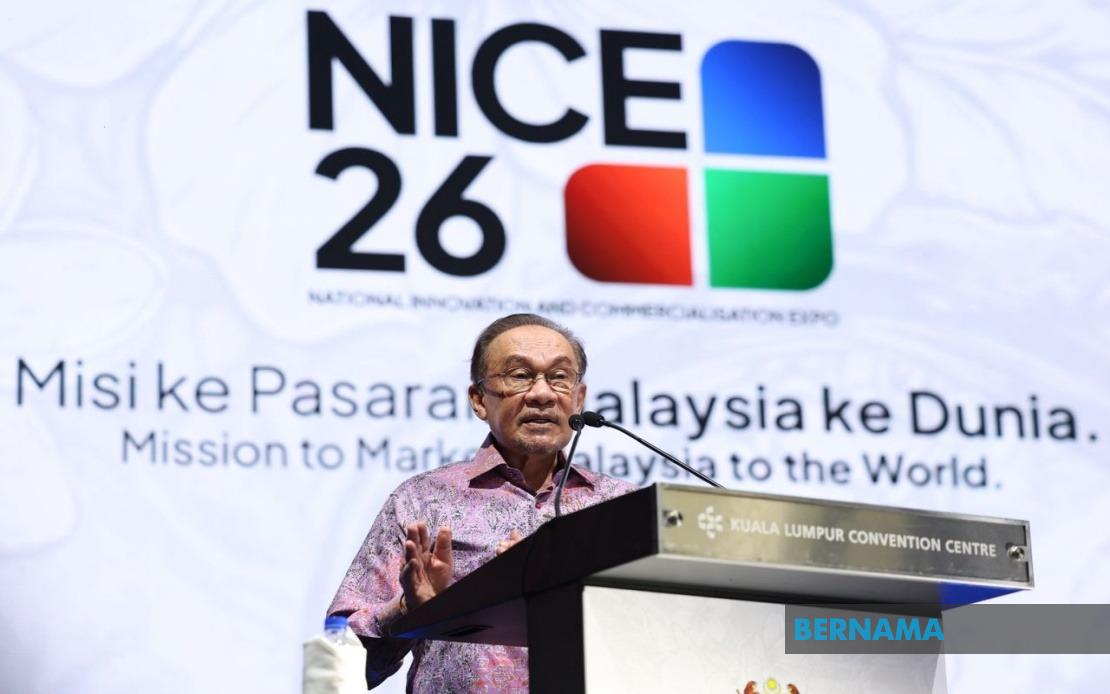
Prime Minister Datuk Seri Anwar Ibrahim has delivered a stark message to Malaysia's innovation ecosystem: the country's administrative machinery must shed decades of entrenched procedures or risk falling irreversibly behind in the global race for technological advancement. Speaking at the National Innovation and Commercialisation Expo 2026 at the Kuala Lumpur Convention Centre, Anwar identified bureaucratic gridlock as a critical constraint on Malaysia's ability to compete internationally in emerging fields like artificial intelligence, biotechnology, and digital innovation.
The Prime Minister's remarks reflected a growing recognition that Malaysia's institutional structures, designed for stability and oversight in earlier eras, have become impediments to the speed required in contemporary innovation ecosystems. He emphasised that the world's most competitive economies have deliberately dismantled the layered approval processes, multiple committee reviews, and extended timelines that once characterised government administration. In contrast, Malaysia's traditional model—whereby major institutional decisions traverse various senate committees, faculty councils, and administrative checkpoints—can extend timelines for critical initiatives by months or years.
Anwar illustrated his argument with a concrete example from the higher education sector. The establishment of Artificial Intelligence faculties at several Malaysian universities was successfully completed in just three months, a stark departure from the standard timeline of approximately one year under conventional procedures. This acceleration was achieved by circumventing the traditional bureaucratic architecture that would normally require multiple rounds of deliberation, approval, and coordination among different administrative layers. The contrast underscored a central tension: Malaysia possesses the institutional ambition to lead in innovation but lacks the organisational agility to match that ambition.
The Prime Minister's critique extends beyond mere inefficiency; it addresses a fundamental philosophical question about how governments should structure decision-making in rapidly evolving sectors. Industries built around artificial intelligence, advanced manufacturing, and digital commerce operate on timelines measured in months or weeks, not years. A delay of even six to twelve months can render an entire initiative obsolete or cause Malaysia to trail competitors who have already established market presence and accumulated expertise. Anwar's challenge implicitly acknowledges that government structures designed for rigorous oversight and careful consensus-building, while valuable for certain functions, actively undermine the experimental, iterative approach that characterises modern technological development.
The implications for Malaysia's competitiveness are substantial. Nations across Southeast Asia and beyond have recognised that attracting investment in high-technology sectors requires not just financial incentives but operational environments where decisions can be made swiftly and deployment can begin promptly. Singapore, South Korea, and latterly Vietnam have restructured their institutional frameworks to enable fast-track approvals for technology initiatives. Malaysia risks ceding competitive advantage if its public institutions cannot match this pace. Universities, research institutes, and government agencies involved in innovation support must have the autonomy and authority to move decisively without constant referral to higher committees or extended consultation periods.
Anwar's directive specifically targets the Ministry of Science, Technology and Innovation and other relevant government agencies, compelling them to acknowledge that the post-pandemic, rapidly digitising world demands fundamentally different operational practices. He rejected the notion that innovation can proceed within the constraints of traditional governance frameworks, effectively instructing ministers to implement what amounts to institutional revolution rather than incremental reform. This signals presidential-level commitment to restructuring, suggesting that resistance from those comfortable with existing processes should expect little sympathy from the highest level of government.
The practical mechanics of such reform remain complex. Eliminating bureaucratic safeguards entirely risks poor decisions, inadequate oversight, and misallocated resources. The challenge lies in distinguishing between the delays caused by unnecessary procedural repetition versus those rooted in legitimate needs for financial accountability, quality assurance, and ethical governance. Malaysia must develop new governance models that preserve necessary oversight while eliminating redundant approval layers. This might involve creating streamlined fast-track pathways for innovation initiatives while maintaining standard processes for routine administrative matters.
For Malaysian businesses and research institutions, Anwar's statements offer both opportunity and urgency. The government is signalling willingness to remove procedural obstacles that have historically frustrated innovators and entrepreneurs. However, the window for such reforms is finite; Malaysia must move decisively before the institutional inertia reasserts itself or political priorities shift. Institutions that have already begun restructuring their internal processes will gain first-mover advantages, while those waiting for top-down directives to cascade through the bureaucracy risk being left behind.
The broader regional context amplifies the stakes. Southeast Asia is experiencing intense competition among nations to position themselves as regional technology hubs. Malaysia possesses advantages in infrastructure, human capital, and financial resources, but these advantages erode if decision-making processes remain slower than those of neighbours. Anwar's intervention at NICE 2026 represents recognition that institutional agility has become a competitive asset as important as traditional resources like capital or natural endowments. The question now is whether Malaysia's bureaucratic apparatus can be successfully transformed or whether decades of institutional practice will ultimately prevail over top-level directives for change.

