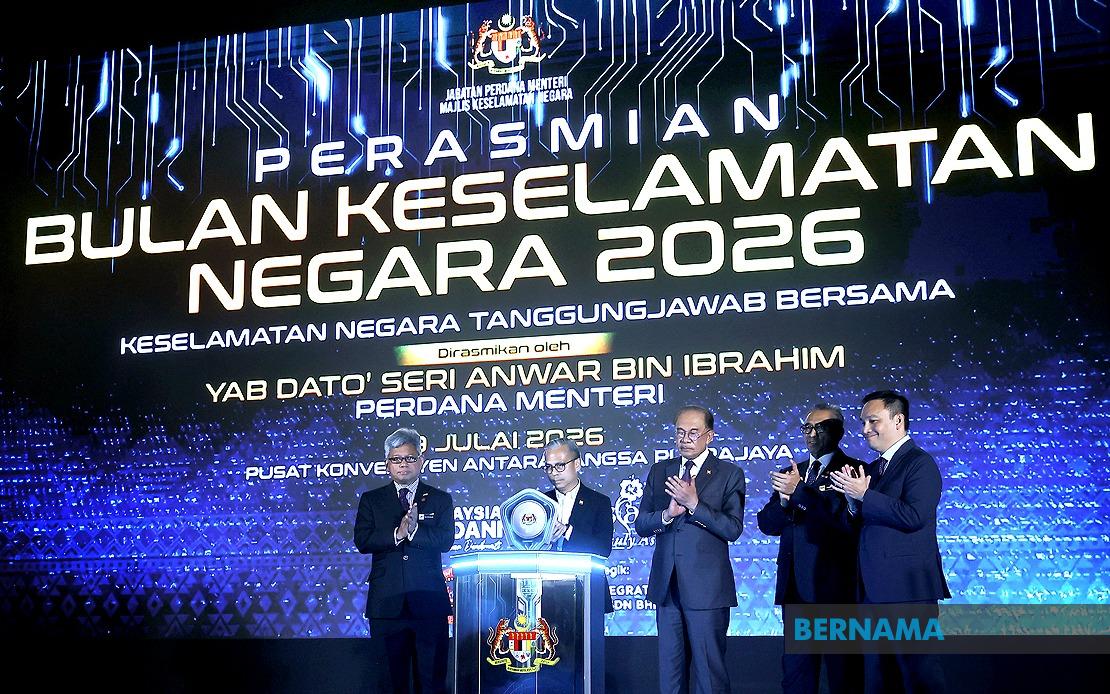
Prime Minister Datuk Seri Anwar Ibrahim has sounded an alarm over Malaysia's continued preoccupation with state, racial and religious grievances, arguing that such divisions threaten both national cohesion and the country's ability to respond to evolving security challenges. Speaking during the official launch of National Security Month 2026 at the National Security Council headquarters in Putrajaya, Anwar expressed frustration that Malaysian political discourse remains anchored to longstanding disputes over identity rather than addressing contemporary security imperatives.
The Prime Minister's intervention reflects growing anxiety within government circles that domestic political divisions are creating vulnerabilities at a time when threats are becoming increasingly sophisticated. Anwar pointed specifically to parliamentary debates, noting that legislators continue to relitigate old grievances surrounding communal identity and regional interests even as the nation faces unprecedented dangers from technological innovation and digital exploitation. His comments suggest that the administration views this disconnect between political preoccupations and actual security needs as not merely unhelpful but genuinely dangerous.
The security landscape Malaysia confronts today has expanded dramatically beyond traditional concerns. Cyber attacks, artificial intelligence misuse, digital infrastructure vulnerabilities, and novel forms of information warfare now rank alongside conventional threats. Anwar's warning implies that the government cannot afford the luxury of recycling historical disputes when emerging technologies create novel vectors for destabilisation. The complex nature of these threats demands institutional agility and forward-thinking analysis that cannot coexist with politicians locked in perpetual battles over identity.
Anwar, who simultaneously holds the Finance portfolio, emphasised that responsibility for this strategic reorientation falls squarely on leaders across all government departments, agencies and ministries. He rejected the notion that responding to security threats constitutes routine bureaucratic work, instead framing it as a fundamental obligation of governance. The implication is clear: security is not the responsibility of specialised agencies alone but rather demands active engagement from senior figures across the entire administration.
The gathering included Communications Minister Datuk Fahmi Fadzil, Chief Secretary to the Government Tan Sri Shamsul Azri Abu Bakar, and National Security director-general Datuk Raja Nurshirwan Zainal Abidin, suggesting the government is mobilising its highest echelons around this security agenda. This shows that addressing modern threats is positioned as a whole-of-government priority rather than a peripheral concern.
Anwar called for a fundamental shift in institutional mindset, advocating that leaders become proactive rather than reactive in confronting security challenges. The conventional approach of waiting for crises to materialise before mobilising responses is, in his view, inadequate for contemporary threats. Such a posture requires organisations to develop capacity in understanding emerging technologies, monitoring nascent risks, and devising countermeasures before vulnerabilities are exploited.
For Malaysian readers, Anwar's comments carry particular significance in a region where identity politics remains deeply embedded in electoral competition and governance. Southeast Asian nations across the spectrum struggle to balance legitimate concerns over cultural and religious identity with the practical demands of economic development and security. Anwar's argument essentially suggests that Malaysia cannot simultaneously win on both fronts if politicians continue investing energy in historical grievances.
The thrust of the Prime Minister's remarks also carries implications for Malaysia's position within the broader Indo-Pacific security environment. As the region grapples with great power competition, technological disruption, and transnational threats, individual nations that fail to modernise their security posture risk marginalisation. Countries that remain consumed by internal divisions are less able to contribute meaningfully to regional stability or to advocate effectively for their interests.
Anwar's intervention reflects a tension that many governments across the developing world confront: the pull of democratic politics, which often rewards appeals to identity, versus the imperatives of effective statecraft, which demand focus on evolving challenges. By articulating this tension publicly, Anwar appears to be attempting to shift elite discourse away from identity grievances toward security pragmatism. Whether this rhetorical move translates into actual political behaviour remains to be seen.
The establishment of National Security Month 2026 itself suggests the government recognises the need to cultivate greater public and institutional awareness of security matters. Such public campaigns typically aim to build consensus around the seriousness of threats while mobilising collective response. Anwar's remarks at the launch indicate that the administration intends to use this platform to reframe national priorities.
Ultimately, Anwar's warning touches on a fundamental question of national strategy: whether Malaysia can afford to remain distracted by the politics of identity when confronted by security threats that respect no communal boundaries. The challenges posed by cyber warfare, digital manipulation, and technological disruption are inherently blind to race, religion, or regional affiliation. Institutions and leaders that remain fixated on such divisions risk fielding responses that are fragmented, inefficient, and ultimately ineffective.

