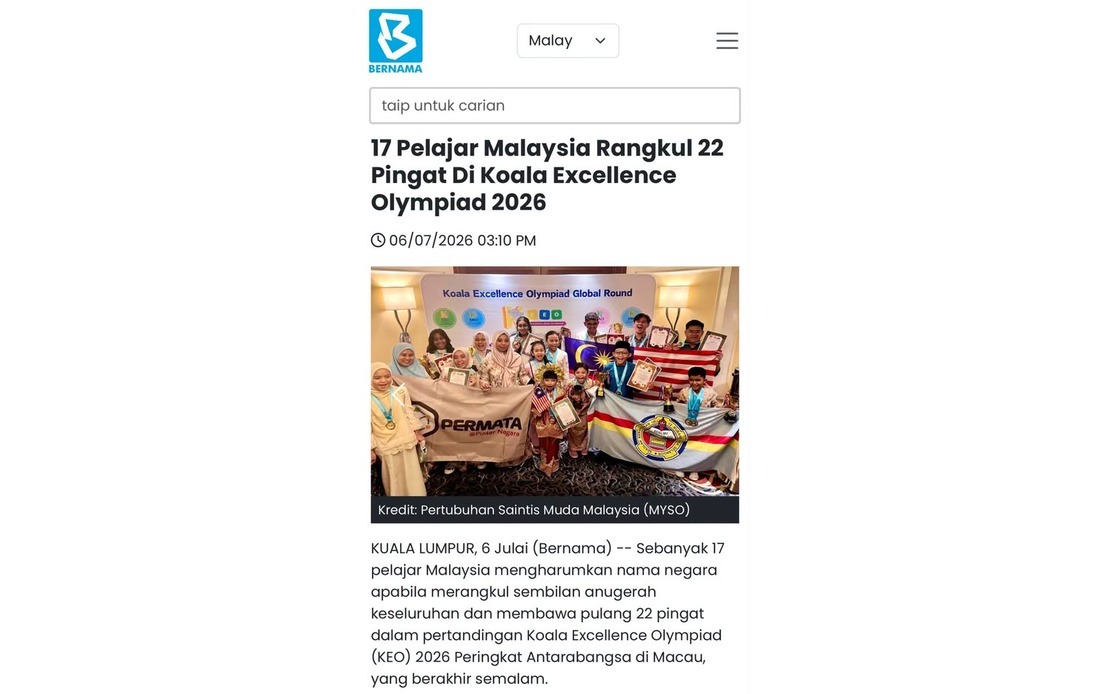
Prime Minister Datuk Seri Anwar Ibrahim has publicly commended a delegation of 17 Malaysian students for their impressive performance at the 2026 Koala Excellence Olympiad (KEO) Global Finals held in Macau, which wrapped up this week. The cohort collectively earned nine overall awards alongside a substantial medal tally that underscores Malaysia's growing competitiveness in international academic competitions. Through a post on social media platform X, the PM urged the young scholars to maintain their trajectory toward excellence and aspire to even greater accomplishments moving forward.
The Malaysian team's medal harvest consisted of five gold medallists, six silver medallists, and eleven bronze medallists, according to Malaysia Young Scientists Organisation (MYSO) coordinator Aidah Misran, who led the Malaysian contingent to the competition. This diverse medal distribution reflects strong performance across multiple competitors rather than dominance in a single discipline, suggesting a well-rounded selection process and comprehensive preparation across the student group. The breadth of the achievement highlights the depth of academic talent available within Malaysia's secondary and tertiary education systems.
The Koala Excellence Olympiad represents a significant platform for young academics to test their mettle against international peers. Developed by Australian educational specialists and alumni, the competition encompasses four core academic domains: English, Mathematics, Science, and Arts. By bringing together students from multiple nations, KEO creates an environment where participants encounter diverse perspectives, problem-solving approaches, and learning methodologies that extend beyond their domestic educational frameworks. For Malaysian participants, such international exposure is invaluable in developing globally-oriented intellectual capabilities.
In Malaysia, MYSO serves as the official coordinating body for the KEO competition, working alongside KEO and Miss Man International Group to organise selection processes, training programmes, and logistical arrangements for competing students. This collaborative structure ensures that Malaysian participants benefit from rigorous preparation and structured mentoring before travelling to international venues. The involvement of such dedicated youth science organisations reflects a broader national commitment to nurturing young talent and maintaining competitive standing in regional and global educational spheres.
Malaysia's consistent participation in major international Olympiad competitions signals strategic investment in human capital development. These competitions serve purposes beyond trophy collection; they identify promising young minds early, provide exposure to advanced problem-solving techniques, and help establish networks among high-achieving peers across borders. For Malaysian education stakeholders, medal counts at events like KEO offer concrete metrics by which to assess the effectiveness of national curriculum standards and enrichment programmes.
The recognition extended by the Prime Minister carries weight beyond ceremonial acknowledgement. When senior government figures publicly celebrate educational achievements, they reinforce societal messaging about the value placed on intellectual pursuits and academic excellence. In the context of Malaysia's aspirations toward becoming a high-income developed nation, such emphasis on youth achievement in STEM and humanities domains aligns with long-term workforce development imperatives. The four-discipline focus of KEO—encompassing both technical and linguistic competencies—mirrors the balanced skill set demanded by evolving global labour markets.
For Malaysian parents and educators, successes at international competitions provide tangible evidence that students in the country can compete effectively alongside peers from more developed nations. This visibility helps counter potential perceptions of educational limitations and encourages greater participation in future competitions. Furthermore, students who medal at prestigious international events often become role models within their schools and communities, inspiring younger cohorts to pursue academic challenges and sustained effort in their studies.
The significance of Malaysia's performance extends to regional dynamics in Southeast Asia. Educational achievements at international platforms contribute to national prestige and soft power, reinforcing Malaysia's identity as a regional hub for education and innovation. As the region experiences rapid economic transformation and increased competition for talent in knowledge-based sectors, demonstrated excellence in academic competitions becomes part of a broader narrative about institutional quality and human capital strength.
Looking ahead, sustained performance at events like KEO requires consistent investment in gifted education programmes, access to advanced training resources, and dedicated mentorship from subject specialists. The success of this year's cohort provides a foundation upon which future selections and preparations can build. Organisers and policymakers would benefit from analysing which schools, regions, and disciplines produced the most medallists, enabling targeted support for underperforming areas while scaling up successful models.
As Malaysia continues navigating post-pandemic educational recovery and longer-term quality enhancement goals, international competition success offers both immediate validation and strategic signposting. The achievements of these 17 students represent not merely personal accomplishment but also a proxy measure of educational system health and competitive capacity. Institutional memory of successful international campaigns, combined with sustained commitment to programmes that identify and develop exceptional young talent, will prove essential for maintaining and building upon these promising foundations in future editions of the Koala Excellence Olympiad and similar platforms.

