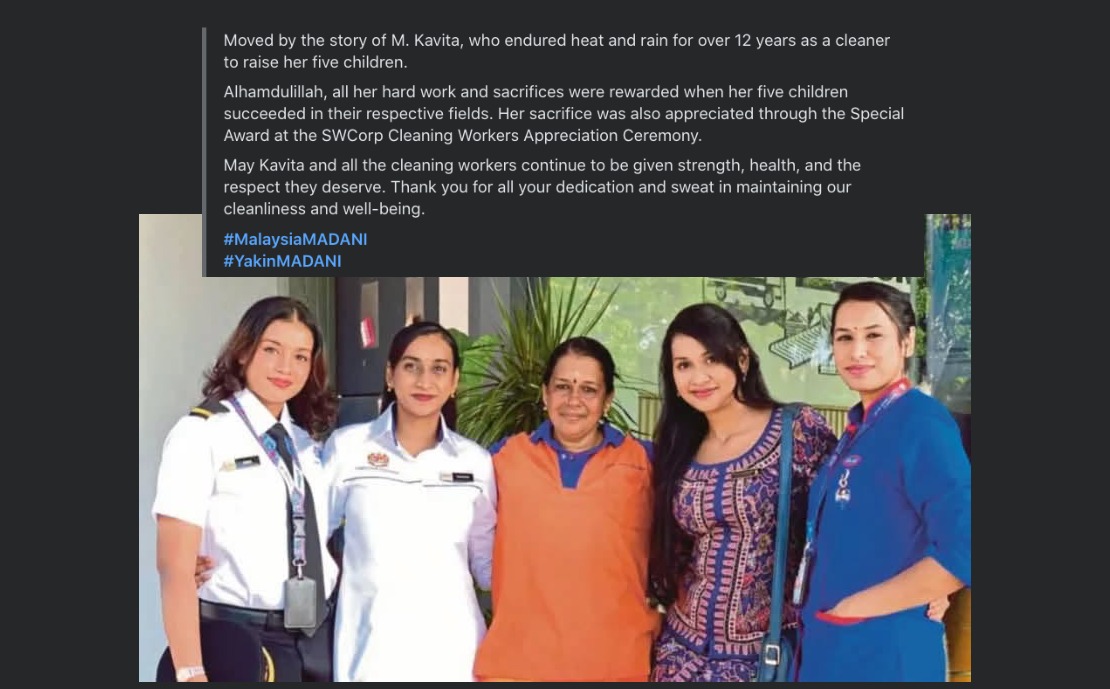
Prime Minister Datuk Seri Anwar Ibrahim has publicly celebrated the life achievements of M. Kavita, a dedicated street sweeper employed by SWM Environment in Seremban, whose unwavering commitment to her family inspired nationwide admiration. Through a Facebook post, Anwar acknowledged the profound impact of Kavita's more than 12 years of labour performed across all weather conditions, work that ultimately enabled her five children to flourish in their respective professional pursuits.
Kavita's story gained widespread traction on social media last month when her children orchestrated a surprise celebration of her 50th birthday at her workplace. The emotional moment captured public imagination precisely because it crystallised a common yet often overlooked narrative within Malaysian society—the quiet sacrifices of frontline workers whose contributions remain largely invisible despite their essential role in maintaining public health and environmental standards. The appearance of four of her daughters in their professional uniforms—including those of a pilot, cabin crew member, and staff nurse—created a poignant visual testament to how parental dedication can transcend economic circumstances.
The Prime Minister's acknowledgment carries particular significance within Malaysia's political context, where celebrations of working-class achievement remain relatively uncommon at the highest levels of government. Anwar's tribute extends beyond mere personal recognition, functioning as an implicit statement about the dignity inherent in all forms of labour. His words—thanking Kavita and all cleaning workers for their dedication in maintaining community wellbeing—reflect a broader discourse about valuing those employed in sanitation and environmental services, sectors that have historically attracted minimal social prestige despite their critical importance.
Kavita's accomplishments were further validated through institutional recognition when she received a Special Award at SWCorp's Cleaning Workers' Day Appreciation ceremony. This dual acknowledgment—both from the nation's highest political office and through formal sectoral recognition—represents an unusual convergence of grassroots acclaim and official validation. For Malaysian readers, particularly those within working-class communities, such moments carry symbolic weight, suggesting that sacrifice and perseverance remain virtues worthy of national attention regardless of professional status.
The trajectory of Kavita's children reflects patterns of social mobility that characterise contemporary Malaysia, where access to education and professional opportunities has expanded significantly across income brackets. That all five children achieved success in distinct fields—spanning aviation, healthcare, and presumably other sectors—underscores both the quality of Malaysia's educational infrastructure and the determination of families operating under constrained economic conditions. These achievements did not materialise through chance but through strategic prioritisation, where parental sacrifices translated directly into educational investment.
The phenomenon of Kavita's story achieving viral status speaks to broader societal currents within Malaysia. Digital platforms have democratised recognition, enabling narratives of everyday heroism to circulate beyond traditional media gatekeepers. The emotional resonance of the birthday surprise video tapped into universal themes of familial love, gratitude, and vindication—themes that transcend socioeconomic boundaries and resonate across diverse Malaysian demographics. In this respect, Kavita's emergence as a minor cultural figure reflects how social media increasingly shapes public consciousness around issues of social value and dignity.
For cleaning workers and sanitation employees across Malaysia, the visibility granted through Kavita's story and the Prime Minister's subsequent recognition may generate tangible or intangible benefits. Improved public regard for frontline environmental workers carries implications for workplace treatment, community perception, and potentially policy considerations around occupational support and benefits. The recognition also provides counterweight to persistent stigmatisation of manual labour, a cultural legacy that continues influencing attitudes toward service sector employment in Malaysia despite economic realities requiring substantial labour force participation in these roles.
The timing of Anwar's tribute reflects evolving political priorities within Malaysia's current administration, which has emphasised social inclusion and recognition of marginalised communities. By highlighting Kavita's contributions through the Prime Minister's platform, the government signals attentiveness to narratives celebrating persistence and success within economically disadvantaged contexts. This positioning aligns with broader governance rhetoric concerning equitable development and inclusive prosperity, messaging that resonates particularly during periods when economic pressures affect working-class households.
Kavita's example also illuminates the gendered dimensions of Malaysian labour, as women constitute significant proportions of both environmental services and domestic support sectors. Her achievement in sustaining five children while maintaining full-time employment reflects navigations of caregiving responsibilities and economic necessity that characterise the lived experiences of many Malaysian women. The celebration of her story, therefore, indirectly validates struggles faced by countless female workers managing multiple responsibilities with limited institutional support or recognition.
Beyond the immediate narrative, Kavita's trajectory demonstrates that educational aspiration and professional achievement remain accessible through family-centred effort and sacrifice within contemporary Malaysia, even when economic circumstances appear constraining. This message holds particular relevance for younger Malaysians from working-class backgrounds, for whom visibility of success stories grounded in their own socioeconomic reality provides both inspiration and validation. The recognition that excellence can emerge from humble circumstances challenges narratives suggesting that professional achievement requires privileged starting points.
The convergence of Prime Minister Anwar's personal tribute, institutional recognition through SWCorp, and organic social media amplification creates a rare moment of unified acknowledgment across political, sectoral, and civil society spheres. Such moments, though infrequent, carry potential to shift baseline expectations regarding public recognition of working-class contributions. As Malaysia navigates ongoing economic pressures and structural inequalities, narratives centring dignity and achievement within constrained circumstances provide important counterbalances to narratives of crisis or decline.
Looking forward, Kavita's story may inspire further institutional reflection on how Malaysian society can better support and recognise essential workers whose labour underpins public health and environmental standards. Whether this recognition translates into substantive policy improvements affecting cleaning workers' compensation, benefits, or working conditions remains an open question. Nevertheless, the unprecedented visibility granted through simultaneous acknowledgment from the Prime Minister and civil society represents a meaningful departure from historical patterns of invisibility affecting Malaysia's sanitation workforce.

