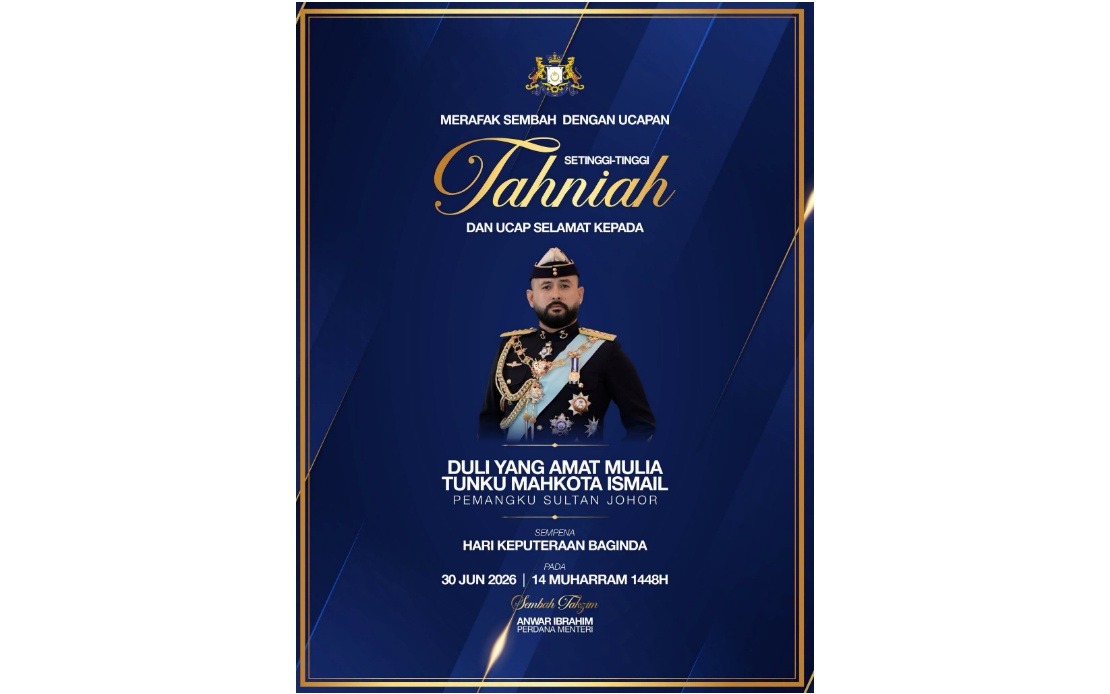
Prime Minister Datuk Seri Anwar Ibrahim marked the birthday of Tunku Mahkota Ismail, Regent of Johor, on June 30 by extending formal congratulations through his official Facebook channel, a gesture that underscores the cordial relationship between the federal government and Johor's traditional monarchy. The birthday celebration of Johor's regent carries significance in Malaysia's constitutional framework, where state rulers maintain ceremonial and symbolic importance alongside their administrative roles within their respective territories.
Anwar's message conveyed more than routine protocol, reflecting the established custom whereby senior federal leaders publicly acknowledge important occasions involving state rulers. In his Facebook post, the Prime Minister expressed wishes for Tunku Mahkota Ismail to enjoy sustained good health and continued well-being, invoking religious blessings typical of such official announcements in Malaysia's multiethnic political culture. These gestures, though ceremonial in nature, serve to reinforce institutional harmony between federal and state-level administrations.
Deputy Prime Minister Datuk Seri Dr Ahmad Zahid Hamidi similarly participated in the commemorative occasion, publishing his own Facebook message that went beyond basic congratulations to articulate specific hopes for the Johor regent. Zahid's statement reflected the conventional Islamic invocations employed by Muslim leaders in official contexts, requesting divine mercy and protection for Tunku Mahkota Ismail as he carries out his responsibilities governing Johor Darul Ta'zim.
The Deputy Prime Minister's remarks specifically referenced Tunku Mahkota Ismail's role in leading the people of Johor, acknowledging both the ceremonial and substantive dimensions of the regency. By praying that Allah SWT grant the regent wisdom to guide the state and its inhabitants, Zahid's message connected personal well-wishes with the broader governance structure that defines Malaysia's constitutional monarchy system. This framing demonstrates how state rulers are publicly positioned as custodians of their territories' welfare and development.
Johor's significance within Malaysia's political and economic landscape makes the regent's position particularly prominent. As one of the nation's largest and most economically developed states, Johor commands considerable influence, and its traditional ruler maintains substantial symbolic authority within this framework. The birthday acknowledgments from Anwar and Zahid thus carry wider implications for federal-state cooperation, particularly in an era where coordination on economic policy, infrastructure development, and regional governance remains essential.
The practice of federal leaders publicly recognizing royal occasions reflects Malaysia's unique political system, where constitutional monarchy intertwines with parliamentary democracy. Unlike purely republican systems, Malaysia's framework necessitates regular formal engagement between elected federal leaders and state rulers, and these public messages serve as visible manifestations of that constitutional relationship. Such greetings help maintain the ceremonial dimensions that bind Malaysia's complex multi-layered governance structure together.
Tunku Mahkota Ismail, as Regent of Johor, represents the continuation of the state's royal lineage and its institutional continuity. The contemporary relevance of state regents in Malaysian governance extends beyond ceremonial functions to encompass consultation on significant state matters and the symbolic embodiment of Johor's identity and interests. Federal leaders' acknowledgment of the regent's birthday thus carries implicit recognition of Johor's place within Malaysia's federation and its ruler's role in safeguarding the state's interests.
For Malaysian observers of political and constitutional affairs, these birthday messages illustrate the ongoing importance of formal recognition protocols within the country's governing structure. While the messages themselves remain brief and conventional, their public dissemination through social media platforms reflects how modern Malaysian political communication increasingly occurs through digital channels, even for traditional ceremonial occasions. This blend of ancient protocol and contemporary technology characterizes modern Malaysian governance.
The broader context of federal-state relations in Malaysia makes such gestures more than mere pleasantries. Malaysia's federal system requires sustained cooperation between the national government and thirteen state administrations, each with its own political dynamics and leadership structures. Johor, with its strategic location, significant population, and economic importance, occupies an especially influential position within this network, making the maintenance of cordial relations with its regent a matter of ongoing practical importance for the federal government.

