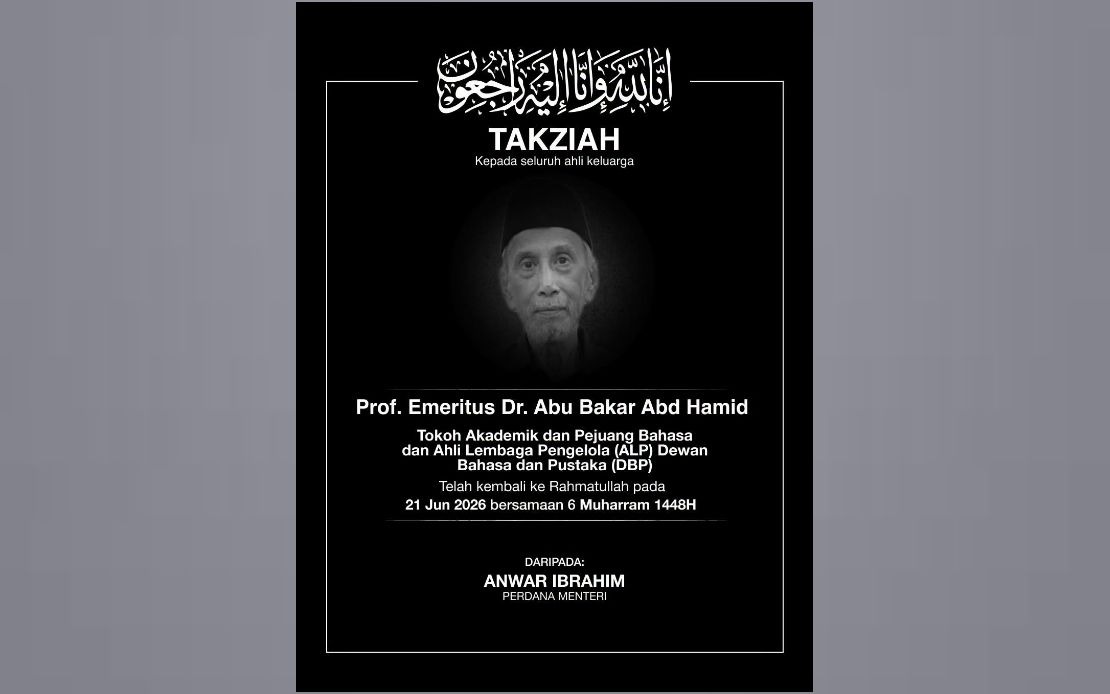
Prime Minister Datuk Seri Anwar Ibrahim has publicly expressed his deep sorrow at the passing of Professor Emeritus Datuk Abu Bakar Abd Hamid, one of Malaysia's most respected scholars and cultural custodians, who died unexpectedly last Sunday. The grief articulated by the nation's leader underscores the significant loss felt across Malaysia's intellectual and literary circles, where Abu Bakar had established himself as an enduring presence for more than five decades.
In a Facebook statement released on June 24, Anwar characterised Abu Bakar as a towering presence in Malay literature and a pivotal architect of institutional development in higher education. The Prime Minister's tribute drew on personal connection, acknowledging his own studentship under the late professor and the formative influence that relationship wielded on his intellectual trajectory. This personal dimension lends particular weight to Anwar's assessment, positioning Abu Bakar not merely as an institutional figure but as a mentor whose impact rippled through generations of Malaysian leaders and intellectuals.
Abstract tributes and formal acknowledgements often obscure the human dimensions of such figures, yet Anwar's reflections deliberately emphasised Abu Bakar's character and pedagogical philosophy. The Prime Minister described him as someone whose passion for knowledge animated his teaching and whose commitment to intellectual growth transcended classroom boundaries. This portrait suggests an educator who viewed knowledge transfer as an ethical responsibility rather than a technical function, qualities increasingly rare in contemporary higher education systems preoccupied with metrics and institutional rankings.
The circumstances of Abu Bakar's death, which occurred at approximately 10.30pm on June 21 at his residence in Petaling Jaya, Selangor, were marked by sudden medical emergency. He had experienced acute shortness of breath that proved fatal, a stark reminder of mortality that affected many within the academic community who had known him personally or through his extensive published work. His death at an advanced age nevertheless represented a premature closure to a mind that remained active and engaged with contemporary scholarly discourse.
AbulBarkar's institutional contributions formed the backbone of Malaysia's modern university system. His role in establishing Universiti Kebangsaan Malaysia during the formative period of 1968, when the nation was consolidating its educational infrastructure in the immediate aftermath of independence, positioned him at a pivotal moment in national development. As joint secretary of the founding committee, he helped shape the foundational vision for what would become a premier research institution, embodying post-independence aspirations for Bumiputera-centred higher education.
His tenure as Universiti Malaya deputy vice-chancellor from 1987 onwards represented another trajectory of leadership, where he oversaw academic programmes and institutional governance during a period of rapid expansion in Malaysian tertiary education. These roles demanded not only scholarly acumen but also administrative capability and political sensitivity, navigating the complex intersections between academic autonomy and government policy that have persistently characterised Malaysian universities. Abu Bakar appears to have managed these tensions with sufficient grace to retain respect across ideological divides.
Beyond the university system, Abu Bakar's influence extended to Malaysia's information architecture when he chaired the Board of Governors of Bernama, the Malaysian National News Agency, from 1996 to 2000. This appointment reflected confidence in his judgment regarding media governance and public communication, domains vital to a developing nation's democratic infrastructure. His stewardship during this period coincided with Malaysia's economic consolidation and the early challenges to media independence that would intensify in subsequent decades.
Throughout his career, Abu Bakar accumulated numerous accolades and recognitions testifying to his scholarly contributions and institutional leadership. These awards reflected both domestic assessment of his significance and international scholarly recognition, indicating that his work transcended parochial concerns to engage with broader literary and cultural theory. The accumulation of such honours typically signals a scholar whose work has proven durable, whose ideas have withstood disciplinary scrutiny, and whose influence extends beyond immediate contemporaries.
Abu Bakar's native connection to Johor, Malaysia's southernmost peninsular state, represented another dimension of his identity. Many significant figures in Malaysian intellectual life have drawn strength from provincial roots, and Johor's own intellectual traditions—encompassing palace scholarship and broader Malay cultural networks—may have informed Abu Bakar's approach to literary studies. This provincial-metropolitan dynamic often enriches intellectual perspectives with grounded sensibilities less likely in purely urban academic contexts.
The burial at Bukit Kiara Muslim Cemetery on Monday provided a dignified conclusion to his earthly journey, though his intellectual legacy persists through published works, institutional innovations, and the scholars he mentored. Anwar's invocation of divine mercy in his tribute—calling for Allah's forgiveness and peace for Abu Bakar's soul—reflects Islamic observance while acknowledging that human judgment of achievement remains provisional against transcendent frameworks.
For Malaysian readers, Abu Bakar's death signals the passing of a generation of nation-builders who participated directly in post-independence institutional construction. As Malaysia confronts contemporary challenges in higher education quality, research output, and the preservation of Malay-Islamic intellectual traditions, the loss of such figures creates vacuum in institutional memory and scholarly continuity. Younger scholars and administrators now inherit institutions shaped by Abu Bakar's foundational work, though without direct access to the reasoning that animated their establishment.