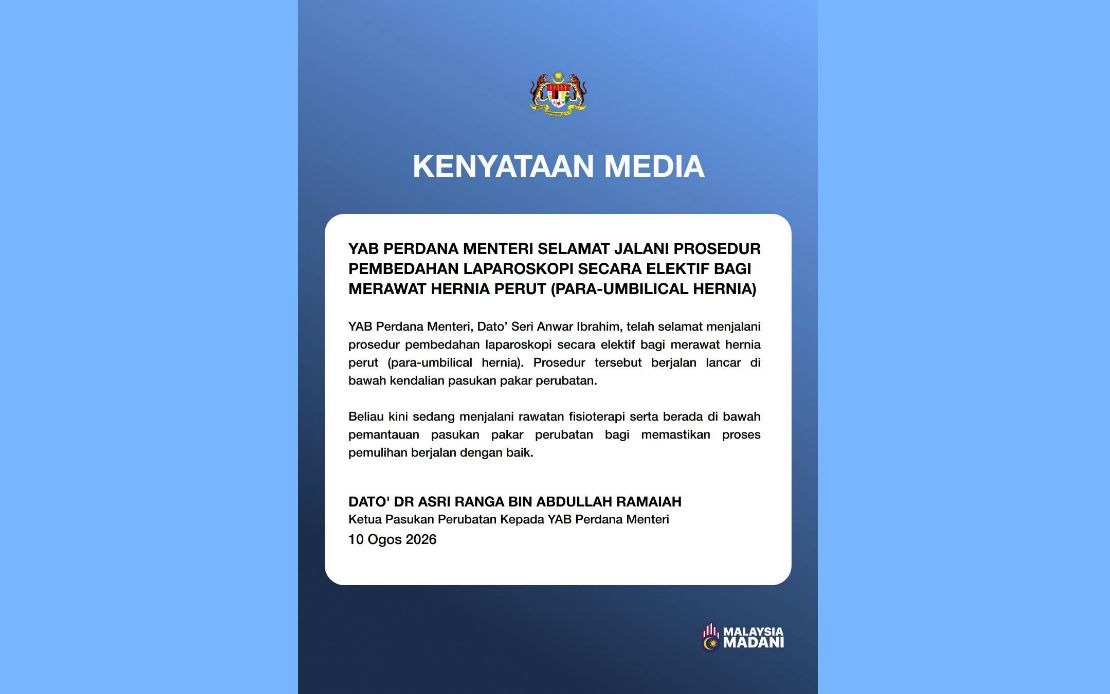
Prime Minister Datuk Seri Anwar Ibrahim has undergone successful elective laparoscopic surgery to address a para-umbilical hernia, according to an announcement from his medical team on August 10. The minimally invasive procedure proceeded without complications under the supervision of experienced surgical specialists, marking another significant milestone in the Prime Minister's ongoing efforts to maintain his health whilst managing the nation's affairs.
The head of the Prime Minister's Medical Team, Datuk Dr Asri Ranga Abdullah Ramaiah, confirmed the successful completion of the operation and outlined the immediate post-operative protocol. Following the procedure, Anwar is engaging in physiotherapy sessions designed to facilitate proper recovery and restore full physical function. The medical team has established a comprehensive monitoring regime to track the Prime Minister's recuperation and ensure that no complications arise during this critical recovery phase.
Laparoscopic surgery represents a modern surgical approach that uses small incisions and specialised instruments to repair internal conditions with minimal tissue trauma. This technique typically allows patients to experience shorter recovery periods compared with traditional open surgical methods, an important consideration given Anwar's demanding responsibilities as the nation's chief executive. The choice of this approach reflects contemporary medical best practices and suggests confidence in achieving a rapid return to normal functioning.
According to Anwar's senior press secretary Tunku Nashrul Abaidah, the Prime Minister is expected to remain under close medical observation for approximately two days following the operation. During this period, the specialist team will conduct regular assessments and prescribed monitoring procedures to ensure the surgical site heals properly and that the patient's vital signs remain stable. This observation period is standard protocol for abdominal procedures, even when performed using minimally invasive techniques.
The para-umbilical hernia condition that required treatment is a relatively common abdominal issue whereby tissue protrudes through a weakness in the abdominal wall near the navel. Although not immediately life-threatening, such hernias can cause discomfort and may deteriorate if left untreated, potentially leading to complications. Elective surgery represents the definitive treatment approach, particularly for individuals with demanding physical and mental schedules who require optimal health maintenance.
The Prime Minister's office requested public prayers for the successful completion of all medical procedures and examinations, whilst emphasising the importance of public support during this period. This appeal reflects cultural and religious sensibilities within Malaysia's diverse society and demonstrates the office's engagement with citizens during moments of national leadership transition or medical intervention. Such communications typically aim to foster national unity and reassurance regarding continuity of governance.
Anwar's commitment to undergoing elective medical treatment demonstrates a proactive approach to health management that ensures he can discharge his constitutional duties without physical impediment. For a serving Prime Minister, maintaining robust health is not merely a personal concern but a matter of national governance and stability. The transparent communication regarding the procedure and recovery process contrasts with historical instances where such matters remained opaque, reflecting evolving standards of public accountability.
The implications of this medical procedure extend beyond immediate personal health considerations. International markets, neighbouring governments, and domestic stakeholders typically monitor the health and stability of national leadership closely. Anwar's successful treatment and relatively rapid expected recovery should provide reassurance regarding the continuity and stability of Malaysia's political administration. The Prime Minister's expected return to full duties within a short timeframe underscores the effectiveness of contemporary surgical techniques and the quality of medical care available to government leadership.
For Malaysian citizens and the broader Southeast Asian region, this incident reinforces the importance of proactive healthcare management and the benefits of modern medical technology. Anwar's decision to address the hernia through elective surgery rather than deferring treatment demonstrates the standard of preventive medicine appropriate for individuals in high-stress positions. The successful outcome provides encouraging evidence regarding the accessibility of advanced surgical capabilities within Malaysia's healthcare infrastructure and the competence of the medical specialists involved.
The medical team's oversight and the structured recovery protocol indicate that Anwar should resume his full range of governmental responsibilities within the expected timeframe. However, the initial period following his return may warrant careful scheduling to avoid excessive physical strain during the early stages of complete healing. The Prime Minister's office and his advisors are likely already developing a phased resumption schedule to ensure that his workload is calibrated appropriately with his recovery trajectory.

