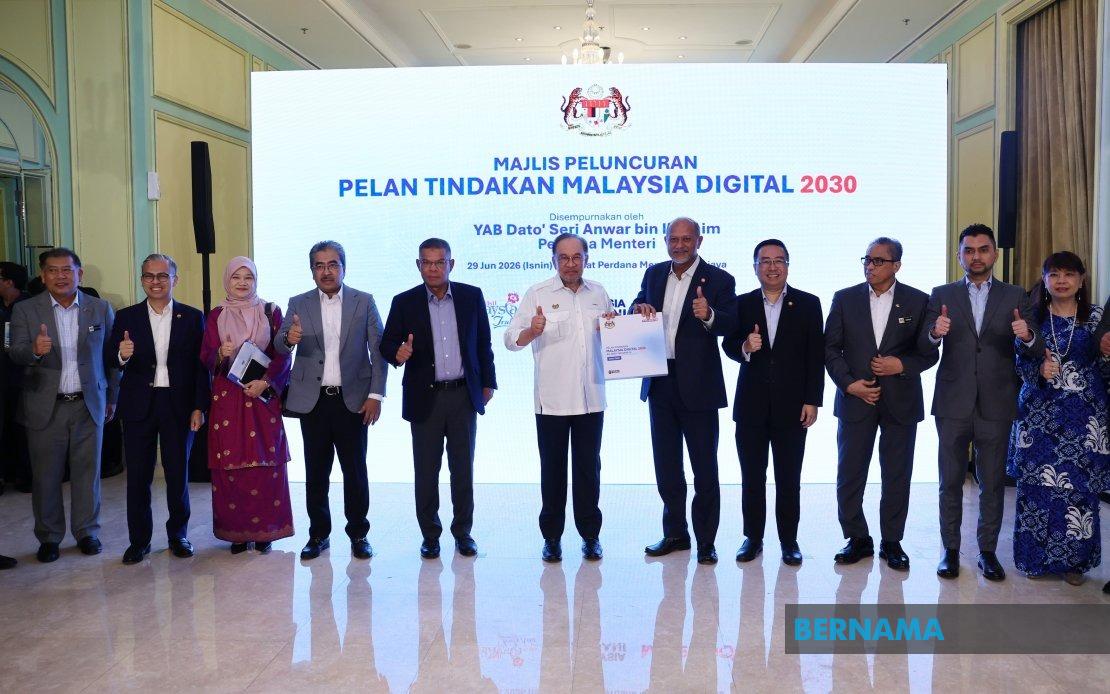
Prime Minister Datuk Seri Anwar Ibrahim has unveiled Malaysia Digital 2030 (MD2030), a comprehensive national action plan spanning 2026 to 2030 that fundamentally reorients the country's approach to digital development. The initiative, launched in Putrajaya with Digital Minister Gobind Singh Deo, Communications Minister Datuk Fahmi Fadzil and Chief Secretary to the Government Tan Sri Shamsul Azri Abu Bakar present, signals an intentional pivot away from Malaysia's historical role as a technology adopter towards becoming a home-grown innovator and creator of digital solutions.
The strategic framework articulates an ambitious vision with concrete numerical targets. Malaysia aims to elevate the digital economy's share of gross domestic product to 30 per cent by 2030, a substantial increase from current levels that would position digital sectors as a major economic driver. Complementing this economic expansion is a commitment to generate 500,000 high-value digital jobs, addressing both employment creation and the upskilling challenge that accompanies technological transformation. The government also targets RM4.5 billion in public sector savings through digitalisation initiatives and the delivery of 95 per cent of government services as fully integrated online end-to-end solutions, reflecting an administrative modernisation agenda.
The MD2030 framework organises its implementation across seven strategic pillars, each anchored to a specific ministry and led by a cluster head overseeing cross-agency coordination. The Government pillar, under Chief Secretary Shamsul Azri, will establish GovTech Malaysia to enhance public service delivery mechanisms. The Economy pillar, directed by Investment, Trade and Industry Minister Datuk Seri Johari Abdul Ghani, pursues regional positioning as a digital innovation and trade hub through promotion of domestically-produced digital goods, technology adoption in high-growth sectors, and monetisation of data and intellectual property assets. Communications Minister Datuk Fahmi leads the Infrastructure pillar, prioritising nationwide broadband connectivity and sustainable digital infrastructure including data centres, cloud systems, and smart city development.
The Talent pillar, overseen by Human Resources Minister Datuk Seri R. Ramanan, addresses workforce preparation through comprehensive policy frameworks, flexible transition programmes, and establishment of Malaysia as a regional digital talent destination. Women, Family and Community Development Minister Datuk Seri Nancy Shukri directs the Society pillar, which emphasises inclusive digital participation through formalisation of a Malaysian Digital Inclusion Index, rural empowerment initiatives, and community-focused digital solutions. Trust and Security, chaired by Digital Minister Gobind, balances innovation enablement with protective measures through the National Data Commission and a dedicated 2026-2030 digital trust and security strategy. Science, Technology and Innovation Minister Datuk Chang Lih Kang leads the Innovation pillar, designing a robust Research, Development, Commercialisation, Innovation and Economy (RDCIE) ecosystem to nurture Malaysia's transition into a technology creator.
This whole-of-government architecture represents a departure from siloed digital initiatives, embedding coordination mechanisms across normally separate policy domains. The Digital Ministry assumes lead agency status for realising the broader "Towards an AI Nation 2030" agenda, positioning artificial intelligence integration as foundational to the entire development strategy. Implementation involves a constellation of specialised agencies including the National AI Office (NAIO), GovTech Malaysia, the Malaysia Digital Economy Corporation (MDEC), CyberSecurity Malaysia, MyDIGITAL Corporation, and the Malaysia Centre for the Fourth Industrial Revolution (MYCentre4IR). This institutional redundancy and overlap is intentional, creating multiple entry points for policy diffusion and ensuring no sector operates in isolation from digital transformation imperatives.
For Malaysia's regional standing, MD2030 carries significant strategic implications. Southeast Asia's digital economy remains fragmented, with cross-border innovation limited and technology creation concentrated outside the region. By positioning itself explicitly as a producer rather than consumer of digital technologies, Malaysia signals ambitions to capture higher-value activities in digital supply chains, analogous to Singapore's fintech leadership or Vietnam's emerging semiconductor manufacturing capabilities. The framework's emphasis on data as a strategic national asset and intelligent systems as normalised infrastructure suggests policymakers recognise that future competitive advantages accrue to nations controlling digital infrastructure and analytics capabilities rather than merely deploying external technologies.
The plan's international context matters particularly given regional competition and geopolitical technology tensions. The emphasis on building a "robust" innovation ecosystem and domestic commercialisation capacity reflects awareness that technology sovereignty—ensuring Malaysia retains control over critical digital infrastructure and does not depend entirely on foreign technology providers—has become a strategic imperative. The National Data Commission and Digital Trust Strategy respond to global concerns about data governance and privacy, positioning Malaysia as a responsible digital steward rather than an unregulated digital free zone that might face international scrutiny or sanctions.
Digital Minister Gobind's statement emphasised that MD2030 demonstrates Malaysia's readiness for technological maturation, with the Digital Ministry coordinating agency implementation through integrated planning and execution. The commitment to balancing innovation with security and governance reflects recognition that unbridled digital expansion without protective guardrails risks creating vulnerabilities in critical infrastructure, financial systems, and citizen privacy. This cautious approach contrasts with narratives in some jurisdictions pursuing technology adoption at the expense of regulatory safeguards.
The vision of a transformed Malaysia where artificial intelligence integrates across life domains, data functions as a strategic asset, and autonomous systems become normalised raises important questions about social adaptation. The Society pillar's emphasis on digital inclusion and rural empowerment acknowledges that rapid technological transition creates winners and losers. Without deliberate intervention ensuring rural communities, economically vulnerable populations, and older demographics can participate in and benefit from digital transformation, Malaysia risks deepening regional and demographic inequalities even as overall digital economy metrics improve.
Implementation timelines matter considerably. The action plan spans 2026 to 2030, providing approximately four to five years for realising the ambitious numerical targets. This compressed horizon demands rapid institutional coordination, significant capital investment in digital infrastructure, and aggressive workforce retraining. The success metrics—30 per cent GDP contribution, 500,000 jobs, 95 per cent digital government services—are quantifiable and will enable regular progress assessment. However, achieving these targets requires sustained political commitment across multiple electoral cycles and unwavering resource allocation even when economic pressures mount or political priorities shift.
Malaysia's position as an upper-middle-income country with existing digital infrastructure provides advantages over lower-income Southeast Asian neighbours attempting similar transformations. The country benefits from established telecommunications networks, a semi-educated workforce with tertiary education access, and accumulated experience from prior digital economy initiatives. Yet these advantages cannot guarantee success. Other countries have launched comparable digital transformation programmes without achieving comparable results when implementation faltered, political consensus fractured, or international conditions shifted unexpectedly. MD2030's success ultimately depends on institutional persistence, coordinated execution across competing bureaucratic interests, and Malaysia's ability to create working environments and regulatory conditions that attract and retain top digital talent against regional competition from Singapore, Hong Kong, and increasingly Vietnam.
The launch of MD2030 represents more than a policy document refresh. It embodies a fundamental reorientation of Malaysia's technological and economic aspirations, acknowledging that rapid digital development has created new possibilities for developing nations willing to invest deliberately in innovation creation rather than mere technology consumption. Whether this ambitious vision translates into concrete achievements will shape Malaysian economic prospects throughout the remainder of this decade.

