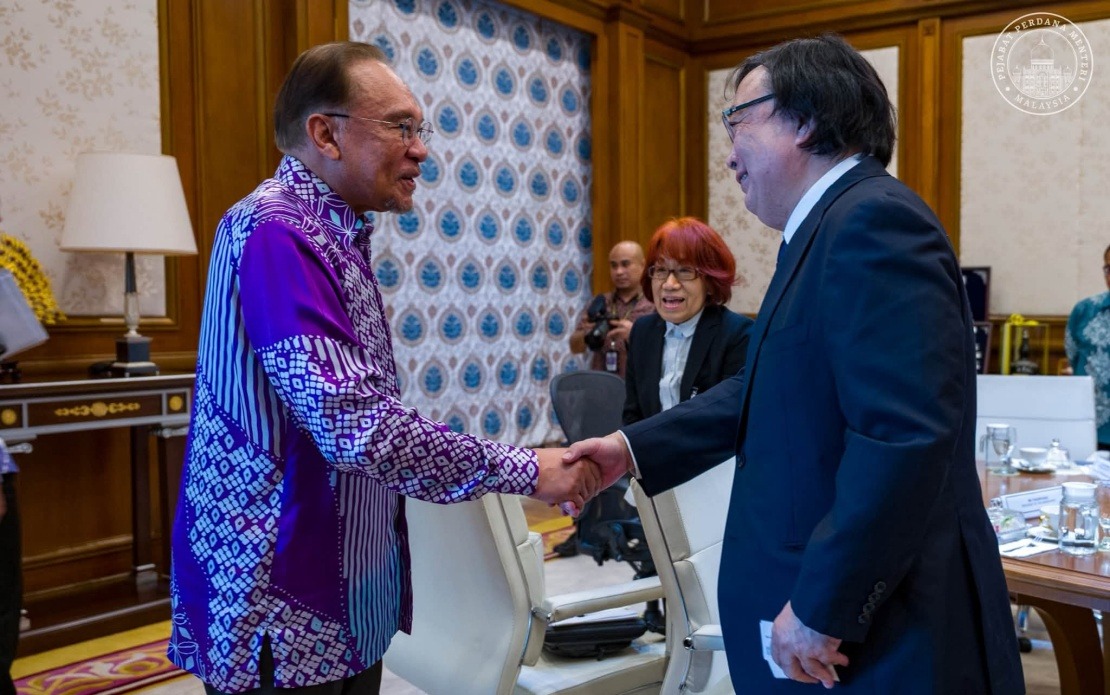
Prime Minister Datuk Seri Anwar Ibrahim met with The Genron NPO President Yasushi Kudo on July 23 to explore fresh avenues for regional cooperation and solidify institutional ties between Malaysia and Japan. The courtesy call centred on the Asia Leaders Roundtable, a dialogue initiative designed to tackle pressing regional and international challenges through sustained engagement among senior policymakers and strategic thinkers across the continent.
The Genron NPO, headquartered in Japan, operates as an independent non-profit think tank with considerable influence in Japanese policy circles and across Asia-Pacific intellectual networks. Its engagement with Malaysian leadership reflects the organisation's broader mandate to foster constructive dialogue on matters affecting regional stability and prosperity. By facilitating meetings between Japanese institutions and Malaysian political figures, the organisation continues its work as a neutral forum for cross-border strategic discussion.
During the meeting, Anwar took the opportunity to express Malaysia's gratitude for the reception and courtesy extended by the Japanese government during his official state visit in June. This reciprocal appreciation signals the warmth characterising contemporary bilateral relations, moving beyond formal diplomatic protocol to reflect genuine partnership sentiment. Such personal exchanges between leaders and institutional heads often carry significant weight in cementing goodwill and establishing channels for deeper future collaboration.
Malaysia's relationship with Japan stands among its most consequential international partnerships, encompassing defence cooperation, trade linkages, and technology transfer. The Comprehensive Strategic Partnership framework that governs the relationship provides a structured mechanism for addressing shared interests spanning security, economic development, and regional architecture. For Malaysian policymakers, maintaining this partnership remains critical to the country's positioning within broader Indo-Pacific strategies and its economic integration into regional value chains.
The Prime Minister's acceptance of an invitation to address the Tokyo Conference 2027 underscores Malaysia's commitment to participating in Japan-led regional dialogue platforms. This commitment builds on previous engagements, including his delivery of a video message at the 2026 conference. Such participatory roles enable Malaysian representatives to influence the intellectual framing of regional issues and ensure Southeast Asian perspectives feature prominently in discussions shaping Asia's strategic future.
The Asia Leaders Roundtable represents an increasingly important avenue for non-governmental actors to contribute to official thinking on regional challenges. As formal government-to-government channels sometimes face constraints or political sensitivities, independent think tanks offer flexibility in discussing contentious issues and exploring innovative solutions. The Genron NPO's convening capacity positions it uniquely to facilitate candid exchanges among leaders who might otherwise face restrictions in their public statements.
From a Malaysian perspective, deepening engagement with Japanese think tanks and policy institutions serves multiple strategic objectives. First, it enables the country to benefit from Japanese expertise on technological innovation, governance reform, and economic development—areas where Japan maintains substantial practical experience and institutional knowledge. Second, it strengthens the Malaysian voice within influential Japanese circles, helping shape perceptions of Southeast Asia and Malaysia's development trajectory among Japanese policymakers and intellectuals.
The timing of this meeting also reflects Malaysia's broader effort to strengthen regional architecture amid shifting geopolitical dynamics. With great power competition intensifying and regional players seeking to maintain strategic autonomy, platforms that bring together influential voices from across Asia serve as stabilising mechanisms. Anwar's engagement with the Genron NPO demonstrates Malaysia's preference for multilayered diplomacy that includes government-to-government relations, economic partnerships, and intellectual exchange.
Japan's enduring interest in Southeast Asia reflects both strategic calculation and economic necessity. As a maritime power dependent on regional stability and trade flows, Japan maintains considerable stakes in Southeast Asian prosperity and security. Through institutions like the Genron NPO, Japan cultivates deeper understanding of the region's complexities and builds relationships with emerging leaders who will shape the region's trajectory in coming decades.
For Malaysian audiences, the significance of such meetings extends beyond bilateral considerations to encompass broader implications for regional order. Malaysia's positioning as a moderate Southeast Asian nation with substantial diplomatic reach means its relationships with major powers carry weight in regional calculations. The Anwar-Kudo meeting, therefore, signals Malaysia's continued commitment to maintaining balanced engagement across Asia and preserving the multilateral frameworks upon which regional stability depends.
Looking forward, the consolidation of ties between Malaysian leadership and Japanese institutions like the Genron NPO offers potential avenues for collaborative problem-solving on transnational challenges—from climate change and pandemic preparedness to maritime security and supply chain resilience. By building relationships at multiple institutional levels, both countries create redundant channels for cooperation that can persist even during periods of political transition or bilateral tension.
The Prime Minister's reaffirmation of Malaysia's commitment to shared peace, stability and prosperity with Japan reflects a vision of Southeast Asia as a region where major powers engage constructively rather than competitively. This positioning has historically served Malaysian interests well, allowing the country to benefit from multiple partnerships while maintaining strategic independence and adherence to its foreign policy principles of non-alignment and mutual respect.

