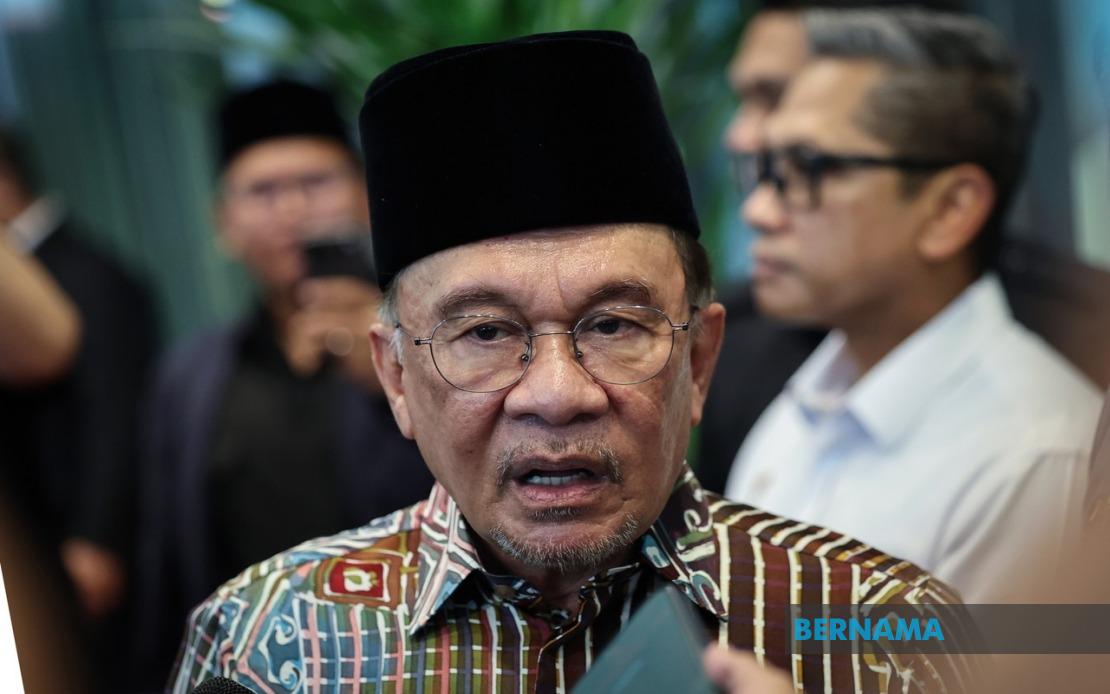
Prime Minister Datuk Seri Anwar Ibrahim has made clear that Malaysia will adopt a hardline stance toward refugee populations that engage in unlawful conduct or threaten social stability. Speaking to journalists on July 27 after attending the International Wakaf Dakwah Convention 2026, Anwar stated unequivocally that no exceptions would be granted to any group, regardless of their status, that violates domestic legislation, creates public disturbance, or seeks to occupy areas without authorization.
The remarks came in response to a significant gathering of several hundred Rohingya refugees who assembled outside the United Nations High Commissioner for Refugees (UNHCR) office at Jalan Bukit Petaling in central Kuala Lumpur. According to reports, the refugees had arrived in the capital by three buses originating from Penang earlier that morning. The congregation resulted in traffic disruption in the busy commercial district, prompting official attention and the Prime Minister's robust response.
Anwar instructed three key enforcement bodies to implement decisive measures against those breaching the law. The Royal Malaysia Police (PDRM), Immigration Department (JIM), and local city authorities (PBT) have been directed to take strong action against any individual or group engaged in unlawful activity. The enforcement approach differentiates between documented and undocumented individuals: those lacking valid permits will face referral to immigration authorities, while those holding proper documentation will receive initial warnings before further legal steps are contemplated.
The Prime Minister's language underscored the government's position that Malaysia's legal framework applies universally, without exemption based on refugee status or humanitarian circumstance. Anwar stressed that the nation operates under established rules that all residents and visitors must observe. He articulated concern that allowing refugees to occupy public spaces without authorization would set a dangerous precedent and potentially create security concerns for ordinary Malaysian citizens.
While acknowledging the humanitarian dimensions of the refugee situation, Anwar maintained that compassion cannot override lawful governance. He recognized that many refugees are pursuing international protection through the UNHCR mechanism, and sympathized with their difficult circumstances. However, he contended that seeking asylum does not grant individuals the right to disregard Malaysian laws or conduct activities that inconvenience the broader community. This distinction between humanitarian understanding and legal enforcement represents the government's attempt to balance obligations under international humanitarian principles with domestic social cohesion.
The incident highlights the complex challenge facing Malaysia as a transit country for displaced populations in Southeast Asia. Malaysia hosts one of the world's largest refugee populations without being a signatory to the 1951 Refugee Convention, placing it in a precarious position legally and operationally. The government has historically maintained that refugee management must not compromise public order or strain local resources, particularly given Malaysia's own development priorities and social sensitivities around rapid demographic change in urban areas.
The Rohingya situation represents a particularly sensitive flashpoint. Since the 2017 military offensive in Myanmar's Rakhine State, over 180,000 Rohingya have arrived in Malaysia, creating significant pressure on housing, employment, and social services. Public assemblies by refugee groups, particularly when they disrupt commerce and traffic in major cities, tend to generate friction with local populations and heighten political controversy. Anwar's firm stance reflects awareness that permitting such gatherings without swift response could invite backlash from segments of the Malaysian public.
The enforcement strategy outlined by the Prime Minister prioritizes administrative processes: documentation verification, issuance of warnings where appropriate, and legal prosecution where necessary. This structured approach aims to distinguish between those who have registered with international organizations and possess some form of official recognition from those operating entirely outside documented frameworks. In practice, however, implementing such differentiation proves challenging given the limited resources of Malaysia's immigration apparatus and the mobility of refugee populations.
Anwar's comments must also be understood within the broader context of Malaysia's international relations. The country maintains diplomatic ties with Myanmar despite concerns over human rights, and must balance support for displaced Rohingya with pragmatic engagement with the regional power responsible for their displacement. By emphasizing that Malaysia's hospitality is conditional upon lawful behavior, the government attempts to maintain a middle position: continuing to host refugee populations while signaling that it will not tolerate challenges to state authority or public order.
The gathering at the UNHCR office itself warrants examination. Such demonstrations typically reflect frustrations among refugee communities regarding protracted living situations, uncertainty about resettlement prospects, and inadequate access to services and economic opportunity. The concentration of several hundred individuals at a single location suggests either planned coordination or spontaneous expression of accumulated grievances. Either interpretation raises questions about refugee community organization and the adequacy of existing communication channels between humanitarian organizations, government agencies, and displaced populations.
Looking forward, Anwar's directive to enforcement agencies sets expectations for how similar incidents will be managed. The policy essentially establishes that lawful assembly will not be tolerated if it disrupts urban spaces or public services, even when conducted by vulnerable populations. This approach differs markedly from accommodations made in some Western nations for refugee advocacy, but reflects Malaysia's assessment of its absorption capacity and social stability thresholds.
The challenge for authorities will be ensuring that enforcement is applied equitably and proportionately, and that measures taken do not inadvertently create grievances that undermine long-term refugee integration. Refugee populations in Malaysia typically seek modest outcomes: legal work permits, access to education for children, and protection from deportation to situations of danger. When these basic needs remain unmet, public demonstrations often escalate as pressure valves for accumulated frustration.
Government agencies must therefore couple enforcement with constructive engagement. While maintaining firm boundaries regarding lawful conduct, authorities should simultaneously address underlying conditions that motivate gatherings. Without such balance, a strictly punitive approach risks pushing refugee populations further into informal channels and creating conditions for more serious disorder. Malaysia's long-term stability depends on managing refugee populations effectively while maintaining public confidence that governmental authority remains legitimate and responsive to broader community concerns.

