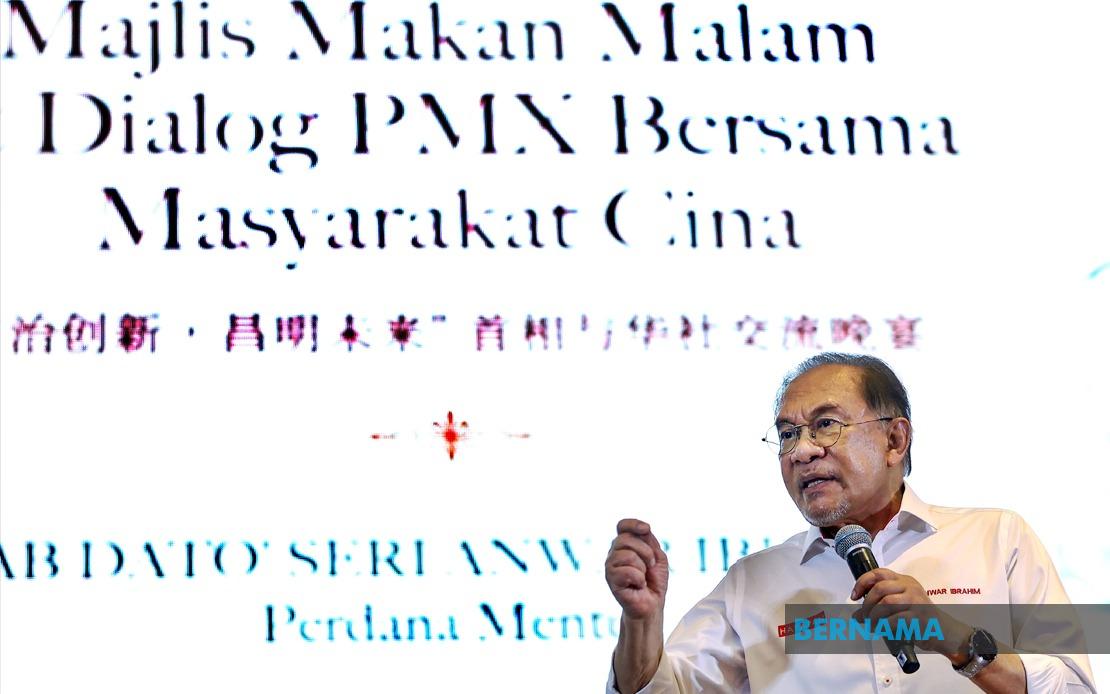
Prime Minister Datuk Seri Anwar Ibrahim reasserted his vision for Malaysia's future during an engagement with the Chinese community in Johor Bahru, underscoring that national success depends on unified effort across all demographic groups. Speaking at a dinner event, he articulated a deeply personal philosophy centred on inclusivity and mutual respect, themes that have increasingly defined his approach to governance since taking office. The gathering reflected his ongoing strategy of maintaining direct contact with various constituencies, a practice that distinguishes his leadership style from his predecessors.
At this stage of his political career, Anwar conveyed that his foremost ambition extends beyond policy achievements to establishing a tangible blueprint for leadership conduct. He framed his tenure not merely as an administrative period but as an opportunity to demonstrate what equitable governance looks like in a multiracial democracy. This messaging resonates particularly in Malaysia's contemporary political landscape, where questions about national cohesion and institutional integrity remain pressing concerns among voters from all communities.
The Prime Minister's remarks centred on a fundamental principle: that every Malaysian citizen merits equal consideration and dignified treatment from their government. He outlined a vision wherein public servants view the nation's wellbeing as a collective responsibility rather than a narrow institutional mandate. This perspective suggests an attempt to reframe the social contract between government and citizens, positioning leadership as a reciprocal relationship built on demonstrated care rather than transactional governance.
Anwar's reflection on his age and remaining tenure revealed a reflective dimension often absent from political discourse in Malaysia. By acknowledging the finite nature of his time in office, he signalled that legacy-building has become a genuine preoccupation. Rather than fixating on short-term electoral advantages or immediate policy wins, his comments suggest a longer historical perspective that considers how his administration will be evaluated by future generations. This temporal consciousness differentiates his statements from typical political rhetoric focused on immediate outcomes.
The emphasis on being remembered as someone who genuinely cared for the population carries particular weight in Malaysian politics, where public trust in institutions and leaders has historically fluctuated. Anwar's articulation of this aspiration—that citizens would remember him fondly after his retirement—taps into deeper sentiments about what constitutes good governance beyond legislative records or economic metrics. It acknowledges that intangible qualities like authenticity and demonstrated commitment shape perceptions of political leadership.
The invocation of collective stewardship, framed as looking after the nation "as our own," positions national development as a shared endeavour requiring active participation from all communities. This language attempts to transcend communal divisions by suggesting that prosperity and stability benefit everyone equally, thereby creating incentives for cross-ethnic cooperation. In the context of Malaysia's ongoing challenges with polarisation, such messaging holds strategic importance beyond its rhetorical value.
The presence of Parti Keadilan Rakyat vice president and Selangor Menteri Besar Datuk Seri Amirudin Shari at the event underscored the party's engagement strategy with key constituency groups. The inclusion of senior PKR leadership alongside the Prime Minister demonstrated unified messaging about the coalition's direction and its commitment to inclusive governance. This political choreography suggests deliberate efforts to reinforce the administration's pluralistic credentials among Chinese Malaysian voters, a demographic whose electoral behaviour significantly influences national outcomes.
Anwar's focus on "fair, clean and dedicated leadership" directly addresses systemic concerns that have preoccupied Malaysian society in recent years. The trilogy of adjectives encapsulates responses to governance challenges that affected previous administrations: fairness tackles perceptions of discrimination or nepotism, cleanliness directly engages with corruption concerns, and dedication addresses questions about commitment to public service versus personal enrichment. By centralising these values, Anwar positioned his government's legitimacy around institutional reform and ethical conduct.
The dinner engagement itself reflects a broader pattern of maintaining visibility and accessibility across Malaysia's diverse communities. Such events serve dual purposes: they provide platforms for politicians to articulate their vision directly to specific audiences, while simultaneously demonstrating commitment to community engagement. For Chinese Malaysians specifically, consistent political attention signals recognition of their significance within Malaysia's political economy and their role in national decision-making. This relationship management remains crucial for coalition stability and electoral viability.
Anwar's statements carry implications for Malaysia's developmental trajectory over the medium term. If his administration successfully embeds practices reflecting the values he articulated—institutional fairness, transparency, and inclusive decision-making—these could establish precedents influencing successor governments. Conversely, if rhetoric diverges from practice, the gap would reinforce public cynicism about political promises. The tests ahead involve translating these principles into concrete policies affecting resource distribution, judicial independence, and bureaucratic conduct.
Regionally, Malaysia's governance approach holds significance for other Southeast Asian democracies grappling with similar tensions between pluralism and national unity. Anwar's vision of leadership that bridges communities offers a potential model, though its success depends entirely on demonstrable outcomes. The region watches whether established democracies can successfully navigate ethnic diversity while maintaining institutional integrity and genuine inclusivity.

