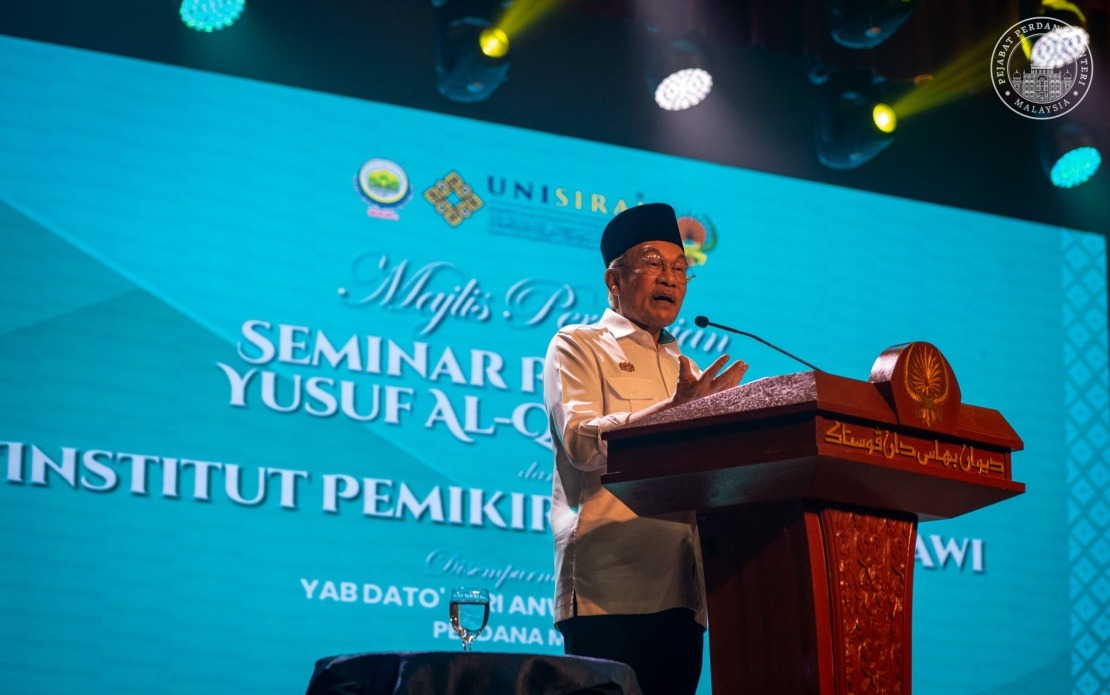
Prime Minister Datuk Seri Anwar Ibrahim has pledged RM2 million from the MADANI Government to support the newly established Al-Qaradawi Thought Institute, marking a significant commitment to preserving and advancing the scholarly contributions of the late Islamic intellectual Sheikh Dr Yusuf Al-Qaradawi. The announcement came during the official opening of the Yusuf Al-Qaradawi Thought Seminar and the institute itself at Wisma Dewan Bahasa dan Pustaka in Kuala Lumpur, underscoring the government's recognition of Al-Qaradawi's enduring influence on Islamic discourse across the Muslim world.
Through a post on X, Anwar expressed his personal gratitude and deep appreciation for Al-Qaradawi's intellectual guidance, moral support, and the bonds of friendship forged over decades. The Prime Minister emphasised that initiatives of this magnitude should yield blessings, create tangible benefits, and illuminate the path forward for the broader Muslim community. His words reflected not merely a ceremonial acknowledgement but rather a reflection of the profound impact that Al-Qaradawi's thinking has exercised on his own intellectual and political trajectory.
Anwar's relationship with Al-Qaradawi spans several pivotal periods in Malaysian Islamic activism and governance. During his formative years as a key figure within the Malaysian Islamic Youth Movement, known by its Malay acronym ABIM, Anwar worked closely with Al-Qaradawi and absorbed his philosophical approach to contemporary Islamic challenges. This formative period proved instrumental in shaping Anwar's later approach to balancing Islamic principles with progressive governance and moderate religious interpretation.
The Prime Minister recalled a particularly instructive moment from the early 1980s, when Islamic resurgence was sweeping across the Muslim world with considerable intensity and often uncompromising ideological fervour. At that juncture, Al-Qaradawi transmitted a significant treatise to ABIM's leadership that carried a cautionary and reformative message. The scholar urged the youth movement to deliberately distance itself from hardline theological positions and instead embrace wasatiyyah, the Islamic principle of moderation and balance that occupies the middle path between extremes.
Anwar emphasised the transformative value of that counsel within the specific historical context in which it arrived. The early 1980s represented a period of considerable intellectual turbulence within Islamic circles globally, marked by the ascendancy of more doctrinaire interpretations and a widespread reluctance to engage seriously with perspectives that diverged from established orthodoxy. Al-Qaradawi's intervention, therefore, arrived as a voice of reasoned restraint and intellectual openness during a moment when such qualities faced considerable headwinds within activist Islamic movements.
The Prime Minister characterised Al-Qaradawi as a true agent of change and what German philosophy terms the zeitgeist, a mover of the spirit of the times whose life's work embodied a commitment to intellectual flexibility and substantive reform in the face of evolving challenges confronting contemporary Islamic societies. Rather than retreating into static doctrinal positions, Al-Qaradawi consistently demonstrated an inclination to engage thoughtfully with the complexities of modern life whilst remaining anchored in Islamic theological foundations.
The establishment of the Al-Qaradawi Thought Institute represents more than a memorial to the scholar's legacy; it signals the MADANI Government's deliberate positioning toward intellectual pluralism within Malaysian Islamic discourse. By allocating substantial resources to research and development activities centred on Al-Qaradawi's extensive body of work, the government has effectively endorsed the intellectual framework that prioritises balanced religious reasoning over polarisation. This approach carries significant implications for how Malaysia navigates ongoing debates surrounding religious interpretation, interfaith relations, and the modernisation of Islamic jurisprudence.
For Malaysia specifically, the institute's establishment arrives at a moment when the nation continues to grapple with questions about the appropriate relationship between religious authority, secular governance, and individual freedoms. Al-Qaradawi's philosophical legacy, emphasising flexibility, contextual reasoning, and rejection of extremist positions, offers a valuable intellectual resource for Malaysians seeking to understand how Islamic principles can coexist with diverse, pluralistic societies. The institute's research activities may prove particularly valuable in training a new generation of Islamic scholars and thinkers equipped to address contemporary challenges from within an authentically Islamic framework.
The RM2 million commitment reflects both the government's financial capacity and its ideological orientation toward the moderate interpretation of Islam that has historically defined Malaysia's approach to religious governance. Unlike some Muslim-majority nations that have experienced significant swings between authoritarian religious conservatism and secular revisionism, Malaysia has maintained, with considerable difficulty and mixed success, an institutional architecture intended to protect religious sensibilities whilst preserving space for civil liberties and democratic participation. Al-Qaradawi's thought, with its emphasis on wasatiyyah and reasoned engagement across ideological boundaries, aligns closely with this Malaysian aspiration.
The seminar and institute opening also serve a broader educational function within the Southeast Asian context. The region's Muslim populations, numbering in the hundreds of millions, encounter distinctive challenges in maintaining Islamic identity and practice within societies marked by religious diversity, rapid modernisation, and competing cultural influences. Al-Qaradawi's intellectual contributions speak directly to these circumstances, offering frameworks for thinking about Islamic obligations and rights that do not require wholesale rejection of modernity or capitulation to secularism. By institutionalising research into his thought at the national level, Malaysia positions itself as a custodian of an important intellectual tradition with transnational relevance.
Moving forward, the institute's activities will likely extend beyond academic research to include public education, interfaith dialogue initiatives, and the translation and dissemination of Al-Qaradawi's major works to younger audiences less familiar with his contributions. Such activities could strengthen Malaysia's soft power position as a nation committed to moderate Islamic practice and intercommunal coexistence, qualities increasingly valued internationally as counterweights to narratives of religious conflict and extremism. The institute thus functions simultaneously as a scholarly endeavour and as a statement of political values regarding the kind of Islamic civilisation Malaysia seeks to foster.
Anwar's personal investment in this initiative signals continuity between his earlier activism with ABIM and his current responsibilities as Prime Minister guiding a diverse, complex nation. The commitment reflects a conviction that Islamic intellectual traditions, when allowed to develop with vigour and openness, strengthen rather than undermine social cohesion and effective governance. As Malaysia continues navigating the intricate relationship between religious conviction and democratic pluralism, institutions dedicated to studying thinkers like Al-Qaradawi may prove increasingly valuable in maintaining the intellectual and moral resources necessary for that ongoing negotiation.

