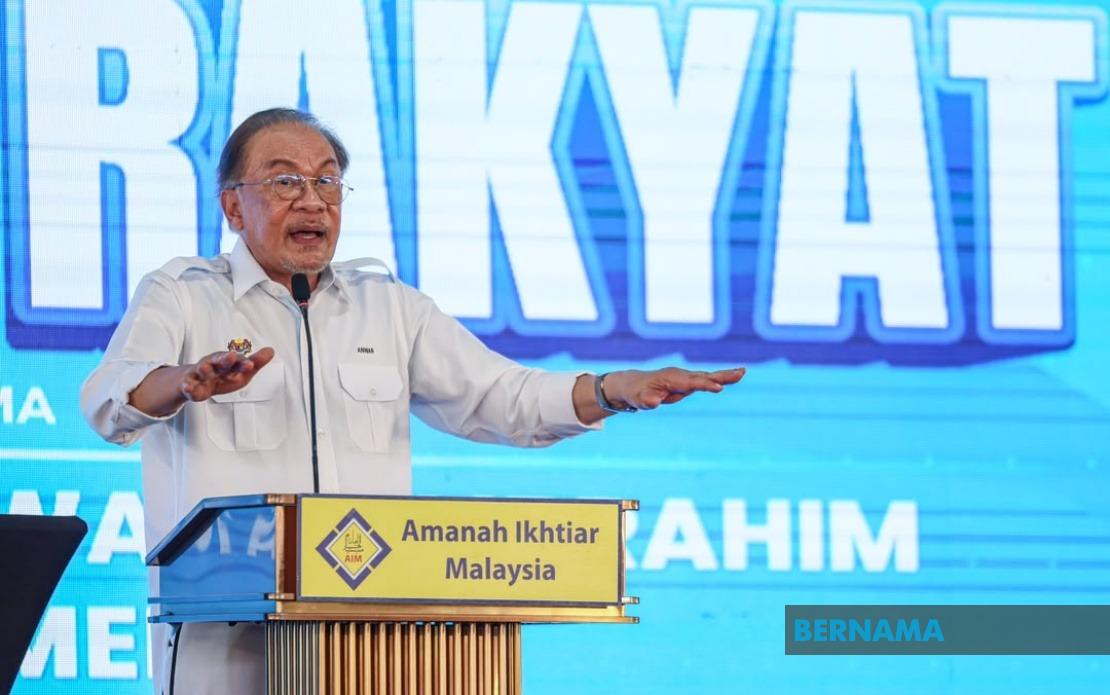
Prime Minister Datuk Seri Anwar Ibrahim has accused rival political parties of coordinating efforts to destabilise his administration, attributing their hostility to the MADANI Government's stringent anti-corruption agenda. Speaking at a campaign event in Batu Pahat during Johor's state election campaign, Anwar suggested that his government's refusal to tolerate the theft of public funds or abuse of power has created anxiety among quarters opposed to transparent governance. The comment reflects ongoing tensions within Malaysia's fractious political landscape, where competing coalitions have been jockeying for advantage ahead of state and federal contests.
Anwar, who chairs Pakatan Harapan, positioned his administration's anti-corruption work as both a principled stance and a source of political vulnerability. He emphasised that the government's approach is uncompromising towards leaders who use their positions to improperly acquire land, secure business contracts, obtain shareholdings, or accumulate wealth through dubious means. This framing attempts to recast political opposition not as legitimate disagreement but as symptomatic of vested interests threatened by institutional reform. For Malaysian voters, particularly those concerned about governance and resource distribution, this argument carries weight given the country's history of corruption cases involving high-ranking officials.
To substantiate his claim about personal integrity, Anwar highlighted his own conduct as Prime Minister, noting that despite numerous official visits to Johor, he has not accepted land, projects, or shareholdings in the state. This personal example serves as a model he wishes to instil in elected representatives across the country. The emphasis on individual restraint reflects an understanding that public trust in leadership depends partly on leaders visibly rejecting opportunities for self-enrichment. However, the broader challenge remains implementing such standards systematically across government apparatus, where petty corruption and minor abuses often escape public scrutiny.
The Prime Minister appealed to Johor voters to grant Pakatan Harapan the mandate to govern the state, framing the election as an opportunity for comprehensive change with tangible benefits for ordinary citizens. He argued that alignment between state and federal governments would enable smoother implementation of welfare programmes and development initiatives. This appeal reflects a common pattern in Malaysian politics, where parties stress administrative efficiency gains from unified governance. For economically-stressed Johor residents, the promise of better-coordinated assistance carries practical significance.
Anwar acknowledged that whilst Johor has received substantial investment in large-scale development projects worth billions of ringgit, fundamental issues persist that demand attention. Housing affordability represents a critical concern, alongside inadequate roads, mosques, prayer spaces, and support for vulnerable populations. The Prime Minister's criticism suggests that merely channelling capital into infrastructure fails to address everyday needs affecting ordinary families. This diagnosis aligns with broader complaints in Malaysian urban and semi-urban areas, where visible commercial development coexists with persistent shortages in affordable housing and essential services.
Central to the MADANI Government's political legitimacy has been its multi-ethnic coalition structure, which includes the Democratic Action Party representing non-Malay constituencies. Anwar defended this cooperation by asserting that DAP ministers within his Cabinet have consistently supported all programmes benefiting Malays and Islam throughout his three-and-a-half years in office. This preemptive defence addresses longstanding anxieties among Malay-Muslim voters about DAP's perceived ideology. By emphasising legislative and administrative support for communal interests, Anwar attempts to neutralise a perennial criticism levelled at Pakatan Harapan's diversity. The claim merits scrutiny, as it essentially asks voters to trust his characterisation rather than evaluate specific policies independently.
Anwar also drew attention to the enthusiastic turnout at the Senggarang campaign event, describing supporter attendance as extraordinary despite hot weather conditions. Such observations typically serve multiple purposes in political discourse: they suggest genuine grassroots enthusiasm, they contrast his standing with perceived weaknesses of opponents, and they create momentum narratives that influence undecided voters. The reference to people waiting under scorching sun represents a common rhetorical device emphasising commitment and legitimacy through bodily sacrifice and endurance.
The Johor state election itself carries significance beyond that single state. With 172 candidates competing for 56 seats, the contest represents a substantial contest of political forces. The timing—voting scheduled for 11 July with early polling on 7 July—creates an intense campaign period during which major parties press their messages. For Southeast Asian observers, Johor's contest matters as a barometer of Malaysian political sentiment and coalition stability heading toward a general election.
Anwar's framing of opposition as motivated purely by resistance to anti-corruption measures requires contextualisation. Malaysian political competition involves genuine policy disagreements, constitutional interpretations, and competing visions for the nation's development path. Attributing all opposition solely to corruption-related anxiety risks oversimplifying the landscape. Yet his emphasis on governance standards speaks to voter concerns that transcend party loyalty. Many Malaysians across the political spectrum support stronger corruption controls, even whilst disagreeing on other governance matters.
The broader implications for Malaysian governance remain complex. Stronger anti-corruption enforcement can enhance institutional legitimacy and public confidence in leadership. Simultaneously, anti-corruption messaging in electoral campaigns can become instrumentalised, with parties selectively applying standards or leveraging anti-corruption rhetoric without substantive reform. The challenge facing Anwar's government involves demonstrating that anti-corruption commitments translate into sustained institutional changes, equitable application across the political spectrum, and tangible improvements in governance quality that ordinary Malaysians experience in their daily interactions with state institutions.
For Johor voters, this election presents choices between competing governance models and resource allocation strategies. Anwar's appeal emphasises anti-corruption principle coupled with welfare-focused development. However, voters will ultimately assess parties based on track records, policy detail, and demonstrated competence rather than rhetorical claims alone. The state election thus functions as both a test of the MADANI coalition's appeal and an indicator of Malaysian voters' priorities as the country navigates ongoing political and economic transitions.

